For about 80 years, the United States pulled off something historically insane.
We’re under 5% of the world’s population, yet after WWII we helped design—and then manage—a global system that made us wealthy, secure, and absurdly influential. Not because we were saints. Because we were smart.
We didn’t run the world like a cartoon villain twirling a mustache.
We ran it like a country that finally learned the lesson every previous empire missed:
Fear works fast.
Consent works longer.
So instead of ruling by intimidation, we built a system other countries could live with—even benefit from.
Alliances instead of vassals.
Rules instead of permanent brinkmanship.
Open sea lanes so global trade didn’t require every cargo ship to bring its own navy.
A dollar-centered financial system that quietly turned the U.S. into the tollbooth for global growth.
Were we perfect? Obviously not. Vietnam. Iraq. CIA adventures best left out of the brochure.
“We’re here to help” has preceded some deeply unhelpful moments.
But the model worked because power was paired with legitimacy. Countries didn’t just tolerate American leadership—they chose it. That’s why the unipolar moment didn’t immediately collapse. The world didn’t instinctively band together to knock us down the way it usually does with dominant powers.
That wasn’t accidental. The arrangements we built were often win-win. Other countries gained security, access, and stability, while we gained influence, markets, and leverage. Everyone could live with the math.
Then Trump arrived and declared America had been run by idiots.
He rejects win-win deals on principle. If someone else benefits, he assumes we’re being cheated. That’s why he keeps insisting the U.S. has been “ripped off” by everyone—from allies to trading partners—and why his solution is always the same: make sure someone else loses harder than we do.
His complaint wasn’t that the U.S. enforced the rules.
America always enforced the rules.
His problem was how.
Where previous presidents used enforcement backed by legitimacy, Trump decided legitimacy was overrated. Too slow. Too many meetings. Too many adults in the room.
Why persuade when you can threaten?
So the tone shifted.
Tariffs as punishment.
Cooperation replaced with compliance.
Diplomacy reduced to: Do what we want or your exports get 25% more expensive in the US market.
That’s a shakedown.
And shakedowns have a cost.
Countries governed by fear don’t align—they hedge. They rewrite trade relationships. They diversify supply chains. They quietly build exits.
They start asking a very dangerous question:
What if America is the risk now?
That’s how trust turns into contingency planning.
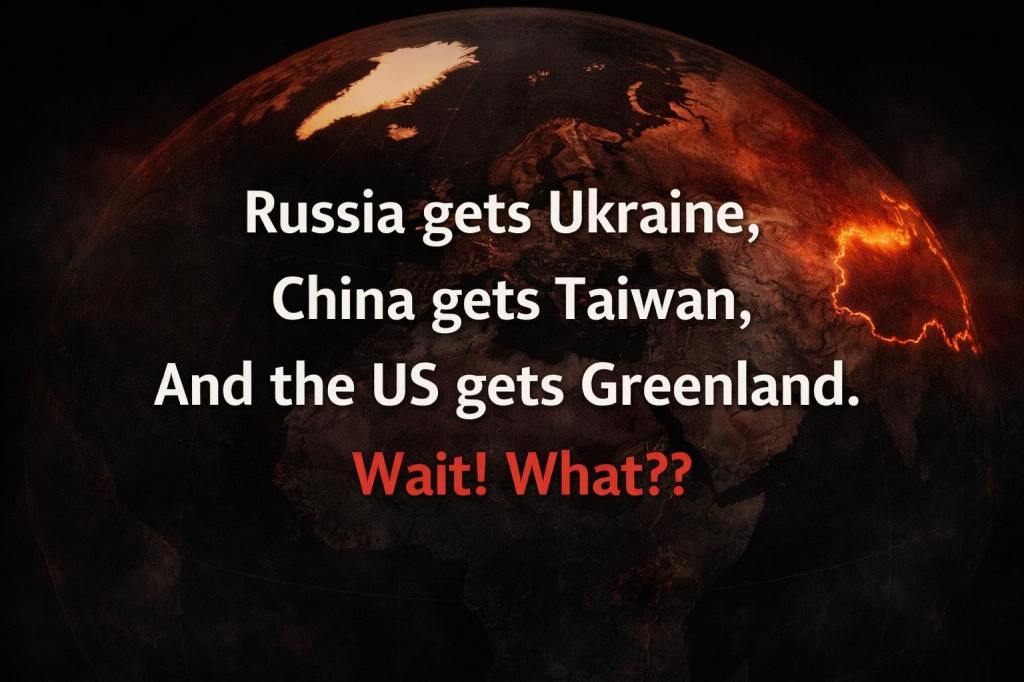
At the same time, we’re being sold a shiny new global vision:
A world carved into spheres.
Russia handles “its” region.
China handles “its” region.
America pulls back to its own region, throws its weight around selectively, and keeps everyone nervous with tariffs.
Congratulations. We’ve rebooted the 1914 server that brought us WWI.
A tripolar world isn’t stable. It’s anxious. Transactional. Every country doing math it never wanted to do:
Who protects me now?
Who do I appease?
Who do I pay off?
What happens when the big guys disagree and I’m standing in the middle?
That’s a tinderbox.
So who in their right mind would trade global dominance for this?
At first glance, it looks like incompetence.
But there’s another explanation that fits the facts much better.
If your goal is preserving American power, this strategy is insane.
If your goal is personal enrichment, it makes perfect sense.
A stable, rules-based world limits leverage.
A fearful, fragmented world is ripe for shakedowns.
A presidency spent at Trump-branded properties, charging governments and lobbyists for access.
Foreign policy that mysteriously flatters regimes doing business with the Trump orbit.
A son-in-law leaving government service and immediately receiving $2 billion from a Saudi sovereign wealth fund—over his own advisers’ objections.
Policy “evolutions,” tariff exemptions, and sudden reversals that just happen to benefit friends and punish critics.
No conspiracy theory required.
It’s public. Documented. Often defended as normal.
But taken together, the pattern is hard to miss.
Trump isn’t dismantling the postwar order because he misunderstands it.
He’s dismantling it because it doesn’t serve him.
We didn’t build the American-led world out of charity.
We built it because it made us rich, safe, and powerful beyond historical precedent.
Tearing it down for personal gain isn’t populism.
It’s looting Uncle Sam.
 Mike McCready
Leave a comment