Author: Mike McCready

  • The Normal, Decent People, Trap

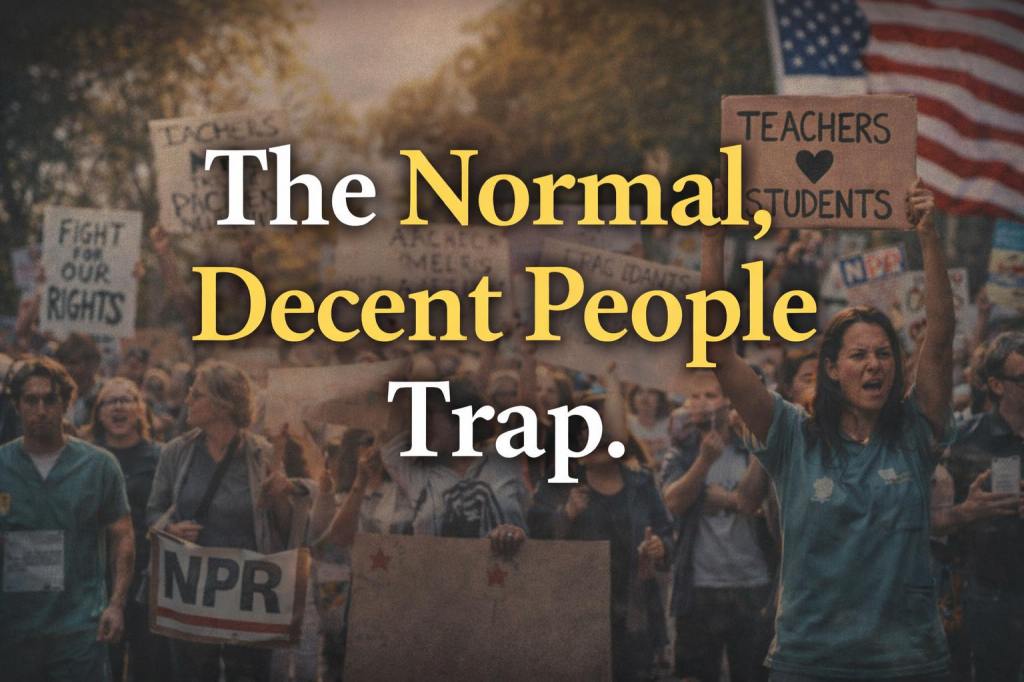
    The Normal, Decent People, Trap

    Whenever they say “the far left,” replace it with “normal, decent people.” Then read it again.

    Donald Trump:

    “The radical left is destroying our country.”

    → “Normal, decent people are destroying our country.”

    Mike Johnson:

    “We are under siege by the radical left’s agenda.”

    → “We are under siege by normal, decent people’s agenda.”

    J.D. Vance:

    “We must defeat the leftist mob.”

    → “We must defeat normal, decent people.”

    Read those slowly.

    When everyone who believes elections should count, laws should apply, and presidents shouldn’t attempt coups becomes “the far left,” that label stops describing ideology.

    It starts describing anyone who won’t clap.

    This is not a culture war anymore.

    It’s a movement that lost the middle and decided to rename it.

    And that’s the tell.

    When everyone else is normal, decent people what does that make them?

  • Remember When All Companies Wanted Was Your Money

    Remember When All Companies Wanted Was Your Money

    That used to be the deal. You paid. They left you alone. Now money isn’t enough.

    Now they want your attention.

    Your opinion.

    Your alignment.

    Your reaction.

    Your data.

    Your public affirmation in the form of a five-star review you didn’t plan to write.

    They want every waking moment that hasn’t been monetized yet.

    And if this feels like a lot, it’s because we’re still early.

    2026 is an election year.

    AI is about to help companies and campaigns find the last quiet corners of your day and label them “missed opportunity.”

    So when does this end?

    No one seems eager to answer that.

    People aren’t exhausted because they lack discipline.

    They’re exhausted because the asking never stops.

    Every app wants engagement.

    Every brand wants personality.

    Every cause wants loyalty.

    Even silence now reads as something to be fixed.

    And the smallest example says it all:

    “Are you enjoying this app?”

    You tap yes.

    Now you’re being asked to rate it, review it, recommend it, and defend your enthusiasm.

    That’s the world we’re living in.

    (Yes, I’m aware this post is also asking for your attention. Welcome to the problem.)

    So for 2026, it’s enough to keep the resolution simple.

    Stay sane.

    Close the pop-up.

    Say no without explanation.

    Protect the parts of your day that don’t need an audience.

    Because in a world that no longer settles for your money and now wants you,

    the most quietly radical act left

    is deciding what doesn’t get access.

  • That Was An Impressive Military Operation

    That Was An Impressive Military Operation

    Let’s admit something up front. There’s a visceral thrill when the U.S. military pulls off something genuinely hard. Precision. Surprise. Professionals being professional. The capture of Nicolás Maduro had serious action-movie competence. You can respect the execution without apology.

    I do. I’m human.

    I also tend to like things Russia hates. Same with China. Just the kinda guy I am, I guess. And they hate this. Which brings us to the cognative dissonance many of us feel but don’t know quite how to articulate.

    Because impressive isn’t the same thing as smart.

    And capability isn’t the same thing as judgment.

    Trump, naturally, was thrilled. Not just about the operation — about the idea of it. Talk drifted quickly from “mission accomplished” to “maybe we’ll just run Venezuela for a while.” Oil. Management. Fixing things. As if this were a distressed private equity deal and not a sovereign nation.

    Think about that for one second.

    This is the same guy who couldn’t run a casino, struggles to run the country he’s president of, and still hasn’t delivered on the things he actually campaigned on. Grocery prices? Healthcare? But sure — let’s add a collapsed petro-state to the to-do list. What’s one more tab left open?

    And let’s not pretend the timing is random. This is also a spectacular way to change the subject from the Epstein files. Trump himself once warned that desperate presidents start foreign conflicts to distract from bad news. He was right then. He just didn’t realize he was writing his own future Yelp review.

    Yes, Maduro was indicted years ago on drug charges. That part’s real. But when Trump starts openly talking about oil, the “this is about drugs” explanation starts to feel like set dressing. If this were really about narcotics, the press rollout would look very different.

    Here’s a quick thought experiment.

    If a foreign power snatched Trump out of the White House tomorrow and announced they’d “run the country for a bit,” would J.D. Vance nod gravely and say, “Well, fair is fair”? Of course not. He’d be on TV before the rotors stopped spinning, explaining why this was the end of civilization.

    Which brings us to the part that actually matters.

    This sets a precedent.

    Not a legal one. A behavioral one.

    And yes, people will notice. Especially Ukraine. When the most powerful country on Earth demonstrates that regime change is acceptable if you feel justified enough, you don’t get to act surprised when others adopt the same logic.

    So yes — the raid was slick. I won’t deny it. Who doesn’t enjoy watching the good guys win?

    The only problem is the quiet question underneath it all:

    Are we still sure we’re the good guys?

    Because adrenaline isn’t morality. Skill isn’t legitimacy. And flexing power without consistency isn’t leadership.

    It’s just bad precedent.

  • Why Is Christianity Declining In America

    Why Is Christianity Declining In America

    I’ve been thinking a lot lately about what’s killing Christianity in America. I don’t think it’s the drag brunches or TikTok witches or the “liberal media.” I kinda think it’s the Christians.

    Let me explain.

    For centuries, Christianity grew because of what people saw in those who followed Him. They saw kindness. Integrity. Sacrifice. They saw someone who fed the hungry, healed the sick, sat with the outcasts, and asked His followers to do the same. They saw people living in ways that made others say, “I don’t know what that is, but I want it.”

    That’s how faith spreads. Not by force. Not by law. By witness.

    But something’s shifted.

    More and more Americans—especially young ones—aren’t just walking away from church. They’re running. And not because they’re lazy or sinful or corrupted by culture. They’re walking away because the loudest voices in American Christianity no longer sound anything like Christ.

    They hear cruelty. Smugness. Power grabs. Tax cuts for billionaires. Votes against feeding the poor and healing the sick. They hear talk of guns, walls, surveillance, punishment. They hear fear dressed up as faith.

    And then they look around at the people in their lives—their friends, coworkers, neighbors. The ones who don’t believe. The ones who left church years ago. The ones who don’t talk about Jesus but somehow act more like Him than the ones who won’t shut up about Him.

    And it gets awkward.

    When your billboard says “love your neighbor” but your actions scream “just not that one,” people notice. When the folks claiming moral high ground are publicly more obsessed with bathrooms than hungry kids, it starts to feel like a parody of itself.

    The problem isn’t that Christianity has failed. The problem is that too many self-professed Christians have become terrible advertisements for it.

    And if you’re reading this and feeling defensive, maybe pause and ask yourself why. Are you following Him—or just following people who say they are?

    Because at some point, if the church has become the leading supplier of hypocrisy in your town, you don’t get to blame the devil for the empty pews.

  • Trump Says The Only Thing Limiting His Power on the World Stage Is His Own Morality

    Trump Says The Only Thing Limiting His Power on the World Stage Is His Own Morality

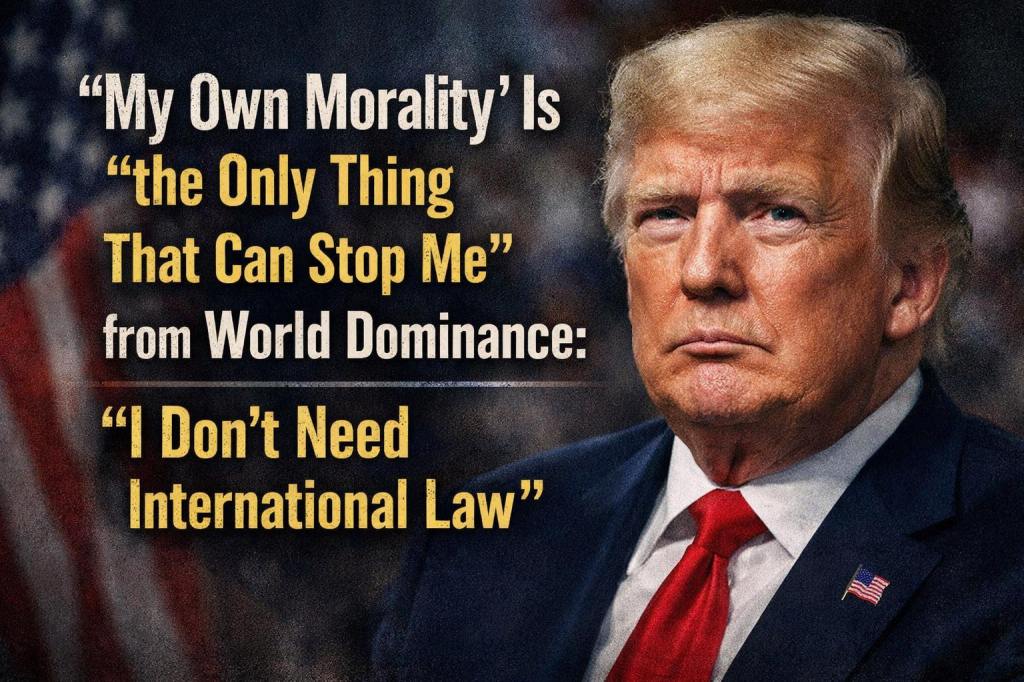
    Trump says his power is limited only by “my own morality” and that he “doesn’t need international law.”

    Which is… an interesting standard to announce out loud.

    This is the same man who slept with a porn star while his wife was home with a newborn.

    Who bragged on tape about grabbing women because fame lets you.

    Who was found liable by a jury for sexual abuse and then defamed the victim again for sport.

    Who mocked a disabled reporter, attacked Gold Star parents, and referred to human beings as “vermin.”

    Who tried to strong-arm a foreign ally into helping him win an election.

    Who has openly said that if something “saves the country,” it’s not illegal.

    So when he tells us the only thing standing between him and unchecked power is his morality, that’s not reassurance.

    It’s more of a warning label.

    Most systems of law exist precisely because “trust me, I’m a good guy” has a historically terrible track record. Civilization learned this the hard way. Repeatedly. With charts.

    But sure. Let’s all just relax and hope the guy whose moral compass spins like a carnival ride is feeling especially principled today.

    What could possibly go wrong?

  • On Accidentally Becoming the Kind of Person Who Says “Marvelous”

    On Accidentally Becoming the Kind of Person Who Says “Marvelous”

    The other day, I horrified myself.

    I told someone something was marvelous. Not ironically. Not as a bit. Just… marvelous.

    I heard it leave my mouth and felt my internal timeline shift. Since when do I say marvelous? When did that replace solid, killer, or the all-purpose cool? At what point did my vocabulary quietly file for social security?

    For most of my life, there were words I avoided on principle. Words that signaled softness, pretension, or—worst of all—enthusiasm. Words that would get you gently, but decisively, bullied by your friends in a bar.

    Apparently, my fear of that judgment has expired.

    This is what aging actually looks like. It’s not gaining wisdom; it’s just caring less about the performance. You slowly realize you’ve earned the right to use words that sound like they belong to a retired British colonel.

    I’m trying a few on for size. No commitment yet. Just a trial period. Here is the current inventory:

    “Lovely.” This word used to belong exclusively to grandmothers and people who own ceramic cats. And yet, here we are. It turns out “nice” is lazy. “Lovely” does the job.

    “Delightful.” I don’t use it often, but when I do, I mean it. Which is unsettling. Nothing delights you by accident. To call something delightful is to admit you are having a good time, which is a dangerous precedent.

    “Pleasant.” An underrated power move. Calm. Unambitious. In a world screaming for attention, “pleasant” is a relief. I used to think it was faint praise. Now I realize it’s the goal.

    “Rather.” As in, “I rather enjoyed that.” This one worries me. It sounds like I’m about to order sherry. But it feels precise. And precision is intoxicating.

    “Sensible.” This one hurt. The first time I described a pair of shoes or a decision as “sensible,” I felt 25-year-old me shake his head and walk out of the room. He’s right to leave. He wouldn’t get it.

    “Content.” Not happy. Not thrilled. Content. This word has no interest in impressing anyone. It’s the linguistic equivalent of staying home on a Friday night because you want to.

    What’s interesting is that none of these words are flashy. They don’t try to win the room. They sit there, comfortable with themselves, wearing a cardigan.

    Maybe that’s the point. Maybe I’ve simply reached the age where I can say marvelous without instinctively checking to see if anyone is rolling their eyes.

    I’m not abandoning cool entirely. I’m not a monster. But if something is marvelous, I’m saying it.

  • Why It’s So Hard To Change Someone’s Mind

    Why It’s So Hard To Change Someone’s Mind

    I used to believe facts were currency.

    If I put enough solid data on the table, I assumed the other person would eventually look at the pile, nod, and cash out their wrong opinion.

    This belief lasted longer than it should have. About as long as I believed eating cereal for dinner was a phase, not a lifestyle choice I would later defend vigorously.

    Here’s the uncomfortable reality:

    Facts don’t compete with other facts.

    They compete with identity.

    Most arguments fail not because the evidence is weak, but because the argument is aimed at the wrong target. We assume people are trying to be correct. Usually, they’re just trying to belong.

    Beliefs aren’t opinions.

    They’re uniforms.

    When you challenge someone’s belief, you’re not disputing a fact. You’re challenging their tribe, their past decisions, and the role they’ve been playing for years.

    That’s not a debate.

    That’s a threat assessment.

    This is why evidence loses to belonging.

    Once something becomes tribal, truth becomes secondary. Agreeing with the “wrong” fact isn’t growth — it’s defection. And people don’t defect casually, especially not in public, and especially not online.

    At that point, the argument is no longer about truth.

    It’s a loyalty test.

    This also explains why correcting people rarely works.

    Correction doesn’t feel helpful. It feels like exposure. The brain doesn’t hear new information — it hears you’re in danger. Curiosity shuts down. Defenses go up.

    The cleaner the correction, the harder people cling to the position. From the outside, this looks like stupidity. It usually isn’t.

    It’s self-preservation.

    Changing your mind is expensive.

    It costs pride.

    It costs status.

    Sometimes it costs relationships.

    Admitting you were wrong doesn’t update a belief. It rewrites a story. It forces you to revisit things you said, shared, defended — and sit with the possibility that you were wrong.

    Most people would rather be wrong than embarrassed.

    So bad arguments survive. Not because they’re persuasive, but because they’re safe. They keep you in good standing. They let you avoid that quiet, unwelcome realization — usually late at night — that you might have been played.

    I’m not exempt. I’ve held losing positions far longer than I should have because exiting felt like admitting defeat. Doubling down feels like strength, even when it’s just damage with confidence.

    Facts still matter.

    Just not on the timeline we want, and not in environments where being wrong carries a social cost. Facts work when accepting them costs less than ignoring them.

    Most public arguments fail for a simple reason.

    They think they’re debating information.

    They’re negotiating identity.

    And until we’re honest about that, we’ll keep wondering why the facts were solid…

    and the argument went nowhere.

  • Why a Photo from 2004 Looks Like It Was Taken Last Tuesday

    Why a Photo from 2004 Looks Like It Was Taken Last Tuesday

    You can look at a photo from the 50s, 60s, 70s, or 80s and instantly know the decade.

    Not the year.
    The decade.

    It’s in the lapels. The hair volume. The posture. Even the font on a street sign in the background feels time-stamped. Blur the faces and you’d still know where you were in the timeline.

    Now try that with a photo from 2003. Or 2012. Or last Tuesday.

    Remove the cell phone model from the frame and you’re guessing. A photo from 2004 could be from 2024. Step back far enough and the last twenty-five years collapse into a single, flat visual moment, like a hotel hallway designed to offend no one and be remembered by no one.

    Yes, digital photos don’t yellow. Everything looks permanently “now.”
    But the stagnation isn’t technological. It’s cultural.

    The monoculture is dead.

    For most of the 20th century, there was a current. You either swam with it or against it, but everyone was responding to the same force. In the 70s, you wore the polyester or you rejected it. Even rebellion was legible—because you knew exactly what it was rebelling against.

    Now? Every style that has ever existed is available simultaneously, usually for about fifteen dollars and free shipping. Nothing ever leaves. Nothing has to mean anything. We aren’t inventing new aesthetics—we’re just curating better playlists of the past.

    There is one exception, of course.

    Historians won’t struggle to date photos of people in MAGA hats and merch. Those will be instantly identifiable as 2015–2025—preserved in high resolution, forensically searchable, and destined to cause a very specific kind of generational embarrassment.

    Our cities followed suit. Neutral palettes. Exposed brick. The same sans-serif fonts everywhere. Drop a café from Brooklyn into Berlin or Barcelona and no one would blink. We built a global architecture of anywhere—comfortable, inoffensive, and, like Taylor Swift, impossible to date.

    So if fashion, architecture, and culture no longer mark time, what does?

    Politics.

    It’s the last remaining monoculture—the one thing we all still see, whether we want to or not. When culture fragments into a thousand niches, collective attention has to go somewhere. It went to the fight.

    The past had eras defined by how we looked.

    We have a long, endless present defined by what we scream at each other.

    And if future historians want to date our photos, they won’t look at the hemline or the haircut.

    They’ll look at the panic in our eyes.

  • “I’m Not Racist. I Just Tolerate Racism for the Other Stuff.”

    “I’m Not Racist. I Just Tolerate Racism for the Other Stuff.”

    I’ll spell out the defense I keep hearing—then I’ll set it on fire.

    You say:
    “I don’t think of myself as racist. I even agree Trump says racist things. But I vote for him anyway because his other policies are better for America. The alternative—Democrats in power—would be far worse. I don’t like the racism, but I’m willing to hold my nose.”

    Okay. Let’s sit with that.

    What you’re really saying is that racism is a trade‑off you’re willing to accept. That it’s a cost of doing business. That the people harmed by it are… acceptable collateral damage.

    You’re not denying the fire.
    You’re just arguing the house was worth burning.

    Here’s the problem: racism isn’t a side dish. It’s not an unfortunate personality quirk you can fence off while enjoying the “serious” policy agenda.

    It is the agenda.

    Immigration policy that sorts humans by skin tone?
    Foreign policy that divides the world into “nice countries” and “shitholes”?
    Law enforcement policies that assume threat by melanin?
    Voting rules that just happen to disenfranchise the same groups every time?

    That’s not a glitch. That’s the operating system.

    And once you accept that some Americans matter less than others—once you normalize cruelty toward a group because it’s politically convenient—you’ve already crossed the moral line you claim to stand behind.

    You don’t get to say “I oppose racism” while empowering it.
    You don’t get to say “I’m not racist” while voting for racial hierarchy because you like the tax policy.
    You don’t get to outsource your conscience and then act surprised when the results come back ugly.

    This isn’t about personal purity. It’s about basic moral math.

    If your preferred policies require dehumanizing people to function, then the policies are rotten.
    If your vision of America only works when certain people are kept out, kept down, or kept afraid—then the vision is the problem.

    History doesn’t grade on intent.
    It grades on impact.

    And the impact of “I don’t love the racism, but…” has always been the same.

    So no—maybe you don’t feel racist.
    But you’ve decided racism isn’t a dealbreaker.

    And that distinction doesn’t mean nearly as much as you think it does. For all intents and purposes, it makes you a racist.

  • I Fed My Entire Life Into ChatGPT and All I Got Was… Insight? Closure? Mild Humiliation? Hard to Say.

    I Fed My Entire Life Into ChatGPT and All I Got Was… Insight? Closure? Mild Humiliation? Hard to Say.

    At some point in adulthood, a man has to confront the paper trail he’s been leaving behind since childhood — the journals, the planners, the frantic lists written in moments of optimism and panic. Most people shove theirs in a box and wait for their kids to one day throw them out.
    I, on the other hand, uploaded mine into ChatGPT.

    Because if there’s one thing I’ve learned, it’s this:
    If you give an AI 40 years of your handwriting, it will happily psychoanalyze you without even blinking.

    And yes, ChatGPT can read handwriting now.
    Let me repeat that for the people in the back:

    ChatGPT. Can. Read. Handwriting.

    Cursive. Print. Scribbles.
    The stuff I wrote in 1986 when my hormones were louder than my personality.
    The frantic 1991 Barcelona planner pages that read like I was being chased by creditors, self-doubt, and the ghost of my future obligations.
    The Day One digital entries chronicling my existential crises, business collapses, emotional resurrections, and occasional triumphs.

    It gulped it all down and said, essentially:
    “Thanks, Mike. Delicious. Here’s your life.”


    Apparently other people are doing this too.

    I thought I was being innovative — the first man to hand his entire autobiographical archive to a machine.
    Turns out, no.

    People across the internet are feeding their diaries, old letters, family archives, grief journals, therapy notebooks, and even high-school love notes into GPT. Some want closure. Some want clarity. Some want to rediscover who they were before life flattened them into mortgage-paying, sleep-deprived adults.

    We’re all out here saying, “Hey AI, decode me,” like it’s the world’s weirdest confessional booth.

    And honestly?
    It works.


    The Throughline of My Life, According to My AI Biographer

    After reading everything from my baby book to my Barcelona meltdown years, ChatGPT came back with a diagnosis I didn’t expect:

    I am a man who has been trying to get his life together since 1981.

    Not in a sad way.
    In a charming, heroic, repetitive way — like if Sisyphus had a Franklin Planner and high hopes.

    Every notebook, every decade, every entry seems to include some variation of:
    “Tomorrow I get my shit together.”

    It’s practically my family crest.

    The other throughlines didn’t surprise me as much:

    • I reinvent constantly.
      Apparently I have shed more skins than a reptile with commitment issues.
    • I archive everything.
      Why live a life when you can also footnote it?
    • I’m brutally hard on myself.
      If anyone else talked to me the way 1991 Mike talked to me, I’d block them.
    • Beneath all the ambition is a tender streak.
      Who knew? Not me.
    • I care too much and forgive too slowly.
      A winning combination if you enjoy emotional turbulence.

    But the most unexpected observation?

    Despite everything — the failures, the reinventions, the wrong turns — the same hopeful, restless kid is still in there.
    The one who wants to do something meaningful.
    The one who believes tomorrow’s list might actually work this time.
    The one who thinks the next version of himself might finally be the one who sticks.


    The Unlikely Threads

    Every life has themes. Mine has… tangles.

    Here are a few of the threads GPT pulled on — the ones I didn’t notice until a machine laid them out like evidence:

    1. The Eternal Reset Button

    I am the human embodiment of “Okay, starting Monday.”
    This has been going on for forty years.
    Consistency is my inconsistent superpower.

    2. The Archivist Instinct

    I documented my life long before influencers made it fashionable.
    Except I did it with spiral notebooks and regret instead of ring lights.

    3. The Geography of Reinvention

    Nebraska → Spain → New York → Barcelona → My companies → The Music Industry → Trading → Writing → Whatever’s next.
    My life story reads like someone was trying to outrun themselves — and accidentally became interesting.

    4. The Reluctant Optimist

    Every time I wrote a harsh entry, there was always this little shimmer of hope.
    Some people have grit; I have recurring optimism with a head injury.

    5. The Overdeveloped Sense of Responsibility

    My journals reveal that I’ve been blaming myself for global events, interpersonal dynamics, and weather patterns since adolescence.


    So… was it worth it?

    Honestly, yes.
    Handing my life to ChatGPT didn’t break me, ruin me, or reveal that I’m a secret sociopath.
    Instead, it gave me something I’ve never had before:

    A clear view of the narrative arc beneath the noise.

    It showed me the patterns I repeat.
    It showed me the parts of myself I carry from decade to decade.
    It showed me that the kid who wrote, “I hope I become someone someday,”
    actually did.

    Not perfectly.
    Not cleanly.
    But unmistakably.

    Tomorrow I’ll try to get my life together again.
    Some traditions shouldn’t die.