Category: Business

  • Why It’s So Hard To Change Someone’s Mind

    Why It’s So Hard To Change Someone’s Mind

    I used to believe facts were currency.

    If I put enough solid data on the table, I assumed the other person would eventually look at the pile, nod, and cash out their wrong opinion.

    This belief lasted longer than it should have. About as long as I believed eating cereal for dinner was a phase, not a lifestyle choice I would later defend vigorously.

    Here’s the uncomfortable reality:

    Facts don’t compete with other facts.

    They compete with identity.

    Most arguments fail not because the evidence is weak, but because the argument is aimed at the wrong target. We assume people are trying to be correct. Usually, they’re just trying to belong.

    Beliefs aren’t opinions.

    They’re uniforms.

    When you challenge someone’s belief, you’re not disputing a fact. You’re challenging their tribe, their past decisions, and the role they’ve been playing for years.

    That’s not a debate.

    That’s a threat assessment.

    This is why evidence loses to belonging.

    Once something becomes tribal, truth becomes secondary. Agreeing with the “wrong” fact isn’t growth — it’s defection. And people don’t defect casually, especially not in public, and especially not online.

    At that point, the argument is no longer about truth.

    It’s a loyalty test.

    This also explains why correcting people rarely works.

    Correction doesn’t feel helpful. It feels like exposure. The brain doesn’t hear new information — it hears you’re in danger. Curiosity shuts down. Defenses go up.

    The cleaner the correction, the harder people cling to the position. From the outside, this looks like stupidity. It usually isn’t.

    It’s self-preservation.

    Changing your mind is expensive.

    It costs pride.

    It costs status.

    Sometimes it costs relationships.

    Admitting you were wrong doesn’t update a belief. It rewrites a story. It forces you to revisit things you said, shared, defended — and sit with the possibility that you were wrong.

    Most people would rather be wrong than embarrassed.

    So bad arguments survive. Not because they’re persuasive, but because they’re safe. They keep you in good standing. They let you avoid that quiet, unwelcome realization — usually late at night — that you might have been played.

    I’m not exempt. I’ve held losing positions far longer than I should have because exiting felt like admitting defeat. Doubling down feels like strength, even when it’s just damage with confidence.

    Facts still matter.

    Just not on the timeline we want, and not in environments where being wrong carries a social cost. Facts work when accepting them costs less than ignoring them.

    Most public arguments fail for a simple reason.

    They think they’re debating information.

    They’re negotiating identity.

    And until we’re honest about that, we’ll keep wondering why the facts were solid…

    and the argument went nowhere.

  • What Makes Trump Bad at Business, Life, and As President?

    What Makes Trump Bad at Business, Life, and As President?

    I don’t build companies anymore. I may go back someday. When I found myself with time on my hands, I decided to learn a new skill. Now. I trade gold on the financial markets.

    When I first made that shift, I was terrible at it. Worse than most. Because I came in wired like an entrepreneur—obsessed with control, allergic to surrender. In business, that mindset serves you. You see what isn’t there yet, and you make it happen. You bend the world until it fits your plan.

    But markets don’t bend. Gold doesn’t care about your plans. It doesn’t care who you are. The market humbles everyone eventually.

    Even back when I built companies, though, I never lied to myself about the numbers. You could spin the story, but the math still had to work. That was the line between ambition and delusion.

    And that’s where Donald Trump went off the rails.

    Trump was never really in the real estate business. His true product was himself—the myth, the name, the attention. The buildings and casinos were just props in a lifelong campaign for validation. When your ego is the business, you can’t afford to face reality.

    That’s why he’d make a terrible trader.

    When the world doesn’t fit his story, he simply changes the story. When a recent jobs report came in weak, he fired the head of the Bureau of Labor Statistics and called the numbers “phony.” When intelligence briefings on the Iran strikes contradicted his claim that America had “obliterated” Iran’s nuclear program, he dismissed the analysts and replaced them with loyalists. Each time, he traded truth for ego protection.

    It’s the same reason his casinos collapsed. The Taj Mahal was financed with nearly $700 million in junk bonds at 14% interest—a structure that guaranteed failure unless fantasy-level profits rolled in. When the math didn’t work, he doubled down instead of cutting losses. That’s not risk-taking. That’s denial.

    In trading, denial kills faster than bad luck. You can’t fire the chart. You can’t rebrand a losing position as “fake news.” You take the loss, you adapt, you move on.

    When I started trading gold, I had to unlearn my old wiring—the instinct to fix what’s outside my control. The market doesn’t reward force; it rewards alignment. You win when you stop fighting the tape and start listening to it.

    Trump never learned that lesson. He can’t. His entire existence depends on never admitting he’s wrong. He’s trapped inside the one product he can’t afford to discount: himself.

    That’s why he was a bad businessman.

    It’s why he’d be a disastrous trader.

    And it’s why he’s a dangerous president.

    Because on the world stage—where power, pride, and perception collide—his refusal to face reality doesn’t just cost him money. It costs nations time, credibility, and lives.

    In the end, the markets always find the truth. So does history.

    And the truth always settles the account.

  • Spain’s Quiet Flex

    Spain’s Quiet Flex

    Spain isn’t just “doing okay” while the rest of Europe nurses a hangover — it’s Europe’s outlier in a good way. Since early 2024, Spain has been growing at roughly three percent a year while the eurozone plods along near one. Credit markets noticed: S&P bumped the sovereign in mid-September, and within days Moody’s and Fitch followed suit. When all three ratings agencies are suddenly in a good mood about you, it’s usually because the story is real, not vibes. 

    The growth mix isn’t mysterious:

    • People: Spain opened the door while others slammed it. Net immigration has averaged around six hundred thousand a year since 2022, mostly working-age and heavily Latin American — which makes integration faster (language, culture, networks). That’s not a talking point; that’s the math. It’s also a big reason employment has hit records and consumer demand is sturdy.  
    • Power: Cheap, abundant renewables have turned Spain from a sunny tourist postcard into an energy-cost arbitrage play for industry and data-heavy services. In 2024, renewables supplied a record ~56% of electricity, and year-to-date 2025 has pushed higher. That lowers input costs and draws capital. (The grid, yes, needs beefing up after the April outage — and investments are now flowing.)  
    • Policy follow-through: NGEU funds have been deployed into real stuff (infrastructure, modernization), and earlier labor reforms tightened up job stability. Brussels’ baseline: Spain can still clock around 2.6% growth in 2025 — in Europe, that’s sprinting.  

    Now for the adult supervision: per-capita gains lag headline GDP, productivity is still yawning, and unemployment — although falling to around 10% — remains among the eurozone’s highest. The fix isn’t a new slogan; it’s a pipeline: streamline rules, crowd in long-term risk capital, and upskill into higher-value services (IT, finance, engineering). That’s where you turn an immigration-led demand pop into durable per-capita prosperity. 

    How Madrid plays its power in Europe

    Spain’s “soft power” used to be sunshine and tapas. Today it’s growth, grid, and people — a combination that gives Madrid surprising clout in EU tables where sluggish peers need a positive outlier. The message Spain quietly sends in Brussels: we can cut emissions, grow faster than you, and do it without slamming the door on newcomers. That lets Spain lean into:

    • Energy bargaining: With wind/solar scaling and interconnectors improving, Spain can punch above its weight in talks about EU power markets, grids, and decarbonization timelines. The subtext is “we’ve shown this can work — now fund the pipes.”  
    • Fiscal credibility: Upgrades from S&P/Moody’s/Fitch improve borrowing optics just as Europe re-tightens fiscal rules. That buys room to keep investing while others cut.  
    • Migration realism: While some capitals grandstand at the border, Spain’s labor-market-first posture is adding capacity exactly where Europe is short. That makes Madrid the practical voice when migration inevitably returns to the EU agenda.  

    What could blow this up? Politics and housing. Sánchez governs with dental floss; big reforms are a knife fight. And if rents keep outrunning wages and public services stay tight, tolerance for high inflows could fray — fast. The economic story is strong; the social license needs maintenance. 

    The scoreboard (for the macro geeks)

    • 2025 growth: Bank of Spain and the European Commission are in the ~2.6% camp; the government’s latest revision is a hair higher after a better-than-expected Q2. Either way, Spain is still outrunning the bloc.  
    • Labor: Unemployment near 10.3%, lowest since 2008 but still elevated versus EU peers. Youth unemployment remains sticky.  
    • Energy: 56% renewables in 2024, roughly ~59% so far in 2025 — with grid investment pledged after the spring blackout.  

    Catalonia: where things actually stand

    Madrid bet on de-escalation and legal normalization. The Amnesty Law for the 2017 independence cases passed and, crucially, Spain’s Constitutional Court upheld it on June 26, 2025. Application is case-by-case: many have already benefited, while high-profile figures like Puigdemont are still working through the process. Politics, not prisons, now dominates. 

    On public sentiment, support for independence has eased off its highs, bobbing around ~38–40% in 2025 surveys, with the Socialists (PSC) leading regionally and pro-independence parties recalibrating. Translation: the temperature is lower, the question isn’t “UDI tomorrow” but “what’s the next workable status that keeps growth and dignity intact?” 

    Bottom line: Spain’s edge right now is a rare mix — demographic momentum, green electrons, and steady EU cash channeled into the real economy. If the ruling class can keep the coalition intact, scale skills faster than rents, and turn grid upgrades into a 2030 powerhouse, Spain’s “quiet flex” becomes structural. If not, it risks being remembered as a great run of form that never quite converted to per-capita lift. I’m betting the former — but only if they keep treating immigration as an asset and productivity as the main event. 

  • Trump Fired the Jobs Report Lady. Because the Jobs Report Was Bad.

    Trump Fired the Jobs Report Lady. Because the Jobs Report Was Bad.

    Well, that didn’t take long.

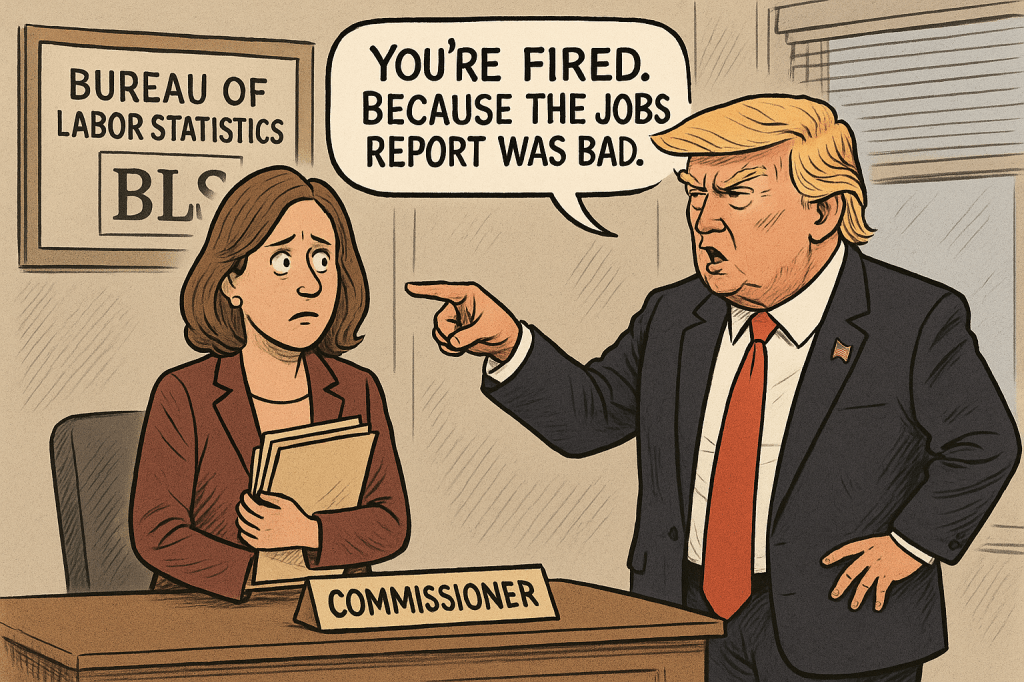
    The July jobs report came in soft—only seventy-three thousand jobs added—and within hours, Donald Trump did what any authoritarian cosplay enthusiast does when reality offends him: he fired the person who reported it.

    Erika McEntarfer, the now-former Commissioner of the Bureau of Labor Statistics, was escorted out because she made the grave mistake of… doing her job. She didn’t cook the numbers, she didn’t fudge the data, and she didn’t go rogue. She simply released the same kind of carefully collected employment figures the BLS has been publishing, without scandal, for over a hundred years.

    But this time, the report was politically inconvenient. And in Trump World, truth isn’t just optional—it’s punishable.

    Let’s pause for a second to explain what the BLS actually is. It’s not a partisan think tank. It’s not the communications arm of the DNC. It’s a statistical agency, filled with career economists and data nerds who live for things like seasonal adjustments and response rates. The BLS is where accuracy goes to get its shoes dirty.

    And yes, they revise the numbers—they always have. The initial jobs report is based on partial survey responses. As more data trickles in—especially from late-reporting firms and federal agencies—the numbers get updated. This happens every month. It’s not fraud. It’s not bias. It’s just… math. But try explaining “statistical methodology” to a guy who thinks windmills cause cancer.

    Here’s the real danger: this isn’t just about one firing. It’s about trust. The kind of trust that global markets, rating agencies, and foreign debt holders depend on when they decide whether to keep parking trillions in U.S. Treasuries. They’re not doing that out of charity. They’re doing it because they believe U.S. institutions are solid. Apolitical. Professional. Uncorrupted by whoever happens to be yelling on television that day.

    But if we start firing data officials every time a chart slopes the wrong way, we’re not a stable country anymore. We’re a banana republic in a red baseball cap.

    The BLS has survived wars, recessions, financial crises, and even past Republican administrations that knew better than to meddle with the scorekeeper. But now? Now we’re here—treating unemployment figures like fake news and gutting statistical integrity because the numbers don’t flatter the guy in the gold elevator.

    What happens next? Do we rehire her if next month’s numbers are better? Do we demand she “find” more jobs next time? Do we just stop counting altogether and replace the report with vibes?

    This isn’t funny. But I’m laughing anyway, because that’s what you do when the country starts playing Russian roulette with its credibility.

    We don’t have to agree on the right economic policy. But we have to agree that facts are still allowed to exist.

    Because if we lose that, it’s not just the jobs report that gets revised downward. It’s our future.

  • After Late-Stage Capitalism: Where Do We Go From Here?

    After Late-Stage Capitalism: Where Do We Go From Here?

    You don’t need a PhD in economics to feel that something’s off.

    Groceries cost more, jobs feel more fragile, housing looks like a luxury product, and half the tech CEOs sound like they’re pitching a video game plot instead of running real-world companies. Meanwhile, billionaires are racing each other to space while your rent races you into a corner.

    This is what people mean when they talk about late-stage capitalism. It’s not an end date on a calendar. It’s a mood. A vibe. A phase in the life cycle of an economic system that feels increasingly disconnected from reality.


    So What Is Late-Stage Capitalism, Really?

    It’s the point in a system’s evolution where:

    • Markets are no longer free, just engineered
    • Wages stagnate while productivity and profits soar
    • Basic needs become “subscription services”
    • Work is precarious, but shareholders are thrilled
    • Governments serve markets instead of citizens
    • Every crisis gets monetized—healthcare, climate, war, education

    It’s Uber drivers with master’s degrees. Teachers driving DoorDash. People crowdfunding insulin while the stock market hits record highs. It’s burnout, hustle, and “grindset” culture masquerading as freedom. It’s a society that treats rest like laziness and wealth like morality.

    In short: it’s the moment when the system stops pretending it’s for everyone.


    So What Comes Next?

    That’s the question. And we’re all going to have to answer it—whether we want to or not. Because systems don’t last forever. They evolve. They collapse. They mutate. Or, sometimes, they’re dragged kicking and screaming into something new.

    Here are five directions we might be headed:


    1. State Capitalism

    Same market, new driver.

    In this version, governments take a more active role—not to help you, but to strategically control markets. Think China’s model: heavy surveillance, controlled growth, and national champions in tech and energy. Markets are tools, not ideals.

    Upside: Infrastructure might actually get built.
    Downside: Dissent gets a lot more expensive.


    2. Technocratic Feudalism

    You’ll own nothing—and still pay monthly fees.

    Imagine a future where democracy erodes, but Amazon has great customer service. Where mega-corporations are the de facto governments, and your social credit score determines what you can access.

    Think: smart homes, dumb laws, and “Terms of Service” that rule your life.

    Upside: Efficiency. Innovation. Personalized everything.
    Downside: No exit button. No real power.


    3. Eco-Social Capitalism

    Capitalism with a conscience—and a carbon cap.

    This is the idealists’ version: a restructured economy that prioritizes sustainability, equity, and long-term thinking. Maybe we get universal basic income. Maybe we regulate tech. Maybe we stop treating the planet like an ATM.

    Upside: Human dignity. Ecological survival.
    Downside: Short-term disruption. Lots of angry billionaires.


    4. Decentralized Utopia

    Crypto, co-ops, and code-based governance.

    This one’s for the web3 dreamers. Power moves from central institutions to decentralized networks. DAOs replace corporations. You vote with tokens, earn through participation, and store your wealth outside the banks.

    Upside: Radical autonomy and transparency.
    Downside: Scams, fragmentation, and the occasional rug pull.


    5. Collapse or Authoritarianism

    When the lights flicker and the flags get darker.

    Not the feel-good option, but one we can’t ignore. If inequality keeps widening, climate shocks intensify, and trust erodes further, we could see the rise of hard borders, strongmen, and failing institutions.

    Upside: None.
    Downside: All of them.


    What Do You Want to Come Next?

    This isn’t just an academic exercise. What comes after late-stage capitalism depends on us. On the stories we tell, the systems we build, and the power we choose to either accept or reject.

    You don’t have to be a policy wonk to start imagining alternatives. You just have to look at the world around you and ask: Is this working? And if it’s not, what would?

    Because the next chapter is being written right now—by corporations, by governments, by you, and by me. And the question isn’t just what comes next.

    It’s who gets to decide.

  • When to Walk Away: A Business Lesson from the Trading Terminal

    When to Walk Away: A Business Lesson from the Trading Terminal

    There’s a moment in business—just like in trading—when your thinking brain quietly exits the building. It doesn’t slam the door or send a calendar invite. It just disappears. And suddenly your emotional brain lights a cigarette, rolls up its sleeves, and says, “Relax—I’ve got this.”

    Spoiler: it does not have this.

    This week, that moment cost me $895 in trading—one bad trade across multiple accounts for a total of an $11,635 loss. But this isn’t about trading. It’s about the universal impulse to stay in the deal too long.

    Read the full post on my Substack here.