You don’t need a PhD in economics to feel that something’s off.
Groceries cost more, jobs feel more fragile, housing looks like a luxury product, and half the tech CEOs sound like they’re pitching a video game plot instead of running real-world companies. Meanwhile, billionaires are racing each other to space while your rent races you into a corner.
This is what people mean when they talk about late-stage capitalism. It’s not an end date on a calendar. It’s a mood. A vibe. A phase in the life cycle of an economic system that feels increasingly disconnected from reality.
So What Is Late-Stage Capitalism, Really?
It’s the point in a system’s evolution where:
Markets are no longer free, just engineered
Wages stagnate while productivity and profits soar
Basic needs become “subscription services”
Work is precarious, but shareholders are thrilled
Governments serve markets instead of citizens
Every crisis gets monetized—healthcare, climate, war, education
It’s Uber drivers with master’s degrees. Teachers driving DoorDash. People crowdfunding insulin while the stock market hits record highs. It’s burnout, hustle, and “grindset” culture masquerading as freedom. It’s a society that treats rest like laziness and wealth like morality.
In short: it’s the moment when the system stops pretending it’s for everyone.
So What Comes Next?
That’s the question. And we’re all going to have to answer it—whether we want to or not. Because systems don’t last forever. They evolve. They collapse. They mutate. Or, sometimes, they’re dragged kicking and screaming into something new.
Here are five directions we might be headed:
1. State Capitalism
Same market, new driver.
In this version, governments take a more active role—not to help you, but to strategically control markets. Think China’s model: heavy surveillance, controlled growth, and national champions in tech and energy. Markets are tools, not ideals.
Upside: Infrastructure might actually get built. Downside: Dissent gets a lot more expensive.
2. Technocratic Feudalism
You’ll own nothing—and still pay monthly fees.
Imagine a future where democracy erodes, but Amazon has great customer service. Where mega-corporations are the de facto governments, and your social credit score determines what you can access.
Think: smart homes, dumb laws, and “Terms of Service” that rule your life.
Upside: Efficiency. Innovation. Personalized everything. Downside: No exit button. No real power.
3. Eco-Social Capitalism
Capitalism with a conscience—and a carbon cap.
This is the idealists’ version: a restructured economy that prioritizes sustainability, equity, and long-term thinking. Maybe we get universal basic income. Maybe we regulate tech. Maybe we stop treating the planet like an ATM.
Upside: Human dignity. Ecological survival. Downside: Short-term disruption. Lots of angry billionaires.
4. Decentralized Utopia
Crypto, co-ops, and code-based governance.
This one’s for the web3 dreamers. Power moves from central institutions to decentralized networks. DAOs replace corporations. You vote with tokens, earn through participation, and store your wealth outside the banks.
Upside: Radical autonomy and transparency. Downside: Scams, fragmentation, and the occasional rug pull.
5. Collapse or Authoritarianism
When the lights flicker and the flags get darker.
Not the feel-good option, but one we can’t ignore. If inequality keeps widening, climate shocks intensify, and trust erodes further, we could see the rise of hard borders, strongmen, and failing institutions.
Upside: None. Downside: All of them.
What Do You Want to Come Next?
This isn’t just an academic exercise. What comes after late-stage capitalism depends on us. On the stories we tell, the systems we build, and the power we choose to either accept or reject.
You don’t have to be a policy wonk to start imagining alternatives. You just have to look at the world around you and ask: Is this working? And if it’s not, what would?
Because the next chapter is being written right now—by corporations, by governments, by you, and by me. And the question isn’t just what comes next.
There’s a moment in business—just like in trading—when your thinking brain quietly exits the building. It doesn’t slam the door or send a calendar invite. It just disappears. And suddenly your emotional brain lights a cigarette, rolls up its sleeves, and says, “Relax—I’ve got this.”
Spoiler: it does not have this.
This week, that moment cost me $895 in trading—one bad trade across multiple accounts for a total of an $11,635 loss. But this isn’t about trading. It’s about the universal impulse to stay in the deal too long.
Science tells us the very first thing we instinctively notice about someone isn’t their height, weight, hairstyle, or even that questionable fashion choice from the ‘90s—it’s whether they’re male or female. And when there’s ambiguity, our brains can glitch a bit, making us do a subconscious double-take. It’s not prejudice; it’s just human wiring.
Now, stick with me here. Just like you, I’m still a bit salty about Pluto losing its planet status. Science updates can mess with our heads, especially when they change how we see the world—or ourselves. But here’s the deal: science has revealed that gender isn’t a simple either/or thing. I know, right?
Think about it—within the category of men you know, some might be macho football fanatics, and some might prefer writing software or novels. Women range from the ultra-feminine to those who could probably beat me at arm-wrestling (honestly, not that high of a bar). Gender traits vary, and now science shows us that variation doesn’t neatly stop at the borders we’ve always assumed.
I understand the discomfort around this—change can feel unsettling. But refusing to acknowledge this complexity is a bit like stubbornly insisting a tomato is a vegetable. Comforting? Maybe. Accurate? Not quite.
And speaking of accuracy, did you know there’s an entire range of naturally occurring biological variations in gender anatomy? Some individuals are born intersex, with genuinely ambiguous physical characteristics due to various combinations of chromosomes, hormones, and anatomy. Science recognizes these realities, and we’ve largely learned not to ridicule people for traits they can’t control—like height, skin color, or sexual orientation. It’s time we grew up and added gender identity to that list of basic human respect.
Which brings me to sports – the big controversy of the political moment. A common objection I hear is, “But what about sports fairness?” Look, fairness matters. No one wants LeBron James competing in women’s gymnastics—although I’d honestly pay good money to see him try (and I tried for at least 15 minutes to get AI to generate an image of that for us to enjoy but apparetly it goes against something called “Standards & Practices” but I think ChatGPT’s creators have lost their sense of humor). But seriously, we already categorize athletes based on criteria like weight, age, and skill. Adding hormone levels or other scientifically sound criteria to ensure fair competition isn’t some radical move. The Olympics do it. Professional sports do it. It’s simply adjusting categories to reflect reality, something sports have always done.
The goal isn’t to erase fairness; it’s to embrace reality with compassion, reason, and a bit of humor. So yeah, Pluto might not be a planet anymore, and gender might not be strictly binary, but we’re still orbiting in the same solar system. Let’s keep adapting, laughing a bit, and relying on science to guide us forward.
Let’s get something straight right off the bat—I’m not talking about people with below-average IQs. Intelligence isn’t the issue here. Some of the smartest people I’ve met couldn’t change a tire or balance a checkbook to save their lives, and some of the most practical, insightful people I know wouldn’t do well on an IQ test.
And I don’t hold myself up as some kind of genius. Believe me, I’ve made my share—and probably some of your share—of dumb decisions. Decisions that would make the Three Stooges look like Nobel Prize winners. But here’s the thing: I am not stupid.
Because stupid isn’t about IQ—it’s about refusing to think critically.
So, let’s run a quick litmus test for critical thinking:
When was the last time you heard a better argument than the one you had and thought, ‘Damn… I might be wrong’? If you can’t think of a single time, that’s a red flag.
Do you ever get new information and just… ignore it? If your instinct is to double down instead of reconsider, congratulations—you’re human. But critical thinkers push past that reflex.
Here’s where I struggle: I have to work hard to feel empathy for people who have all the information they need to make good voting decisions but still choose to vote against their own interests.
It’s one thing to be misled. It’s another to be willfully ignorant. And when people keep making choices that actively harm themselves—and the rest of us—it’s hard not to be frustrated.
The truth is, democracy depends on people actually thinking. And if we can’t do that, we’re in real trouble.
I’ve got a blooper reel running in my head. No, it’s not the kind of reel you’d expect after a day of business or trading mishaps. This isn’t about missed opportunities or the times I could’ve done better in my career. This is the real blooper reel. The one that plays on a loop whenever I let my guard down.
It’s the awkward social moments, the times I misread the room, and the moments when I know—deep down—I’ve let people down. It’s about failing to live up to my own standards. Every time I should have been more present, more compassionate, or just plain more human… I’m there in my head, replaying it all.
What’s strange is that it’s always running. Every conversation, every social interaction, every moment where I didn’t say the right thing or dropped the ball—it loops in my mind, over and over. And I’m not sure how to turn it off. Not because I haven’t tried, but because it’s like the movie I didn’t ask to be the star of. It just keeps going.
I’m not diagnosed with OCD (though, who knows, maybe that’s in the cards for later). I’ve got ADHD—which is probably part of the reason why I sometimes struggle to focus on what’s in front of me rather than the endless mental reruns. But ADHD doesn’t explain the constant mental commentary. That’s all me, every day, reliving these moments in vivid, technicolor detail like I’m trapped in an infinite loop of social faux pas.
Maybe the “blooper reel” is universal—we just don’t admit it out loud. But I can’t help but feel like I’m watching a never-ending series of mistakes, and the worst part is, I imagine everyone who has been on the receiving end missteps is constantly watching too. So the shame and embarrassment are always turned up to 11.
I don’t want this to sound like some “woe is me” post. The reality is, I’m working through this. I’m figuring out how to let go of the things that don’t serve me and focus on what’s ahead. But it’s hard. It’s exhausting. And for someone who’s spent years building businesses, trading gold, and dealing with the stresses of life, it’s a whole new level of self-inflicted pressure.
I know I’m not the only one dealing with this. There are so many of us out there—fighting to silence the self-doubt, the moments we didn’t do or say enough. The truth is, it’s a battle. And some days, I’m winning. Other days? I’m stuck rewinding the same mistakes, trying to “fix” things that are long past fixing.
But here’s the thing: I’m learning to embrace the fact that perfection doesn’t exist. That reel may never stop playing, but maybe I don’t have to listen to it on repeat. I’m still human, and I’ll still make mistakes, but I’m trying to make peace with the fact that I don’t need to be perfect.
So if you’re out there feeling like I am—stuck in your own head, running your personal blooper reel—just know you’re not alone. We’re all trying to find a way to live with the past, move forward, and make the future just a little less complicated.
MikeMcCready.com is back, after a five-year hiatus. That’s right—five years. It’s like I put the site in a time capsule, buried it, and then dug it up again with a rusty shovel. Honestly, I’m a little surprised the whole thing didn’t just disintegrate into dust, but here we are, better than ever.
You may notice something right off the bat: this site looks nothing like the old one. That’s because I completely trashed the previous version. It was like a car that kept breaking down, so I decided to set it on fire and buy a new one. And by new one, I mean I built a site from scratch. That’s right—zero to hero, baby.
Now, let me address the posts that appear before today. Yes, you’ll see some content from the old site lingering around. These are the posts that I felt were worth preserving—things that are still relevant or have some value, even if they come with a bit of dust. They were brought over here, mostly because I’m a nostalgic fool and can’t let go of everything (I’m looking at you, 2017 blog posts). But from this point forward, everything you see on this site will be fresh, new, and part of this new era of MikeMcCready.com.
So, why the reboot? Honestly, I felt like the old site had run its course. It wasn’t speaking to who I am now or where I’m headed. I’ve done a lot since I last posted here: from dealing with some health challenges, to a lot of travel, to exiting Music Xray and taking on new challenges like scalping gold on XAUUSD and trying not to lose my shirt while doing it. Life, business, and politics are always evolving, and it felt like time to build something that reflects all the evolution that’s taken place in my world.
This site isn’t just a platform for old achievements, though—it’s going to be a place where I can share my thoughts, reflections, and insights into the things that matter to me: from politics and society to personal growth and the constant flux that is my life. Because let’s face it, if we’re not learning and evolving, then what are we doing? (Don’t answer that—just keep reading.)
I’ll also be writing with a little more humor than before. Because if there’s one thing I’ve learned in my career—and in life—it’s that humor makes everything more bearable. Politics, business, trading… they’re all serious, but if we can’t laugh at ourselves every once in a while, we’re probably doing it wrong.
So welcome to the new MikeMcCready.com. It’s a place for fresh ideas, occasional rants, and a bit of reflection on everything I’ve learned along the way. Whether you’re here for my thoughts on business, trading, or why authoritarianism is bad for democracy (let me count the ways), I hope you’ll find something that sparks your interest.
Thanks for coming back. It’s good to be here. I’m sticking around for a while.
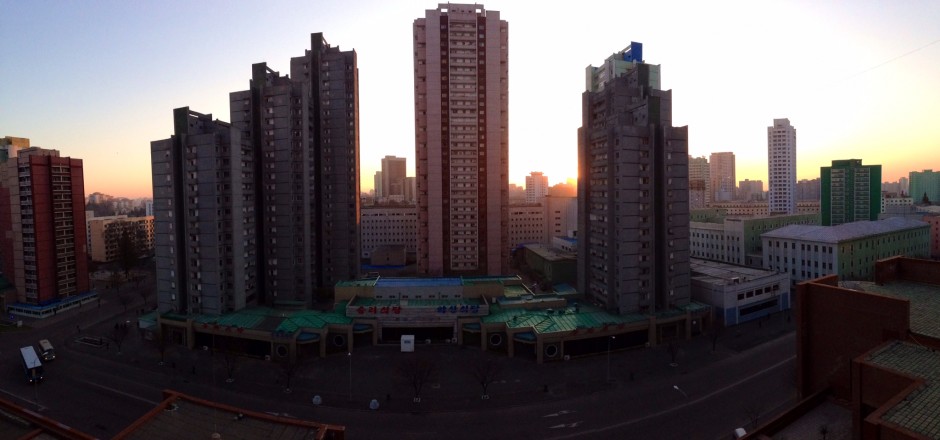
The image above is of Pyongyang at dawn as seen from my hotel window.
This is the third in a series of posts on my recent trip to North Korea. This is part 1 and this is part 2. …………………
The Tupolev jetliner on which we arrived from Beijing pulled up near the only terminal at Pyongyang’s Sunan International Airport. There was construction underway next door at the skeleton of the new terminal that’s being built and as we deplaned down the stairs, every worker stopped in his tracks and observed us in fascination. Working at this particular site must be one of the most interesting construction jobs in town. Seeing foreigners every day, observing how they dress, what they carry with them, how they interact with each other… that’s quite unusual for North Koreans of all classes.
In mid November it’s cold in Korea and I was anxious to get inside the terminal but the expected blast of warm air didn’t hit us as we approached the doors, which were being held open by the steady stream of passengers who had deplaned in front of us. The terminal wasn’t heated. Most public buildings aren’t heated including museums and even theaters – although we were told the heating in the theater, where we saw the circus (that’s another story) was on the fritz but usually working.
Passport controlThe main room of the airport terminal is long and rectangular, about the size and shape of a football field. It is open from one end to the other but divided into zones or spaces. The quarter we walked into was where the lines formed to get through passport control. That’s where they take the visa they previously issue you that shows you’re authorized to be in the country. I’d had my visa for a while as our trip was planned five months in advance. Once they take it from you at the airport, you never see it again. Later, when you meet your minders, you’re relieved of your passport and you don’t see that again until you’re about to depart the country. That was one of the strangest feelings in my life and when my passport was taken I felt naked. But the feeling passed and everything was fine.
Passport control is all business. They don’t stamp your passport; not even if you ask nicely. Taking pictures in the airport is strictly prohibited and they don’t bother to ask nicely. The pictures I’m showing you of the airport are nabbed off the Internet where apparently someone was able to get away with it. North Korea’s attitude toward visitors is similar to how you might think of guests in your home. You are expected to behave nicely, be gracious, compliment the host often, and if you came to gawk or criticize you’ll wear out your welcome quickly and if you go even further and repeatedly disobey key rules (like preaching Christianity), you’ll be asked to leave – or worse, to stay longer then you intended; perhaps much longer and perhaps you’ll be given a new career as a miner, a logger, or as a rock breaker. Kenneth Bae, the Korean-American missionary who is currently being held in North Korea was recently sent back to a hard labor camp.
While that thought was always in the back of my mind, I never once felt unwelcome or in any kind of danger. The recipe for a great and enlightening trip to North Korea is pretty simple. Just follow the rules, which are not unreasonable in exchange for a glimpse into their world for a few days. The rules are of course quite unreasonable if you have to live there. But that’s what I went to see and if things you and I consider crazy weren’t going on there, I wouldn’t have had the curiosity to go. When I’ve recounted a story or two about some of the constraints we were under, a few friends have said to me, “Well, I would have said this, or I would have just reacted like that….” and yes, it constantly crossed my mind to push the boundaries, but philosophical contention would have just shut down our minders, made them feel defensive and less likely to be open with us. After all, since we did not speak Korean and we could not go anywhere outside the hotel without our minders, we were dependent upon them for much of our experience there. No doubt it was limited, but it would have been counter-productive to limit it even more by being a contrarian. My advice? Just roll with it. You’ll have a more enriching experience and doing otherwise isn’t going to change anything except potentially your departure date.
Reverse security at Pyongyang airport. You actually go through x-ray to get out of the airport.To get into North Korea at the airport you actually go through backward airport security. We went through a metal detector and had our luggage x-rayed in order to leave the airport and we were required to hand-over our electronic devices to be inventoried. I gave them my MacBook Pro, my iPad, and two iPhones. I lost sight of each one for only a very brief moment while I was otherwise being asked about my possessions but they were immediately returned to me. I had them all powered off. I’m not an expert in spy-craft but I don’t think there was enough time, the right people, or the right equipment there to have done anything to them or altered them in any way. I didn’t lack paranoia but I really didn’t see anything that concerned me.
The North Korean officials aren’t disturbed anymore with foreigners bringing in their consumer electronics. I’m sure they don’t hesitate to spy on you and hack into your devices if they deem you to be a person of interest. We three music business friends didn’t make that grade. And North Korea is not concerned about how you might communicate with the outside world, because you basically can’t. Your devices are pretty useless to you inside the country. They can’t connect to the local cell network so their only worthwhile feature is really just the camera. North Korea used to require westerners to “check their devices” at the airport and pick them up on the way out but they have relaxed that policy in the past year or so.
On the other side of reverse airport security we were met by our two minder-guides. A 29 year old guy named Pyong and a 24 your old woman named Pang. Pang and my travel companion, Charlie Kennedy, who was on his eighth trip to North Korea, go way back and said warm hellos. Pyong was unfamiliar but warm nonetheless.
Charlie is a bit of a local celebrity in the Democratic People’s Republic of Korea and it was due to him that I was able to go on this trip. He owns a record company in London to which are signed some artists you’ve heard of. On the side, he’s an aviation enthusiast and years ago he began going to places in the world where the commercial airliners fly planes that are perfectly safe, but that are old and no longer in service in other parts of the globe. For example, he and his aviation buddies go to Iran to fly on Boing 707’s since the only Boing 707 in operation outside Iran belongs to John Travolta. On one of their trips, they had the idea of figuring out how to go to North Korea to fly on soviet-built planes that are no longer in service in Russia and thus began Charlie’s North Korea exploits. In order to organize these trips, Charlie teamed up with London-based Juche Travel Services, who were already operating regular tourist travel from London into the hermit kingdom.
Left to right, Pyong, Charlie Kennedy, Pang, Michael Bramwell, MeWhen you’re a westerner who shows up to take internal flights throughout North Korea, your profile rises among the officials who are concerned with such things. So, when Charlie asked if he could come back the next time with two friends who were not especially into aviation, and get a “Greatest Hits” tour of North Korea, they we happy to accommodate and as a consequence, we were teed up for a very special tour with perhaps a bit more access than most. So, as we walked from the front doors of the airport to the waiting minivan, Charlie was stopped multiple times by local officials and other minder/guides who were there to pick up other guests. He was all but asked to sign autographs. I knew right then that this was going to be an amazing experience.
Being a minder in North Korea is a top job and requires excellence in studies at Kim Il-Sung University, their version of Harvard. Even so, neither of our minders had ever met a foreigner before receiving their first assignments as guides, several years ago. Neither had ever traveled outside North Korea. It follows that they had never been in another time zone. They understood jet lag conceptually but had never experienced it. Their English was completely fluent. Not perfect. Not what you would expect from someone who had completely immersed themselves in a language and a culture for years, but impressive for having learned it entirely inside North Korea and through their interactions with foreigners. Communication with them was easy and misunderstandings, when they occurred, were quickly cleared up.
An example of propaganda seen throughout the country, meant to raise morale and inspire the people.A few days later, after confidences had been won and camaraderie had set in, I asked Pyong and Pang if their government is concerned about how much exposure the minders have to foreigners. We were told that they indeed are concerned and that after a few tours they are required to go to de-briefing classes where they share their experiences with other minders and talk about keeping the faith in the North Korean system of Juche (total self-reliance). I wondered about the social prestige of being a minder. Was it considered a prestigious job? Enviable? They told us that while it’s considered a good job and one needs to have performed their studies with excellence and be hand-picked for the post, most North Koreans were unaware the job even existed. I threw out the hypothetical scenario of Pang’s mom telling a friend what Pang’s job is. She said most people would look back in bewilderment and say something like, “What? So her job is to accompany foreigners in the country and speak English all day and attend to them? Why is that a job? That job exists?” To put it in context, you have to realize how long a North Korean can go without ever seeing a foreigner. Outside Pyongyang, foreigners are rarely seen at all and are never seen off the beaten path.
The airport is about 40 minutes north of the city so on the ride in to Pyongyang, we were told the rules about taking pictures. We would be allowed to take as many as we wanted except in places where we were told beforehand that no photos would be allowed. Frankly, that didn’t happen often, mostly due to not being taken to very many places that would be embarrassing to North Korea. Occasionally, we were told not to take pictures in places where the reason behind the ban was puzzling, like the museum to the city’s subway system. Pyong and Pang were frank about the reasons photos and our movements were restricted. They told us there had simply been too many foreigners in the country with an agenda to make North Korea look bad. They said that every city in the world has ugly parts and every country deals with poverty and they aren’t different. But they do get upset they have to ask their invited guests not to go home and talk smack about their country. To them it’s a bit perplexing and they believe it arises due to the misinformation we’re all given about North Korea and to the basic animosity the world unjustifiably feels toward them. They believe their bad reputation is purposefully caused by the US.
One of the only ways into North Korea is through China. From Beijing there are daily flights on Air Koryo, the North Korean state-run airline. The planes they operate, at least for these daily flights to Pyonyang, are fairly new and modern, built in the 1990’s, and they feel just like any Boing 737 or Airbus A320 you may have recently boarded. But they are not. They are Russian-made Tupolev 204′s. We sat in the back mysteriously curtained-off quarter of the plane, which appeared to be reserved for westerners but I’ve been told that’s not the case and that it is not unusual to sit among the natives on these flights.
The first thing you notice in this section of the plane is the presence of two uniformed government security officers. They don’t try to be discrete. They want you to know they are there and what purpose they serve. They observe you intensely throughout the entire flight. What are you reading? Are you taking pictures? Of what?
It’s such a strange sensation to feel this watched. Our section of the plane wasn’t filled so my two travel companions and I each had a row of three seats to ourselves. One of the security officers sat down next to me about an hour into the flight as I was taking some pictures and video inside the cabin. He didn’t overtly object to anything I was doing but it did feel a bit intrusive and while he was there I became very self-conscious. We surmised their actions were meant to just send the message that eyes were upon us and we shouldn’t forget it.
A North Korean Air Koryo attendant wears a pin showing portraits of the late North Korean leaders Kim Il Sung and Kim Jong Il, while she prepares the cabin before take off for Pyongyang from Beijing, China.Upon boarding, the odd and the curious began to stand out to me. Every North Korean on the plane, from the flight attendants to military personnel to the “businessmen” was wearing a lapel pin displaying the portrait of Kim Il-Sung, the founder and deceased eternal President of the country. Some pins also included the portrait of also-deceased former ruler Kim Il-Sung’s son, Kim Jong-Il. The pins are such a presence in the country that we almost never saw someone who wasn’t wearing one. To not wear a pin regularly might almost be seen as an act of disloyalty – and given that anyone’s friends and neighbors might report them for such acts, ordinary citizens tend to publicly overstate their devotion to the regime at every opportunity. I began to think of the entire North Korean society as a bit sect-like. And as on a commune where everyone might be referred to as brother this or sister that, North Koreans refer to each other as “comrade” and they generously salt their conversations with references to the Dear Leader. As in…
“How was your day?”
“It was hard, but not nearly as hard as that of the Dear Leader who has the weight of the Korean People’s future on his great and mighty shoulders.”
These pins are not available to foreigners. You can’t buy them and they aren’t given as gifts. They are not trivialized. You are meant to be North Korean to own one and you’d better not go more than two days in a row without wearing one if you know what’s good for you! They are worn on the lapel of respectable clothing. Citizens are excused from sporting one if they are dressed for hard manual labor.
The next thing I noticed was what was playing on the plane’s TV monitors. It was like bad 70′s TV variety show esthetics mixed with Stalinist patriotic propaganda. Idealistic scenes of North Koreans with happy and fulfilling lives wash across the screens. Young lovers walking among the flowers and beautiful landscapes of North Korean paradise are intermixed with shots of military parades and trainings meant to display the country’s readiness for anything. This is all set to music. Pop music? Rock music? No way. The country is on a pretty strict diet of hymn-like anthems and marches.
It’s not that the people don’t love pop, rock, blues, soul, and funk. It’s that they’ve never even been exposed to it. Bruce Springsteen? They’ve never heard the name. Elvis? Michael Jackson? Nope. How about the recent pop sensation Psy from South Korea who sings Gangnam Style in their language? The song shocked one of our minders when we played it for him. He had never heard it or anything like it and didn’t seem too thrilled to hear of a South Korean who had become world famous – although, a friend of mine who travels to North Korea frequently tells me that most North Koreans are vicariously proud of the South’s international achievements and that the minders are a bit more versed in international pop culture than the average citizen, who would certainly be completely clueless.
It’s easy and lazy to simply return from a trip to North Korea and relate the surreal reality. I’d love to (and will) recount experiences and conversations I had and I’ll do my best to make it an entertaining and informative read. But if you know anything about North Korea you already know the anecdotes about the isolationism, the lack of knowledge of the outside, the orchestrated, contrived, and sometimes staged tours given to foreigners who are adventurous enough to get approved for visas and travel to the hermit kingdom.
North Korea fascinates me. It’s potentially a nuclear-armed nation with a temperamental, thin-skinned regime that has a hair-trigger and a complicated relationship with reality.
But after consuming all the documentaries, Vice episodes (including those featuring Dennis Rodman), and reading the accounts of recent visitors, I hungered to get past the staring-and-scoffing stage. I aspired to more. I wanted to understand the root causes of the madness. Having moved to Spain just 10 years beyond that country’s emergence from a right-wing dictatorship, I know there are layers of complexity to any country’s politics, economics, culture, and relationships with the outside. I know that if we can’t comprehend how North Korea views itself and how it understands the world we can’t begin to predict its behavior or even engage it constructively.
So before I delve into my own experiences and observations in upcoming posts, I want to set the stage in this post with what brought North Korea to its current situation. I’ll keep it light and short.
Beginning in 1910, all of Korea was occupied by the Japanese and the Japanese were brutal occupiers. Many Koreans fled to Manchuria to escape the brutality including a particular family by the name of Kim. After Japan lost World War II, the Soviet Union and the western allies (led by the US) split Korea across the middle and forced Japan out. Although the United Nations had a plan to unify the country and hold elections, before they could do so the Soviet Union recognized the northern half as a sovereign country and installed the son of the Kim family – who subscribed to communist ideals and had proven to be an effective leader – as the vetted ruler.
Kim Il Sung (surnames come first in Korean) quickly organized his military and set his sights on reunifying all of Korea under his new government. With the help of Soviet and Chinese espionage services, Kim Il Sung reached the erroneous conclusion that the United States would not intervene if the North invaded the South. And so the Korean war began in June of 1950 with Kim Il Sung launching an invasion.
Pyongyang, North Korea after allied bombing during Korean War
At first it looked good for Kim Il Sung but after nearly accomplishing his goal of conquering the entire peninsula, the United Nations interceded and the United Stated provided almost 90% of the 341,000 troops that drove Kim’s forces back deep into the North, almost back to China. Between 1950 and 1952, the US dropped more conventional ordinance and napalm on North Korea than they dropped throughout all of the Pacific campaign of World War II. In fact, not a single building of any significance was left standing in North Korea. You can imagine the public sentiment toward the US that provoked in the North.
In order to help Kim Il Sung prevent a complete loss, China stepped in with large numbers of troops and the Soviet Union began providing technical and strategic assistance. They pushed the United Nations-backed allies back toward the original lines where things stagnated resulting in a tactical stalemate.
That Chinese-and-Soviet-assisted comeback essentially restored the line between the North and South at the 38th parallel (where it had been prior to the North’s invasion) and caused the US to propose a cease-fire, which was signed in July of 1953. The cease-fire remains in place today but technically the war has not ended. The US today maintains roughly 28,500 soldiers, sailors, airmen, and Marines in South Korea to counter-balance the North.
Immediately, Kim Il Sung led a massive rebuilding campaign in the North and began establishing one of the most successful-ever cults of personality. He began calling himself the “Great Leader” and had statues and monuments built in his honor. He established a centrally organized economy with state-owned industry and collective farms in the traditional Marxist fashion.
One of the most important tenants of his power involved contriving the narrative that he actually won the war. The narrative points to the fact that the South had provoked skirmishes along the border and the persistence of rumors that it was actually the South that was about to invade the North and try to unify all of Korea under the South’s rule. Thus, according to this narrative, the North’s invasion was actually provoked and was a defensive measure. Holding the line at the 38th parallel, creating a stalemate, forcing heavy losses among the Americans, and forcing the US to request the armistice agreement counted as a victory for Kim Il Sung.
Kim Il Sung created one of the most successful cults-of-personality in human history
That was his story and he stuck to it. It’s the narrative that is taught as gospel in the North, officially known as the Democratic People’s Republic of Korea (DPRK). To North Koreans, the United States is the unprovoked country that ruthlessly bombed them into the Stone Age. To strengthen his grip on power, Kim Il Sung claimed that the US deliberately spread diseases among the North Korean population. Though both Moscow and Beijing later determined these claims to be false, they helped spread the rumors for many years to come.
Rebuilding was a herculean task and Kim Il Sung drove the country forward by imbuing a staunch culture of self reliance. This idea of the masses being the masters of their destiny, counting only on their own resources, became known as “Juche” (pronounced joot-chay).
By the early 1990’s North Korea was mostly isolated from the rest of the world except occasional contact and trade with Russia, China, Cuba, and Vietnam. The country had over-spent on arms and its agriculture sector was unable to produce enough food to feed the population. The state-run media continued to contribute to the cult-of-personality Kim Il Sung had built. In 1994, Kim Il Sung died of a sudden heart attack and his son, Kim Jong Il assumed power.
Kim Jong Il inherited his father’s cult of personality when he succeeded him in 1994
Kim Jong Il mostly continued the policies of his father and inherited the cult of personality. Both he and his father are essentially deified in public education and many North Koreans believed that Kim Jong Il had magical powers to control the weather based upon his mood. Due to the collapse of the communist block in the rest of the world, North Korea lost its trading partners and became even more isolated. Floods, droughts, and famine in the 90’s worsened its conditions and up to 3.5 million people are believed to have died of starvation. Foreign aid sent by many countries, including the US, is believed to have fallen into the hands of the ruling class and was undistributed to the masses.
Kim Jong Il’s government was reputed to be the most repressive in the world, at one time having over 200,000 political prisoners, held mostly in harsh labor and mining camps where life expectancy was often measured in months. Under Kim Jong Il there was no freedom of the press, religion, or equal education.
There are over 500 statues of his father, Kim Il Sung in North Korea. Some are as large as the Statue of Liberty. Statues of Kim Jong Il, who died in 2011 have now been erected as well. When Kim Jong Il died, his 27 year old (aprox) son, Kim Jong Un assumed power and remains the country’s leader today.
Kim Jong Un, the grandson of Kim Il Sung & son of Kim Jong Il is the current leader of North Korea (officially, Democratic People’s Republic of Korea)
Meanwhile, in the South, a right wing government took hold and although it too went through rough times, over the decades the country has found prosperity – first through a burgeoning textile industry and later through heavy industry and technology. South Korea is a democratic nation today with worldwide-known brands such as Daewoo, Hyundai, and Samsung and has even spawned an international pop star (Psy – Gangnam Style).
North Korea on the other hand, remains firmly intent on the idea of reunification. In fact, a frequent slogan officially posted across the country decries “Single Minded Unity”. Yet the likelihood of any kind of reunification remains remote at best. Despite that, everyone I asked stated firmly that reunification would indeed occur and that in fact it was near. Everyone asserted this would occur peacefully and only required the US to withdraw its troops from the South in order to give the North the opportunity to “convince” the South of the reasonableness of their reunification position.
Single-Minded Unity: A frequently seen image in DPRK denoting “Korea Is One”
The North maintains the 4th largest standing army in the world and its population largely foregoes luxuries like hot water in homes so that the state can develop nuclear weapons, maintain a large military complex and continue to foment the cult of personality of its leaders.
Occasionally, North Korea threatens the west (and the US in particular) with nuclear strikes and it continues to develop and test long-range missiles and nuclear warheads. In decades past, it is believed the North sent occasional specialized paramilitary teams onto Japan’s mainland to kidnap doctors and other professionals and hold them in North Korea to practice their trades and teach at the universities. In Japan, these people simply disappeared and were never heard from again. Only occasionally were there intelligence leaks indicating they were alive and well living inside the DPRK.
It is also believed that North Korea is the largest producer of falsified US currency, a leading exporter of methamphetamine, and secretly tries to export its nuclear knowledge to generate much-needed cash.
Since the beginning of the rule of the young Kim Jong Un the country has opened a bit more. Travel restrictions to the country have eased though foreign visitors are not free to roam the country and must be accompanied by guides / minders. Economic investment from China has increased. Despite that, several Americans who were traveling there have been detained and two remain in custody today, the latest was detained while I was in the country and I’ll recount that anecdote in a future post.
That essentially brings us to the present time and provides the backdrop for my trip to the DPRK.