Tag: donald-trump

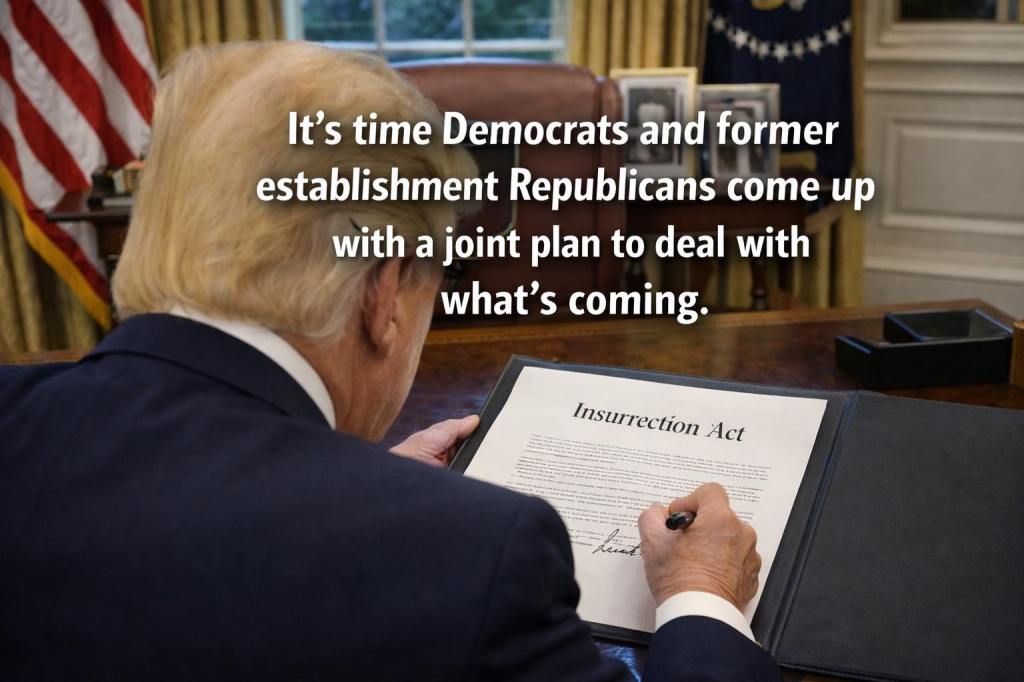
  • It’s time Democrats and former establishment Republicans come up with a joint plan to deal with what’s coming.

    It’s time Democrats and former establishment Republicans come up with a joint plan to deal with what’s coming.

    For a while, “Trump might invoke the Insurrection Act” lived in the same category as “he might nuke a hurricane” or “he might try to buy Greenland.”

    Absurd. Darkly funny. Filed under surely even he wouldn’t.

    And yet here we are. Again.

    He’s now openly flirting with the idea that we “shouldn’t even have elections,” casually name-checking the Insurrection Act like it’s a coupon he forgot to use last time. You know—normal democracy stuff. Totally chill. Nothing to see here. Please enjoy the gift shop on your way out.

    This isn’t a policy disagreement anymore.

    This is a stress test for the republic.

    The playbook is familiar: declare chaos, insist only you can fix it, suspend normal rules “temporarily,” and then act shocked when people notice the temporary part never seems to end. It’s the political equivalent of saying, “I’m just going to hold onto your wallet for safekeeping,” and then moving to another country.

    And before anyone says, “Relax, he’s just joking,” let me offer a general life rule:

    When someone keeps joking about canceling elections, eventually it stops being a joke. It becomes a rehearsal.

    What’s different this time—and what should scare the pants off everyone—is that he’s no longer just saying this stuff at rallies. He’s saying it with the infrastructure, the legal theories, and the personnel lined up behind him. This is less Drunk Uncle at Thanksgiving and more HR meeting with a PowerPoint.

    Which brings me to the uncomfortable but necessary point:

    This can’t be handled by Democrats alone.

    It requires Democrats and former establishment Republicans—the ones who still believe the Constitution is not a vibes-based document—to quietly, urgently, and jointly agree on a plan. Not a campaign. Not a press release. A plan.

    Document everything.

    Clarify lines of authority.

    Make the guardrails visible before someone tries to drive through them.

    Democracy doesn’t usually die with tanks in the streets. It dies with paperwork, legal justifications, and a lot of people saying, “Well, surely the courts will stop it,” right up until the moment they don’t.

    If that sounds alarmist, I get it. I’d prefer a lighter topic too. Maybe something fun. Like dental surgery. Or horse barn cleanup.

    But this is the moment where the adults—across parties—either act like adults…

    or we all get to learn, very quickly, what the Insurrection Act actually looks like in practice.

    Spoiler: it’s not a rom-com.

    So yes. Deep breaths.

    And then: eyes open, receipts saved, institutions defended.

    Because history has a cruel sense of humor—and it really hates when people say, “It can’t happen here.

    Democracies don’t collapse all at once—they erode while people wait for someone else to stop it. Our grandparents understood that. It’s our turn to prove we do too.
  • Regardless of what side you’re on, you want to understand why all of this is happening? Well, here’s why.

    Regardless of what side you’re on, you want to understand why all of this is happening? Well, here’s why.

    The United States stood at a crossroads. We had a choice.

    We could treat the Confederacy for what it was—a violent, anti-democratic insurrection—or we could pretend it was just a “heated disagreement between brothers” and, after the Civil War, go get a beer.

    We chose the beer.

    There were no mass trials.

    No hangings.

    No real cleaning of house.

    The generals went home.

    The politicians went back to Congress.

    The ideology didn’t die; it just took a sabbatical.

    Reconstruction was brief, half-hearted, and violently sabotaged. We did it for about fifteen minutes before getting bored and handing the keys back to the guys in the white hoods. The message was clear:

    You can wage war against the United States—and eventually, we’ll name a high school after you.

    That precedent matters.

    When you don’t punish a rebellion, you don’t end it.

    You franchise it.

    You teach the losers that force works.

    That intimidation works.

    That democracy is optional if you’re loud enough, violent enough, or just willing to wait out the news cycle.

    So the Confederacy didn’t disappear.

    It mutated.

    It became Jim Crow.

    Then “States’ Rights.”

    Then the “Silent Majority.”

    Then the Culture War.

    The branding changes, but the product is the same: hierarchy must be preserved, and the federal government is illegitimate unless it’s hurting the right people.

    Fast-forward to now.

    We have a movement that treats cruelty like a virtue and empathy like a character flaw. A party that views loyalty tests as standard operating procedure. Government agencies weaponized without subtlety. ICE raids staged for prime time.

    To the guys currently cheering this on: you probably think you’re the protagonist in this movie. You think you’re 1776.

    Check your costume.

    You’re wearing 1861 gray.

    You are aligning yourselves with the losers of history’s most obvious moral tests. You are marching in lockstep with the very people your grandfathers crossed an ocean to shoot at.

    The offramp is right here, and it’s simple.

    You don’t need to make a public apology.

    You don’t need to hug a hippie.

    You just need to look at the guys standing next to you—the ones itching for a civil war, the ones measuring drapes for the camps—and ask yourself if that’s really the team photo you want to be in.

    Walk away now, and you can claim you were just confused.

    Stay much longer, and you’re just an accomplice.

    Germany didn’t ban the Nazi party because they were being vindictive. They did it because they learned a lesson we refused to:

    Democracy cannot survive nostalgia for the people who tried to slit its throat.

    We keep acting surprised that authoritarian instincts keep resurfacing in America. But we never dug up the roots.

    We just built monuments on top of them and acted surprised when nothing healthy grew.

  • Russia gets Ukraine, China gets Taiwan, And the US gets Greenland…. Wait! What?

    Russia gets Ukraine, China gets Taiwan, And the US gets Greenland…. Wait! What?

    For about 80 years, the United States pulled off something historically insane.

    We’re under 5% of the world’s population, yet after WWII we helped design—and then manage—a global system that made us wealthy, secure, and absurdly influential. Not because we were saints. Because we were smart.

    We didn’t run the world like a cartoon villain twirling a mustache.

    We ran it like a country that finally learned the lesson every previous empire missed:

    Fear works fast.

    Consent works longer.

    So instead of ruling by intimidation, we built a system other countries could live with—even benefit from.

    Alliances instead of vassals.

    Rules instead of permanent brinkmanship.

    Open sea lanes so global trade didn’t require every cargo ship to bring its own navy.

    A dollar-centered financial system that quietly turned the U.S. into the tollbooth for global growth.

    Were we perfect? Obviously not. Vietnam. Iraq. CIA adventures best left out of the brochure.

    “We’re here to help” has preceded some deeply unhelpful moments.

    But the model worked because power was paired with legitimacy. Countries didn’t just tolerate American leadership—they chose it. That’s why the unipolar moment didn’t immediately collapse. The world didn’t instinctively band together to knock us down the way it usually does with dominant powers.

    That wasn’t accidental. The arrangements we built were often win-win. Other countries gained security, access, and stability, while we gained influence, markets, and leverage. Everyone could live with the math.

    Then Trump arrived and declared America had been run by idiots.

    He rejects win-win deals on principle. If someone else benefits, he assumes we’re being cheated. That’s why he keeps insisting the U.S. has been “ripped off” by everyone—from allies to trading partners—and why his solution is always the same: make sure someone else loses harder than we do.

    His complaint wasn’t that the U.S. enforced the rules.

    America always enforced the rules.

    His problem was how.

    Where previous presidents used enforcement backed by legitimacy, Trump decided legitimacy was overrated. Too slow. Too many meetings. Too many adults in the room.

    Why persuade when you can threaten?

    So the tone shifted.

    Tariffs as punishment.

    Cooperation replaced with compliance.

    Diplomacy reduced to: Do what we want or your exports get 25% more expensive in the US market.

    That’s a shakedown.

    And shakedowns have a cost.

    Countries governed by fear don’t align—they hedge. They rewrite trade relationships. They diversify supply chains. They quietly build exits.

    They start asking a very dangerous question:

    What if America is the risk now?

    That’s how trust turns into contingency planning.

    At the same time, we’re being sold a shiny new global vision:

    A world carved into spheres.

    Russia handles “its” region.

    China handles “its” region.

    America pulls back to its own region, throws its weight around selectively, and keeps everyone nervous with tariffs.

    Congratulations. We’ve rebooted the 1914 server that brought us WWI.

    A tripolar world isn’t stable. It’s anxious. Transactional. Every country doing math it never wanted to do:

    Who protects me now?

    Who do I appease?

    Who do I pay off?

    What happens when the big guys disagree and I’m standing in the middle?

    That’s a tinderbox.

    So who in their right mind would trade global dominance for this?

    At first glance, it looks like incompetence.

    But there’s another explanation that fits the facts much better.

    If your goal is preserving American power, this strategy is insane.

    If your goal is personal enrichment, it makes perfect sense.

    A stable, rules-based world limits leverage.

    A fearful, fragmented world is ripe for shakedowns.

    A presidency spent at Trump-branded properties, charging governments and lobbyists for access.

    Foreign policy that mysteriously flatters regimes doing business with the Trump orbit.

    A son-in-law leaving government service and immediately receiving $2 billion from a Saudi sovereign wealth fund—over his own advisers’ objections.

    Policy “evolutions,” tariff exemptions, and sudden reversals that just happen to benefit friends and punish critics.

    No conspiracy theory required.

    It’s public. Documented. Often defended as normal.

    But taken together, the pattern is hard to miss.

    Trump isn’t dismantling the postwar order because he misunderstands it.

    He’s dismantling it because it doesn’t serve him.

    We didn’t build the American-led world out of charity.

    We built it because it made us rich, safe, and powerful beyond historical precedent.

    Tearing it down for personal gain isn’t populism.

    It’s looting Uncle Sam.

  • That Was An Impressive Military Operation

    That Was An Impressive Military Operation

    Let’s admit something up front. There’s a visceral thrill when the U.S. military pulls off something genuinely hard. Precision. Surprise. Professionals being professional. The capture of Nicolás Maduro had serious action-movie competence. You can respect the execution without apology.

    I do. I’m human.

    I also tend to like things Russia hates. Same with China. Just the kinda guy I am, I guess. And they hate this. Which brings us to the cognative dissonance many of us feel but don’t know quite how to articulate.

    Because impressive isn’t the same thing as smart.

    And capability isn’t the same thing as judgment.

    Trump, naturally, was thrilled. Not just about the operation — about the idea of it. Talk drifted quickly from “mission accomplished” to “maybe we’ll just run Venezuela for a while.” Oil. Management. Fixing things. As if this were a distressed private equity deal and not a sovereign nation.

    Think about that for one second.

    This is the same guy who couldn’t run a casino, struggles to run the country he’s president of, and still hasn’t delivered on the things he actually campaigned on. Grocery prices? Healthcare? But sure — let’s add a collapsed petro-state to the to-do list. What’s one more tab left open?

    And let’s not pretend the timing is random. This is also a spectacular way to change the subject from the Epstein files. Trump himself once warned that desperate presidents start foreign conflicts to distract from bad news. He was right then. He just didn’t realize he was writing his own future Yelp review.

    Yes, Maduro was indicted years ago on drug charges. That part’s real. But when Trump starts openly talking about oil, the “this is about drugs” explanation starts to feel like set dressing. If this were really about narcotics, the press rollout would look very different.

    Here’s a quick thought experiment.

    If a foreign power snatched Trump out of the White House tomorrow and announced they’d “run the country for a bit,” would J.D. Vance nod gravely and say, “Well, fair is fair”? Of course not. He’d be on TV before the rotors stopped spinning, explaining why this was the end of civilization.

    Which brings us to the part that actually matters.

    This sets a precedent.

    Not a legal one. A behavioral one.

    And yes, people will notice. Especially Ukraine. When the most powerful country on Earth demonstrates that regime change is acceptable if you feel justified enough, you don’t get to act surprised when others adopt the same logic.

    So yes — the raid was slick. I won’t deny it. Who doesn’t enjoy watching the good guys win?

    The only problem is the quiet question underneath it all:

    Are we still sure we’re the good guys?

    Because adrenaline isn’t morality. Skill isn’t legitimacy. And flexing power without consistency isn’t leadership.

    It’s just bad precedent.

  • Why It’s So Hard To Change Someone’s Mind

    Why It’s So Hard To Change Someone’s Mind

    I used to believe facts were currency.

    If I put enough solid data on the table, I assumed the other person would eventually look at the pile, nod, and cash out their wrong opinion.

    This belief lasted longer than it should have. About as long as I believed eating cereal for dinner was a phase, not a lifestyle choice I would later defend vigorously.

    Here’s the uncomfortable reality:

    Facts don’t compete with other facts.

    They compete with identity.

    Most arguments fail not because the evidence is weak, but because the argument is aimed at the wrong target. We assume people are trying to be correct. Usually, they’re just trying to belong.

    Beliefs aren’t opinions.

    They’re uniforms.

    When you challenge someone’s belief, you’re not disputing a fact. You’re challenging their tribe, their past decisions, and the role they’ve been playing for years.

    That’s not a debate.

    That’s a threat assessment.

    This is why evidence loses to belonging.

    Once something becomes tribal, truth becomes secondary. Agreeing with the “wrong” fact isn’t growth — it’s defection. And people don’t defect casually, especially not in public, and especially not online.

    At that point, the argument is no longer about truth.

    It’s a loyalty test.

    This also explains why correcting people rarely works.

    Correction doesn’t feel helpful. It feels like exposure. The brain doesn’t hear new information — it hears you’re in danger. Curiosity shuts down. Defenses go up.

    The cleaner the correction, the harder people cling to the position. From the outside, this looks like stupidity. It usually isn’t.

    It’s self-preservation.

    Changing your mind is expensive.

    It costs pride.

    It costs status.

    Sometimes it costs relationships.

    Admitting you were wrong doesn’t update a belief. It rewrites a story. It forces you to revisit things you said, shared, defended — and sit with the possibility that you were wrong.

    Most people would rather be wrong than embarrassed.

    So bad arguments survive. Not because they’re persuasive, but because they’re safe. They keep you in good standing. They let you avoid that quiet, unwelcome realization — usually late at night — that you might have been played.

    I’m not exempt. I’ve held losing positions far longer than I should have because exiting felt like admitting defeat. Doubling down feels like strength, even when it’s just damage with confidence.

    Facts still matter.

    Just not on the timeline we want, and not in environments where being wrong carries a social cost. Facts work when accepting them costs less than ignoring them.

    Most public arguments fail for a simple reason.

    They think they’re debating information.

    They’re negotiating identity.

    And until we’re honest about that, we’ll keep wondering why the facts were solid…

    and the argument went nowhere.

  • Why a Photo from 2004 Looks Like It Was Taken Last Tuesday

    Why a Photo from 2004 Looks Like It Was Taken Last Tuesday

    You can look at a photo from the 50s, 60s, 70s, or 80s and instantly know the decade.

    Not the year.
    The decade.

    It’s in the lapels. The hair volume. The posture. Even the font on a street sign in the background feels time-stamped. Blur the faces and you’d still know where you were in the timeline.

    Now try that with a photo from 2003. Or 2012. Or last Tuesday.

    Remove the cell phone model from the frame and you’re guessing. A photo from 2004 could be from 2024. Step back far enough and the last twenty-five years collapse into a single, flat visual moment, like a hotel hallway designed to offend no one and be remembered by no one.

    Yes, digital photos don’t yellow. Everything looks permanently “now.”
    But the stagnation isn’t technological. It’s cultural.

    The monoculture is dead.

    For most of the 20th century, there was a current. You either swam with it or against it, but everyone was responding to the same force. In the 70s, you wore the polyester or you rejected it. Even rebellion was legible—because you knew exactly what it was rebelling against.

    Now? Every style that has ever existed is available simultaneously, usually for about fifteen dollars and free shipping. Nothing ever leaves. Nothing has to mean anything. We aren’t inventing new aesthetics—we’re just curating better playlists of the past.

    There is one exception, of course.

    Historians won’t struggle to date photos of people in MAGA hats and merch. Those will be instantly identifiable as 2015–2025—preserved in high resolution, forensically searchable, and destined to cause a very specific kind of generational embarrassment.

    Our cities followed suit. Neutral palettes. Exposed brick. The same sans-serif fonts everywhere. Drop a café from Brooklyn into Berlin or Barcelona and no one would blink. We built a global architecture of anywhere—comfortable, inoffensive, and, like Taylor Swift, impossible to date.

    So if fashion, architecture, and culture no longer mark time, what does?

    Politics.

    It’s the last remaining monoculture—the one thing we all still see, whether we want to or not. When culture fragments into a thousand niches, collective attention has to go somewhere. It went to the fight.

    The past had eras defined by how we looked.

    We have a long, endless present defined by what we scream at each other.

    And if future historians want to date our photos, they won’t look at the hemline or the haircut.

    They’ll look at the panic in our eyes.

  • “I’m Not Racist. I Just Tolerate Racism for the Other Stuff.”

    “I’m Not Racist. I Just Tolerate Racism for the Other Stuff.”

    I’ll spell out the defense I keep hearing—then I’ll set it on fire.

    You say:
    “I don’t think of myself as racist. I even agree Trump says racist things. But I vote for him anyway because his other policies are better for America. The alternative—Democrats in power—would be far worse. I don’t like the racism, but I’m willing to hold my nose.”

    Okay. Let’s sit with that.

    What you’re really saying is that racism is a trade‑off you’re willing to accept. That it’s a cost of doing business. That the people harmed by it are… acceptable collateral damage.

    You’re not denying the fire.
    You’re just arguing the house was worth burning.

    Here’s the problem: racism isn’t a side dish. It’s not an unfortunate personality quirk you can fence off while enjoying the “serious” policy agenda.

    It is the agenda.

    Immigration policy that sorts humans by skin tone?
    Foreign policy that divides the world into “nice countries” and “shitholes”?
    Law enforcement policies that assume threat by melanin?
    Voting rules that just happen to disenfranchise the same groups every time?

    That’s not a glitch. That’s the operating system.

    And once you accept that some Americans matter less than others—once you normalize cruelty toward a group because it’s politically convenient—you’ve already crossed the moral line you claim to stand behind.

    You don’t get to say “I oppose racism” while empowering it.
    You don’t get to say “I’m not racist” while voting for racial hierarchy because you like the tax policy.
    You don’t get to outsource your conscience and then act surprised when the results come back ugly.

    This isn’t about personal purity. It’s about basic moral math.

    If your preferred policies require dehumanizing people to function, then the policies are rotten.
    If your vision of America only works when certain people are kept out, kept down, or kept afraid—then the vision is the problem.

    History doesn’t grade on intent.
    It grades on impact.

    And the impact of “I don’t love the racism, but…” has always been the same.

    So no—maybe you don’t feel racist.
    But you’ve decided racism isn’t a dealbreaker.

    And that distinction doesn’t mean nearly as much as you think it does. For all intents and purposes, it makes you a racist.

  • I Was Offline for a Week. Now Hitler’s Back.

    I Was Offline for a Week. Now Hitler’s Back.

    I’m late to this. I’ve been offline, living like it’s 2003. No news alerts, no rage-scrolling, no exposure to a single influencer or pundit. It was glorious. But then I plugged back in and saw it: Young Republican leaders caught in group chats saying “I love Hitler,” joking about gas chambers and rape, sneering about “watermelon people,” and casually tossing around words like “faggot” and “retarded”—like they were just swapping fantasy football picks.

    A decade ago, even whispering something like “I love Hitler” would have ended your political career, your public life, your dating prospects, your gym membership—hell, even your WiFi password might’ve stopped working out of pure moral inertia. Now? You get a wink, a shrug, and maybe a spot on someone’s podcast.

    This isn’t just about antisemitism, although it is deeply, virulently that. It’s deeper. It’s a willful rejection of decency itself. Like they’ve looked straight at the moral floor and said: “Nah. Let’s keep digging.”

    And look—racism isn’t exactly a new bug in the human operating system. It’s baked into our wiring. Infants as young as six months show preference for faces of their own race. One study even found that children tend to trust people who sound and look like them. Tribal bias is an evolutionary leftover—like the appendix, or Twitter.

    But the whole point of civilization is to override our worst instincts. We educate. We empathize. We evolve. We try to beat that tribal lizard-brain back into its cage, one generation at a time. Or, in the more cynical version of human progress, we just wait until all the bloodlines blend into one and racism becomes logistically impossible.

    MAGA seems uninterested in either path.

    I have MAGA friends—smart ones—who are slowly, quietly backing away from Trump. They don’t say it aloud, but I can see it. They’re starting to wince at the Proud Boys merch and the screaming matches at school board meetings. But they still can’t quite let go. They’ve convinced themselves MAGA is the “lesser of two evils,” that the left is so deranged that they must cling to the burning ship out of duty.

    But here’s the uncomfortable truth: while one of those “evils” is arguing over pronouns, the other one is now literally flirting with Nazi ideology. Not metaphorically. Not “like Nazis.” Actual Nazi language. Actual Nazi aesthetics. One staffer literally put a swastika-shaped American flag on his Capitol Hill office wall, like it was an ironic dorm poster.

    The GOP took a hard right, blew past Reagan, sideswiped Goldwater, and now fishtails somewhere between Franco and full-blown fascism, headlights off, tiki torch on.

    And still, my MAGA friends won’t change the channel. Even when they know they’re being lied to. Even when they feel the disgust in their gut. Tribalism is a hell of a drug. It overrides reason. It punishes doubt. It turns moral nausea into partisan loyalty.

    That’s how people who never would’ve said the word “Hitler” outside a history class end up defending it as a “joke.” That’s how the descent happens—not in a single leap, but in a thousand rationalizations, one meme, one tweet, one group chat at a time.

    This isn’t just a MAGA problem. It’s a human problem. We are all wired to pick sides and defend them, even when the facts rot out from underneath us. The only antidote is constant moral clarity—across the board, not just when it’s convenient. When you see people celebrating cruelty, racism, and violence, you don’t stay quiet. You don’t look for whataboutisms. You say: No. That’s not who we’re supposed to be.

    Because once the tribal drums drown out your conscience, you’ll look up and realize you’ve been goose-stepping for a while—and didn’t even notice the rhythm change.

  • Stop Calling It a Democracy! (Wait… Why?)

    Stop Calling It a Democracy! (Wait… Why?)

    You may have noticed a curious trend lately. Some of our friends on the right no longer refer to the United States as a democracy. That word, they insist with increasing vigor, is leftist propaganda. No, no—we’re not a democracy, they say. We’re a Constitutional Republic! As if they’ve just uncovered a glitch in the Matrix that invalidates everything from Schoolhouse Rock to centuries of American political thought.

    So what’s going on here?

    Well, I did some digging. And the main reason this talking point is echoing through the right-wing influencer ecosystem is that they believe calling the U.S. a “democracy” is part of a sinister leftist plot to abolish the Electoral College. You heard that right. The logic goes: if we keep calling this place a democracy, people might start thinking majority rule should actually mean majority rule—gasp—even in presidential elections.

    This line of reasoning usually shows up in social media debates where someone on the left refers to American democracy being in peril, and someone on the right jumps in with a “correction”: “We’re not a democracy. We’re a constitutional republic.”

    Now, I don’t want to be unkind, but if you’re one of the folks who thinks this is some sort of mic drop, I gently suggest you request a refund from your high school civics teacher. Because you’re not wrong—you’re just… not quite right enough to be taken seriously.

    Let’s break it down:

    America is, in fact, a democracy—that’s the genus. The species is constitutional republic. Think of it like this: If you have a dog at home, that’s the overall category. Golden retriever is the type of dog you have. Saying “the U.S. isn’t a democracy; it’s a constitutional republic” is like saying “that’s not a dog—it’s a golden retriever.” Technically true, but also deeply unserious.

    There are different flavors of democracy around the world. Some countries are parliamentary democracies (like the U.K. or Canada), others are social democracies (like Sweden or Norway), and some are semi-presidential republics (like France). We, for better or worse, are a constitutional republic with representative democracy baked into the cake.

    That means:
    We elect people to make decisions for us (representative democracy),
    Those decisions are limited by a founding document (constitutional),

    And, despite what your uncle insists, the will of the people is supposed to matter.

    That doesn’t mean pure majority rule. Nobody’s suggesting we run the country by Twitter poll (though let’s be honest, that might still yield better outcomes than certain state legislatures). But it does mean that the people—yes, all the people—are meant to be the ultimate source of authority. That’s the beating heart of any democracy, constitutional or otherwise.

    The right’s sudden allergy to the word “democracy” isn’t really about semantics. It’s about power. More specifically, it’s about preserving minority rule through institutions like the Electoral College and the Senate—where a few hundred thousand voters in Wyoming get more say than millions in California. And let’s not even talk about gerrymandering. (No, really, let’s not. My blood pressure.)

    So the next time someone tells you that “we’re not a democracy,” feel free to smile politely and respond: “That’s not a dog—it’s a golden retriever.” Then, if you’re feeling generous, you can remind them that the Founders literally used the word “democracy” in their writings—Jefferson, Madison, Franklin—all of them. They warned about its dangers, yes, but they were also building toward it, not away from it.

    This wordplay trend might seem harmless, but words matter. Pretending we’re not a democracy opens the door to justifying all kinds of anti-democratic behavior. If the people don’t really matter, then voter suppression, gerrymandering, and minority rule start to look like features, not bugs.

    And when a former president is back in office promising to be “your retribution,” that’s not the time to start downgrading the concept of democracy. That’s the time to defend it like it’s the last golden retriever on Earth.

  • When the MAGAverse Starts Salivating Over Violence, You Should Pay Attention

    When the MAGAverse Starts Salivating Over Violence, You Should Pay Attention

    The assassination of Charlie Kirk should have been a moment of unified horror. A line no one crosses. A point where even the most jaded among us stop the memes, take a breath, and agree that political violence is off-limits.

    Instead?

    MAGA took a torch to that line.

    They didn’t mourn. They mobilized.

    Overnight, Kirk’s death became a rallying cry—not just for justice, but for vengeance. Not just against the shooter, but against everyone not wearing a red hat. The same people who once screamed “false flag” at every mass shooting suddenly found deep clarity: This was the left’s fault. This was Biden’s America. This was war.

    You could feel it pulsing through Telegram threads and X posts like a glitch in the Matrix: This wasn’t grief. This was glee. A strategic opportunity. The narrative hardened within hours—before the body was even cold: “The left did this. The media did this. The FBI did this. Now it’s time to respond.”

    And that’s when I started to feel really uneasy.

    Because underneath the performative rage and red-faced shouting, you can detect something quieter—and far more dangerous: calculation.

    There are elements on the far right who want unrest.

    Not just because it makes for good fundraising, or because it fires up the base.

    But because chaos can be useful.

    If society feels like it’s spinning out, you can justify extraordinary responses. Crackdowns. Curfews. Maybe even martial law.

    Sound far-fetched? It’s not. Trump already floated the idea of postponing the 2020 election. His allies pushed martial law as a real option after he lost. There’s precedent—not legal precedent, but emotional precedent—for crossing these lines when the moment feels just unstable enough.

    And now?

    We’re teetering.

    The institutions meant to hold the line are wobbling. Public trust is cratering. FBI resources for investigating domestic terrorism were gutted not long ago—dismissed as political overreach by the very people who now act shocked that political violence is escalating.

    They didn’t want the threat exposed. Because some of them saw political gain in pretending it didn’t exist.

    But here we are.

    Kirk is dead. Other politicians have been assassinated. People online are openly calling for civil war like it’s just a slightly spicier sequel to January 6.

    And the temperature keeps rising.

    The truth is, when elections feel rigged, when facts feel fluid, and when citizens feel voiceless, violence starts to look like a microphone.

    That’s not a left-wing or right-wing problem. That’s a human problem. And it’s one we’ve seen before—in history books, in failed democracies, in collapsing regimes where conspiracy becomes currency and strongmen promise “order” in exchange for obedience.

    You think that couldn’t happen here?

    It’s already trying to.

    And when MAGA influencers start spinning assassinations into political momentum—not in spite of the violence, but because of it—it’s not just disgusting. It’s terrifying.

    This is the moment where we need to get our damn heads on straight.

    Because if we keep feeding this beast, it won’t stop at speeches or Senate hearings. It will demand more blood. More enemies. More obedience.

    And once the fire gets hot enough, it doesn’t care who it burns.