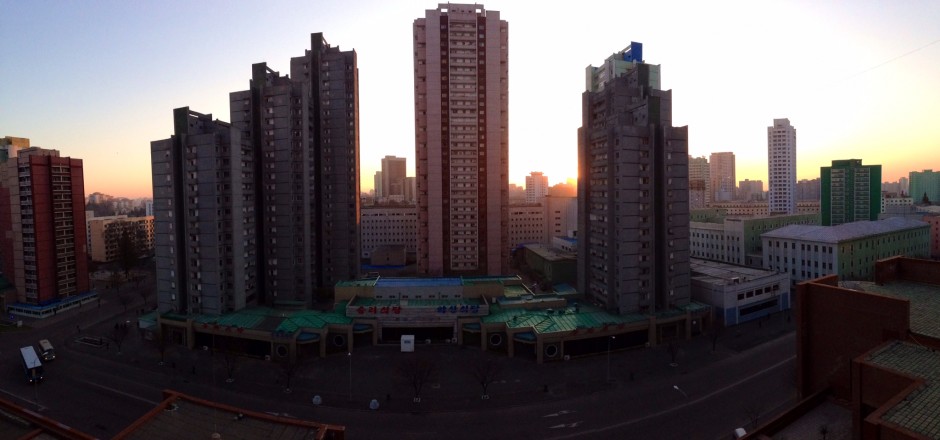
The image above is of Pyongyang at dawn as seen from my hotel window.
This is the third in a series of posts on my recent trip to North Korea. This is part 1 and this is part 2.
…………………
The Tupolev jetliner on which we arrived from Beijing pulled up near the only terminal at Pyongyang’s Sunan International Airport. There was construction underway next door at the skeleton of the new terminal that’s being built and as we deplaned down the stairs, every worker stopped in his tracks and observed us in fascination. Working at this particular site must be one of the most interesting construction jobs in town. Seeing foreigners every day, observing how they dress, what they carry with them, how they interact with each other… that’s quite unusual for North Koreans of all classes.
In mid November it’s cold in Korea and I was anxious to get inside the terminal but the expected blast of warm air didn’t hit us as we approached the doors, which were being held open by the steady stream of passengers who had deplaned in front of us. The terminal wasn’t heated. Most public buildings aren’t heated including museums and even theaters – although we were told the heating in the theater, where we saw the circus (that’s another story) was on the fritz but usually working.
Passport controlThe main room of the airport terminal is long and rectangular, about the size and shape of a football field. It is open from one end to the other but divided into zones or spaces. The quarter we walked into was where the lines formed to get through passport control. That’s where they take the visa they previously issue you that shows you’re authorized to be in the country. I’d had my visa for a while as our trip was planned five months in advance. Once they take it from you at the airport, you never see it again. Later, when you meet your minders, you’re relieved of your passport and you don’t see that again until you’re about to depart the country. That was one of the strangest feelings in my life and when my passport was taken I felt naked. But the feeling passed and everything was fine.
Passport control is all business. They don’t stamp your passport; not even if you ask nicely. Taking pictures in the airport is strictly prohibited and they don’t bother to ask nicely. The pictures I’m showing you of the airport are nabbed off the Internet where apparently someone was able to get away with it. North Korea’s attitude toward visitors is similar to how you might think of guests in your home. You are expected to behave nicely, be gracious, compliment the host often, and if you came to gawk or criticize you’ll wear out your welcome quickly and if you go even further and repeatedly disobey key rules (like preaching Christianity), you’ll be asked to leave – or worse, to stay longer then you intended; perhaps much longer and perhaps you’ll be given a new career as a miner, a logger, or as a rock breaker. Kenneth Bae, the Korean-American missionary who is currently being held in North Korea was recently sent back to a hard labor camp.
While that thought was always in the back of my mind, I never once felt unwelcome or in any kind of danger. The recipe for a great and enlightening trip to North Korea is pretty simple. Just follow the rules, which are not unreasonable in exchange for a glimpse into their world for a few days. The rules are of course quite unreasonable if you have to live there. But that’s what I went to see and if things you and I consider crazy weren’t going on there, I wouldn’t have had the curiosity to go. When I’ve recounted a story or two about some of the constraints we were under, a few friends have said to me, “Well, I would have said this, or I would have just reacted like that….” and yes, it constantly crossed my mind to push the boundaries, but philosophical contention would have just shut down our minders, made them feel defensive and less likely to be open with us. After all, since we did not speak Korean and we could not go anywhere outside the hotel without our minders, we were dependent upon them for much of our experience there. No doubt it was limited, but it would have been counter-productive to limit it even more by being a contrarian. My advice? Just roll with it. You’ll have a more enriching experience and doing otherwise isn’t going to change anything except potentially your departure date.
Reverse security at Pyongyang airport. You actually go through x-ray to get out of the airport.To get into North Korea at the airport you actually go through backward airport security. We went through a metal detector and had our luggage x-rayed in order to leave the airport and we were required to hand-over our electronic devices to be inventoried. I gave them my MacBook Pro, my iPad, and two iPhones. I lost sight of each one for only a very brief moment while I was otherwise being asked about my possessions but they were immediately returned to me. I had them all powered off. I’m not an expert in spy-craft but I don’t think there was enough time, the right people, or the right equipment there to have done anything to them or altered them in any way. I didn’t lack paranoia but I really didn’t see anything that concerned me.
The North Korean officials aren’t disturbed anymore with foreigners bringing in their consumer electronics. I’m sure they don’t hesitate to spy on you and hack into your devices if they deem you to be a person of interest. We three music business friends didn’t make that grade. And North Korea is not concerned about how you might communicate with the outside world, because you basically can’t. Your devices are pretty useless to you inside the country. They can’t connect to the local cell network so their only worthwhile feature is really just the camera. North Korea used to require westerners to “check their devices” at the airport and pick them up on the way out but they have relaxed that policy in the past year or so.
On the other side of reverse airport security we were met by our two minder-guides. A 29 year old guy named Pyong and a 24 your old woman named Pang. Pang and my travel companion, Charlie Kennedy, who was on his eighth trip to North Korea, go way back and said warm hellos. Pyong was unfamiliar but warm nonetheless.
Charlie is a bit of a local celebrity in the Democratic People’s Republic of Korea and it was due to him that I was able to go on this trip. He owns a record company in London to which are signed some artists you’ve heard of. On the side, he’s an aviation enthusiast and years ago he began going to places in the world where the commercial airliners fly planes that are perfectly safe, but that are old and no longer in service in other parts of the globe. For example, he and his aviation buddies go to Iran to fly on Boing 707’s since the only Boing 707 in operation outside Iran belongs to John Travolta. On one of their trips, they had the idea of figuring out how to go to North Korea to fly on soviet-built planes that are no longer in service in Russia and thus began Charlie’s North Korea exploits. In order to organize these trips, Charlie teamed up with London-based Juche Travel Services, who were already operating regular tourist travel from London into the hermit kingdom.
Left to right, Pyong, Charlie Kennedy, Pang, Michael Bramwell, MeWhen you’re a westerner who shows up to take internal flights throughout North Korea, your profile rises among the officials who are concerned with such things. So, when Charlie asked if he could come back the next time with two friends who were not especially into aviation, and get a “Greatest Hits” tour of North Korea, they we happy to accommodate and as a consequence, we were teed up for a very special tour with perhaps a bit more access than most. So, as we walked from the front doors of the airport to the waiting minivan, Charlie was stopped multiple times by local officials and other minder/guides who were there to pick up other guests. He was all but asked to sign autographs. I knew right then that this was going to be an amazing experience.
Being a minder in North Korea is a top job and requires excellence in studies at Kim Il-Sung University, their version of Harvard. Even so, neither of our minders had ever met a foreigner before receiving their first assignments as guides, several years ago. Neither had ever traveled outside North Korea. It follows that they had never been in another time zone. They understood jet lag conceptually but had never experienced it. Their English was completely fluent. Not perfect. Not what you would expect from someone who had completely immersed themselves in a language and a culture for years, but impressive for having learned it entirely inside North Korea and through their interactions with foreigners. Communication with them was easy and misunderstandings, when they occurred, were quickly cleared up.
An example of propaganda seen throughout the country, meant to raise morale and inspire the people.A few days later, after confidences had been won and camaraderie had set in, I asked Pyong and Pang if their government is concerned about how much exposure the minders have to foreigners. We were told that they indeed are concerned and that after a few tours they are required to go to de-briefing classes where they share their experiences with other minders and talk about keeping the faith in the North Korean system of Juche (total self-reliance). I wondered about the social prestige of being a minder. Was it considered a prestigious job? Enviable? They told us that while it’s considered a good job and one needs to have performed their studies with excellence and be hand-picked for the post, most North Koreans were unaware the job even existed. I threw out the hypothetical scenario of Pang’s mom telling a friend what Pang’s job is. She said most people would look back in bewilderment and say something like, “What? So her job is to accompany foreigners in the country and speak English all day and attend to them? Why is that a job? That job exists?” To put it in context, you have to realize how long a North Korean can go without ever seeing a foreigner. Outside Pyongyang, foreigners are rarely seen at all and are never seen off the beaten path.
The airport is about 40 minutes north of the city so on the ride in to Pyongyang, we were told the rules about taking pictures. We would be allowed to take as many as we wanted except in places where we were told beforehand that no photos would be allowed. Frankly, that didn’t happen often, mostly due to not being taken to very many places that would be embarrassing to North Korea. Occasionally, we were told not to take pictures in places where the reason behind the ban was puzzling, like the museum to the city’s subway system. Pyong and Pang were frank about the reasons photos and our movements were restricted. They told us there had simply been too many foreigners in the country with an agenda to make North Korea look bad. They said that every city in the world has ugly parts and every country deals with poverty and they aren’t different. But they do get upset they have to ask their invited guests not to go home and talk smack about their country. To them it’s a bit perplexing and they believe it arises due to the misinformation we’re all given about North Korea and to the basic animosity the world unjustifiably feels toward them. They believe their bad reputation is purposefully caused by the US.


 Mike McCready


