Tag: economy

  • Spain’s Quiet Flex

    Spain’s Quiet Flex

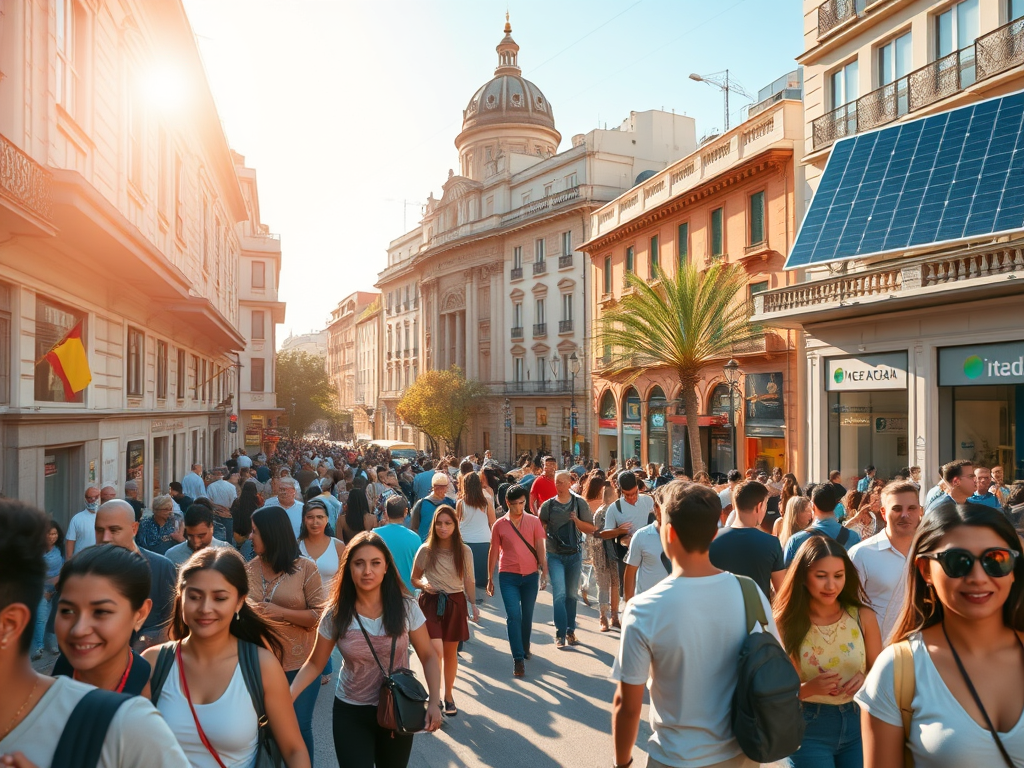
    Spain isn’t just “doing okay” while the rest of Europe nurses a hangover — it’s Europe’s outlier in a good way. Since early 2024, Spain has been growing at roughly three percent a year while the eurozone plods along near one. Credit markets noticed: S&P bumped the sovereign in mid-September, and within days Moody’s and Fitch followed suit. When all three ratings agencies are suddenly in a good mood about you, it’s usually because the story is real, not vibes. 

    The growth mix isn’t mysterious:

    • People: Spain opened the door while others slammed it. Net immigration has averaged around six hundred thousand a year since 2022, mostly working-age and heavily Latin American — which makes integration faster (language, culture, networks). That’s not a talking point; that’s the math. It’s also a big reason employment has hit records and consumer demand is sturdy.  
    • Power: Cheap, abundant renewables have turned Spain from a sunny tourist postcard into an energy-cost arbitrage play for industry and data-heavy services. In 2024, renewables supplied a record ~56% of electricity, and year-to-date 2025 has pushed higher. That lowers input costs and draws capital. (The grid, yes, needs beefing up after the April outage — and investments are now flowing.)  
    • Policy follow-through: NGEU funds have been deployed into real stuff (infrastructure, modernization), and earlier labor reforms tightened up job stability. Brussels’ baseline: Spain can still clock around 2.6% growth in 2025 — in Europe, that’s sprinting.  

    Now for the adult supervision: per-capita gains lag headline GDP, productivity is still yawning, and unemployment — although falling to around 10% — remains among the eurozone’s highest. The fix isn’t a new slogan; it’s a pipeline: streamline rules, crowd in long-term risk capital, and upskill into higher-value services (IT, finance, engineering). That’s where you turn an immigration-led demand pop into durable per-capita prosperity. 

    How Madrid plays its power in Europe

    Spain’s “soft power” used to be sunshine and tapas. Today it’s growth, grid, and people — a combination that gives Madrid surprising clout in EU tables where sluggish peers need a positive outlier. The message Spain quietly sends in Brussels: we can cut emissions, grow faster than you, and do it without slamming the door on newcomers. That lets Spain lean into:

    • Energy bargaining: With wind/solar scaling and interconnectors improving, Spain can punch above its weight in talks about EU power markets, grids, and decarbonization timelines. The subtext is “we’ve shown this can work — now fund the pipes.”  
    • Fiscal credibility: Upgrades from S&P/Moody’s/Fitch improve borrowing optics just as Europe re-tightens fiscal rules. That buys room to keep investing while others cut.  
    • Migration realism: While some capitals grandstand at the border, Spain’s labor-market-first posture is adding capacity exactly where Europe is short. That makes Madrid the practical voice when migration inevitably returns to the EU agenda.  

    What could blow this up? Politics and housing. Sánchez governs with dental floss; big reforms are a knife fight. And if rents keep outrunning wages and public services stay tight, tolerance for high inflows could fray — fast. The economic story is strong; the social license needs maintenance. 

    The scoreboard (for the macro geeks)

    • 2025 growth: Bank of Spain and the European Commission are in the ~2.6% camp; the government’s latest revision is a hair higher after a better-than-expected Q2. Either way, Spain is still outrunning the bloc.  
    • Labor: Unemployment near 10.3%, lowest since 2008 but still elevated versus EU peers. Youth unemployment remains sticky.  
    • Energy: 56% renewables in 2024, roughly ~59% so far in 2025 — with grid investment pledged after the spring blackout.  

    Catalonia: where things actually stand

    Madrid bet on de-escalation and legal normalization. The Amnesty Law for the 2017 independence cases passed and, crucially, Spain’s Constitutional Court upheld it on June 26, 2025. Application is case-by-case: many have already benefited, while high-profile figures like Puigdemont are still working through the process. Politics, not prisons, now dominates. 

    On public sentiment, support for independence has eased off its highs, bobbing around ~38–40% in 2025 surveys, with the Socialists (PSC) leading regionally and pro-independence parties recalibrating. Translation: the temperature is lower, the question isn’t “UDI tomorrow” but “what’s the next workable status that keeps growth and dignity intact?” 

    Bottom line: Spain’s edge right now is a rare mix — demographic momentum, green electrons, and steady EU cash channeled into the real economy. If the ruling class can keep the coalition intact, scale skills faster than rents, and turn grid upgrades into a 2030 powerhouse, Spain’s “quiet flex” becomes structural. If not, it risks being remembered as a great run of form that never quite converted to per-capita lift. I’m betting the former — but only if they keep treating immigration as an asset and productivity as the main event. 

  • Gen X: We Were Supposed to Be Too Sharp for This Sh*t

    Gen X: We Were Supposed to Be Too Sharp for This Sh*t

    There’s a very specific kind of shame in watching a country fall apart and realizing your generation was supposed to stop it.

    We were the skeptical kids. The “don’t fall for it” crowd. We grew up with irony, sarcasm, and a healthy distrust of institutions. We made fun of cults. We rolled our eyes at televangelists. We knew better.

    At least, we thought we did.

    We were the last analog generation—and the first digital one. We knew how to rewind a cassette and reboot a modem. We brought the internet into being, and with it, the promise of better information, smarter systems, and a more connected world.

    We gave the world Google, Amazon, YouTube.

    We gave it Nirvana, Nine Inch Nails, the Wu-Tang Clan.

    We built the platforms. Designed the interfaces.

    We were supposed to be the bridge between what was and what could be.

    But now?

    We’re watching the whole thing buckle—and pretending we’re just observers.

    We post memes about how great it was to grow up drinking from hoses, while an entire generation can’t afford rent, let alone a mortgage.

    We forward videos about “the good old days” while Gen Z drowns in debt, climate fear, and medical bills for anxiety disorders they inherited from watching us lose the plot.

    And who’s in charge now?

    Trump. Again.

    President 2.0.

    This time with fewer guardrails, more power, and even less shame.

    And standing right behind him, RFK Jr.—now Secretary of Health—gutting the CDC, firing career scientists, and rebuilding America’s public health policy around gut feelings and internet comment sections.

    We used to point at the USSR and say, “Those poor people don’t get real news—just government propaganda.”

    Now we’ve got half the country cheering for our own state-run media, rage-bait headlines, and “alternative facts,” while willingly ignoring everything they know is true.

    We’re not living in 1984. We’re living in something dumber.

    A self-inflicted propaganda state where people know it’s bullshit—and eat it up anyway.

    And Gen X?

    We were supposed to be immune to this.

    Too jaded. Too sharp. Too allergic to fascism.

    We were supposed to be the firewall.

    But we ghosted.

    No Gen X president because the boomers.

    No major Gen X political movement.

    No defining generational stand.

    We just kept scrolling.

    Kept reposting.

    Kept telling ourselves we were “above it.”

    But the truth is—we’re blowing it.

    We were there when the rot was setting in.

    And we didn’t stop it.

    We let the dumbest grifter of our lifetime sell America a cheap hat and a fake war on reality.

    We watched as housing became a luxury, healthcare became a subscription plan, and truth became a punchline.

    We let RFK Jr. cosplay as a truth-teller while he dismantled actual science.

    And now, with AI about to automate our jobs, scrape our souls, and deepfake us into oblivion, we’re busy sharing memes about the 80s while billionaires plug themselves into immortality servers.

    We were supposed to be the generation that didn’t fall for bs.

    Instead, we’re managing the collapse like theme park actors refusing to break character while the rollercoaster catches fire.

    And yeah, I’m a bit crispy about all of this.

    Not just at Trump. Not just at RFK Jr.

    But at us.

    We were supposed to be too sharp for this sh*t.

    We were supposed to know better.

    We were supposed to do better.

    And if we don’t wake up—right now—history won’t even remember our failure.

    It’ll be too busy documenting the fallout.

    So come on Gen X. It’s time!

  • Trump Fired the Jobs Report Lady. Because the Jobs Report Was Bad.

    Trump Fired the Jobs Report Lady. Because the Jobs Report Was Bad.

    Well, that didn’t take long.

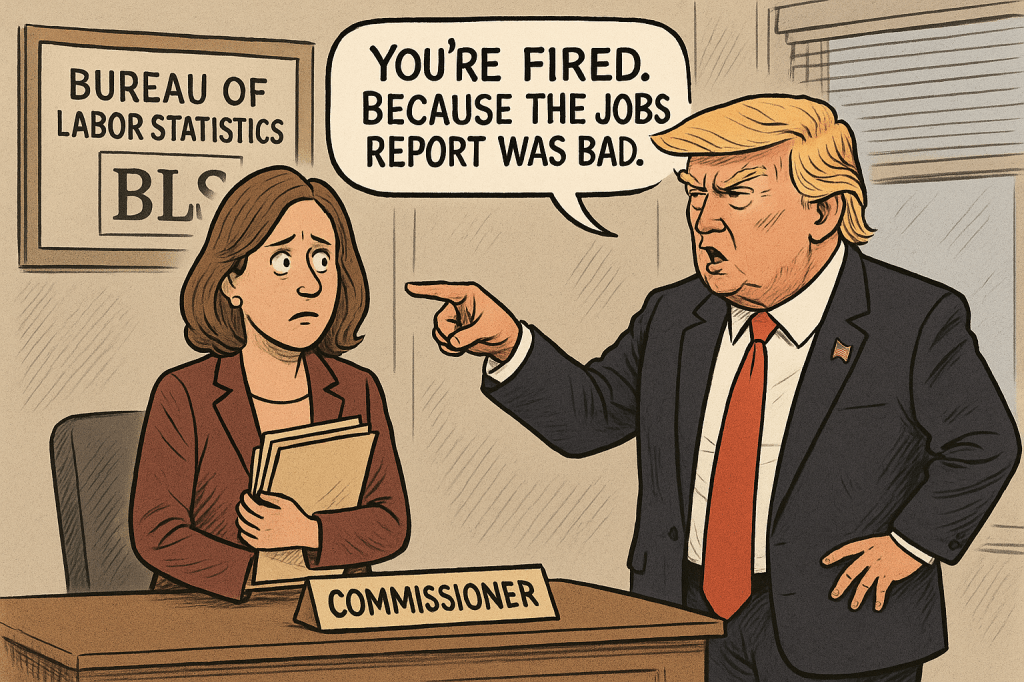
    The July jobs report came in soft—only seventy-three thousand jobs added—and within hours, Donald Trump did what any authoritarian cosplay enthusiast does when reality offends him: he fired the person who reported it.

    Erika McEntarfer, the now-former Commissioner of the Bureau of Labor Statistics, was escorted out because she made the grave mistake of… doing her job. She didn’t cook the numbers, she didn’t fudge the data, and she didn’t go rogue. She simply released the same kind of carefully collected employment figures the BLS has been publishing, without scandal, for over a hundred years.

    But this time, the report was politically inconvenient. And in Trump World, truth isn’t just optional—it’s punishable.

    Let’s pause for a second to explain what the BLS actually is. It’s not a partisan think tank. It’s not the communications arm of the DNC. It’s a statistical agency, filled with career economists and data nerds who live for things like seasonal adjustments and response rates. The BLS is where accuracy goes to get its shoes dirty.

    And yes, they revise the numbers—they always have. The initial jobs report is based on partial survey responses. As more data trickles in—especially from late-reporting firms and federal agencies—the numbers get updated. This happens every month. It’s not fraud. It’s not bias. It’s just… math. But try explaining “statistical methodology” to a guy who thinks windmills cause cancer.

    Here’s the real danger: this isn’t just about one firing. It’s about trust. The kind of trust that global markets, rating agencies, and foreign debt holders depend on when they decide whether to keep parking trillions in U.S. Treasuries. They’re not doing that out of charity. They’re doing it because they believe U.S. institutions are solid. Apolitical. Professional. Uncorrupted by whoever happens to be yelling on television that day.

    But if we start firing data officials every time a chart slopes the wrong way, we’re not a stable country anymore. We’re a banana republic in a red baseball cap.

    The BLS has survived wars, recessions, financial crises, and even past Republican administrations that knew better than to meddle with the scorekeeper. But now? Now we’re here—treating unemployment figures like fake news and gutting statistical integrity because the numbers don’t flatter the guy in the gold elevator.

    What happens next? Do we rehire her if next month’s numbers are better? Do we demand she “find” more jobs next time? Do we just stop counting altogether and replace the report with vibes?

    This isn’t funny. But I’m laughing anyway, because that’s what you do when the country starts playing Russian roulette with its credibility.

    We don’t have to agree on the right economic policy. But we have to agree that facts are still allowed to exist.

    Because if we lose that, it’s not just the jobs report that gets revised downward. It’s our future.

  • After Late-Stage Capitalism: Where Do We Go From Here?

    After Late-Stage Capitalism: Where Do We Go From Here?

    You don’t need a PhD in economics to feel that something’s off.

    Groceries cost more, jobs feel more fragile, housing looks like a luxury product, and half the tech CEOs sound like they’re pitching a video game plot instead of running real-world companies. Meanwhile, billionaires are racing each other to space while your rent races you into a corner.

    This is what people mean when they talk about late-stage capitalism. It’s not an end date on a calendar. It’s a mood. A vibe. A phase in the life cycle of an economic system that feels increasingly disconnected from reality.


    So What Is Late-Stage Capitalism, Really?

    It’s the point in a system’s evolution where:

    • Markets are no longer free, just engineered
    • Wages stagnate while productivity and profits soar
    • Basic needs become “subscription services”
    • Work is precarious, but shareholders are thrilled
    • Governments serve markets instead of citizens
    • Every crisis gets monetized—healthcare, climate, war, education

    It’s Uber drivers with master’s degrees. Teachers driving DoorDash. People crowdfunding insulin while the stock market hits record highs. It’s burnout, hustle, and “grindset” culture masquerading as freedom. It’s a society that treats rest like laziness and wealth like morality.

    In short: it’s the moment when the system stops pretending it’s for everyone.


    So What Comes Next?

    That’s the question. And we’re all going to have to answer it—whether we want to or not. Because systems don’t last forever. They evolve. They collapse. They mutate. Or, sometimes, they’re dragged kicking and screaming into something new.

    Here are five directions we might be headed:


    1. State Capitalism

    Same market, new driver.

    In this version, governments take a more active role—not to help you, but to strategically control markets. Think China’s model: heavy surveillance, controlled growth, and national champions in tech and energy. Markets are tools, not ideals.

    Upside: Infrastructure might actually get built.
    Downside: Dissent gets a lot more expensive.


    2. Technocratic Feudalism

    You’ll own nothing—and still pay monthly fees.

    Imagine a future where democracy erodes, but Amazon has great customer service. Where mega-corporations are the de facto governments, and your social credit score determines what you can access.

    Think: smart homes, dumb laws, and “Terms of Service” that rule your life.

    Upside: Efficiency. Innovation. Personalized everything.
    Downside: No exit button. No real power.


    3. Eco-Social Capitalism

    Capitalism with a conscience—and a carbon cap.

    This is the idealists’ version: a restructured economy that prioritizes sustainability, equity, and long-term thinking. Maybe we get universal basic income. Maybe we regulate tech. Maybe we stop treating the planet like an ATM.

    Upside: Human dignity. Ecological survival.
    Downside: Short-term disruption. Lots of angry billionaires.


    4. Decentralized Utopia

    Crypto, co-ops, and code-based governance.

    This one’s for the web3 dreamers. Power moves from central institutions to decentralized networks. DAOs replace corporations. You vote with tokens, earn through participation, and store your wealth outside the banks.

    Upside: Radical autonomy and transparency.
    Downside: Scams, fragmentation, and the occasional rug pull.


    5. Collapse or Authoritarianism

    When the lights flicker and the flags get darker.

    Not the feel-good option, but one we can’t ignore. If inequality keeps widening, climate shocks intensify, and trust erodes further, we could see the rise of hard borders, strongmen, and failing institutions.

    Upside: None.
    Downside: All of them.


    What Do You Want to Come Next?

    This isn’t just an academic exercise. What comes after late-stage capitalism depends on us. On the stories we tell, the systems we build, and the power we choose to either accept or reject.

    You don’t have to be a policy wonk to start imagining alternatives. You just have to look at the world around you and ask: Is this working? And if it’s not, what would?

    Because the next chapter is being written right now—by corporations, by governments, by you, and by me. And the question isn’t just what comes next.

    It’s who gets to decide.

  • No One Believes Trump Anymore—And the World’s Acting Like It

    No One Believes Trump Anymore—And the World’s Acting Like It

    Last night, Israel struck deep into Iran—over the quiet objections of the White House. Think about that for a second.

    It was a direct rejection of Donald Trump’s promise to negotiate a new peace framework with Iran. Netanyahu didn’t just doubt Trump’s ability to get it done—he didn’t even think it was worth pretending anymore. He moved without permission, and without Trump.

    This is what it looks like when the world stops believing the U.S. president has any real pull.

    Europe’s Not Waiting Either

    Across the Atlantic, European leaders have authorized Ukraine to use Western-supplied weapons inside Russian territory. That’s a massive policy shift—one that would normally require careful alignment with Washington.

    But there’s no alignment. Because there’s no trust. Trump said he alone could end the war in Ukraine. NATO waited a while for that offer to play out and decided they’d rather take their chances without him.

    Putin Is Publicly Mocking Him—and He Doesn’t Even Notice

    Russian state television aired nude photos of Melania Trump as part of a grotesque propaganda stunt. A few years ago, that would’ve triggered diplomatic retaliation. Under Trump 2.0? Crickets.

    Either he doesn’t realize he’s being mocked, or he doesn’t care. Maybe he still thinks Putin respects him. Maybe he’s just afraid to break up with his last remaining bromance. Whatever the case, the message from Moscow couldn’t be clearer: we don’t respect you.

    Markets Are Screaming It, Too

    Gold is on a rocket ride—not because the economy is overheating, but because confidence in Trump’s economic leadership is melting like a popsicle in Mar-a-Lago. His trade policies shift by the hour. His tariffs are threats without timelines. His “art of the deal” these days seems to be: promise big, deliver nothing, move on.

    He said he’d sign 90 trade deals in 90 days. We’re on day 70-something. So far, we’ve got two vague “frameworks.” That’s political lingo for: everyone smiled politely and agreed to get back to each other. Someday.

    DOGE Was Supposed to Be the Fix—It’s a Punchline Now

    The Department of Government Efficiency was Trump’s shiny new hammer to smash waste and fraud. Musk was going to run it. Budgets were going to shrink. Swamps were going to drain.

    Instead, the whole thing is collapsing under its own irony. Cuts that were supposed to save money are actually costing money. Programs got slashed only to be reinstated under lawsuits or emergency exceptions. And Musk? He’s out. He quit DOGE, slammed the spending bill, and said he’s done being a political shield for broken promises.

    The Musk Breakup Says It All

    Trump once claimed Elon Musk would be a key partner in reshaping government. Now he’s threatening to revoke Tesla and SpaceX contracts, and Musk is saying—on record—that Trump can’t be trusted to manage a budget, let alone a country.

    It’s one thing to lose your enemies. But when you start losing your allies, your enablers, and your billionaire yes-men? That’s when the walls start closing in.


    The Big Picture: Nobody Thinks He Can Do the Job

    Israel ignored him. Europe bypassed him. Putin humiliates him. Musk walked. Gold’s spiking. Trade deals are MIA. And the big-budget reforms that were supposed to show “Trump means business” have turned into another bloated mess.

    This isn’t strength. This isn’t strategy. This is what weak leadership looks like on a global stage. It’s not that the world is in chaos despite Trump—it’s that the world no longer sees him as someone worth coordinating with at all.

    He promised to bring peace, prosperity, and power back to America. What we’ve got instead is confusion, rejection, and gold at $3,400.

  • My Struggle with Stupid People

    My Struggle with Stupid People

    Let’s get something straight right off the bat—I’m not talking about people with below-average IQs. Intelligence isn’t the issue here. Some of the smartest people I’ve met couldn’t change a tire or balance a checkbook to save their lives, and some of the most practical, insightful people I know wouldn’t do well on an IQ test.

    And I don’t hold myself up as some kind of genius. Believe me, I’ve made my share—and probably some of your share—of dumb decisions. Decisions that would make the Three Stooges look like Nobel Prize winners. But here’s the thing: I am not stupid.

    Because stupid isn’t about IQ—it’s about refusing to think critically.

    So, let’s run a quick litmus test for critical thinking:

    When was the last time you heard a better argument than the one you had and thought, ‘Damn… I might be wrong’? If you can’t think of a single time, that’s a red flag.

    Do you ever get new information and just… ignore it? If your instinct is to double down instead of reconsider, congratulations—you’re human. But critical thinkers push past that reflex.

    Here’s where I struggle: I have to work hard to feel empathy for people who have all the information they need to make good voting decisions but still choose to vote against their own interests.

    It’s one thing to be misled. It’s another to be willfully ignorant. And when people keep making choices that actively harm themselves—and the rest of us—it’s hard not to be frustrated.

    The truth is, democracy depends on people actually thinking. And if we can’t do that, we’re in real trouble.

  • The Great Wealth Transfer Is Finally Here, But With A Plot Twist

    The Great Wealth Transfer Is Finally Here, But With A Plot Twist

    Remember when everyone was hyping the “Great Wealth Transfer,” where aging baby boomers were set to pass down $84 trillion to younger generations? Well, surprise! Plot twist. Instead of money trickling down from Grandma and Grandpa, we’re watching it rocket up from the pockets of the middle and working class straight into the bank accounts of the already-rich.

    This is all thanks to the infinite wisdom of the American voter.

    Exhibit A: Trump’s latest move, rolling back the minimum wage for federal contractors. Biden had bumped it up to $15/hour (adjusted recently to $17.75/hour), trying to give working folks a chance at affording something wild—like rent or food. But Trump swung the pendulum back down to $13.30 an hour—or potentially as low as the $7.25 federal minimum. Because apparently, “Making America Great” involves making sure the billionaire class can afford that extra yacht.

    Here’s how the rich-get-richer machine works: cut wages for workers, boost corporate profits, and voila! The wealth gap grows faster than your credit card debt after a Taylor Swift concert. The rich buy more assets—real estate, stocks, private islands—and the rest of us keep renting our dreams from them.

    It’s the Great Wealth Transfer, alright—but in reverse gear, accelerating uphill.

    We’ve gotta stop fueling a system rigged against regular folks. Investing in working people isn’t charity—it’s smart economics. Time to shift gears and actually build a future that benefits everyone, not just the privileged few. It may have sounded like buzz words but “building from the middle out” really meant something .

  • An Easy Way To Understand Trade Deficits (I promise)

    An Easy Way To Understand Trade Deficits (I promise)

    Okay, I know “trade deficit” doesn’t exactly scream edge-of-your-seat excitement, and I don’t want to presume you don’t already know this stuff. But I’ll keep it short. This matters. You’ll see why.

    Running a trade deficit just means we’re buying more from other countries than we’re selling to them. And why do we do that? Because they can make the products there and sell them to us more cheaply than we can make them here. We buy from them using our dollars, which they can’t really spend in their own countries so (for the most part) they reinvest those dollars in the US, putting them right back into our economy—buying our bonds, our real estate, funding our companies. That’s not a weakness on our part, that’s a power move. As an example, just think about how the cost of big flat screen TVs has dropped over the years.

    Think of it like this: we’re the house in the global casino. Everyone wants to play at our table, and they’re more than happy to leave their chips with us. That’s what being the world’s reserve currency gets you. For other countries trade deficits might not be a good thing. but for us? Hell yeah!

    Now about tariffs. Trump loves tariffs like they’re the Swiss Army knife of trade policy. But really, they’re just a tax hike dressed up as patriotism. When we slap tariffs on imported goods, prices go up—and we’re the ones paying. It’s like punching yourself in the face and calling it tough love. Trump says these tariffs willl generate $800 billion in new revenueue for the IRS, coming right out of the pockets of consumers. It’s a tax hike under another name.

    That said, not all tariffs are evil. Sometimes they make sense—like when they’re used to protect critical industries or level the playing field against countries that don’t play fair. And hey, bringing some manufacturing back to the U.S.? Totally smart. Especially if tensions with China get worse. We don’t want to be stuck relying on overseas factories if shit hits the fan.

    But going full throttle with broad tariffs? That’s not strategy, that’s just chaos. It invites retaliation, screws with supply chains, and freaks out investors.

    Side note: CEO’s of US companies that inport foreign parts are paying between $1m for a group and $5m to have a one on one dinner with Trump at Mar-a-Lago; likely to have their imports exempted or to lobby to have their competitors targeted but not them. Historicallly, tariffs have been the source of massive government corruption.

    So yeah, let’s have real conversations about trade and competitiveness. Let’s rebuild the parts of our economy that actually need shoring up. But let’s stop pretending a trade deficit means we’re losing. Most of the world would love to have our “problems.”

    We’ve got the leverage. Let’s not fumble it because ‘someone’ doesn’t understand how the system works – or understands it all too well.