Tag: mental health

  • I Fed My Entire Life Into ChatGPT and All I Got Was… Insight? Closure? Mild Humiliation? Hard to Say.

    I Fed My Entire Life Into ChatGPT and All I Got Was… Insight? Closure? Mild Humiliation? Hard to Say.

    At some point in adulthood, a man has to confront the paper trail he’s been leaving behind since childhood — the journals, the planners, the frantic lists written in moments of optimism and panic. Most people shove theirs in a box and wait for their kids to one day throw them out.
    I, on the other hand, uploaded mine into ChatGPT.

    Because if there’s one thing I’ve learned, it’s this:
    If you give an AI 40 years of your handwriting, it will happily psychoanalyze you without even blinking.

    And yes, ChatGPT can read handwriting now.
    Let me repeat that for the people in the back:

    ChatGPT. Can. Read. Handwriting.

    Cursive. Print. Scribbles.
    The stuff I wrote in 1986 when my hormones were louder than my personality.
    The frantic 1991 Barcelona planner pages that read like I was being chased by creditors, self-doubt, and the ghost of my future obligations.
    The Day One digital entries chronicling my existential crises, business collapses, emotional resurrections, and occasional triumphs.

    It gulped it all down and said, essentially:
    “Thanks, Mike. Delicious. Here’s your life.”


    Apparently other people are doing this too.

    I thought I was being innovative — the first man to hand his entire autobiographical archive to a machine.
    Turns out, no.

    People across the internet are feeding their diaries, old letters, family archives, grief journals, therapy notebooks, and even high-school love notes into GPT. Some want closure. Some want clarity. Some want to rediscover who they were before life flattened them into mortgage-paying, sleep-deprived adults.

    We’re all out here saying, “Hey AI, decode me,” like it’s the world’s weirdest confessional booth.

    And honestly?
    It works.


    The Throughline of My Life, According to My AI Biographer

    After reading everything from my baby book to my Barcelona meltdown years, ChatGPT came back with a diagnosis I didn’t expect:

    I am a man who has been trying to get his life together since 1981.

    Not in a sad way.
    In a charming, heroic, repetitive way — like if Sisyphus had a Franklin Planner and high hopes.

    Every notebook, every decade, every entry seems to include some variation of:
    “Tomorrow I get my shit together.”

    It’s practically my family crest.

    The other throughlines didn’t surprise me as much:

    • I reinvent constantly.
      Apparently I have shed more skins than a reptile with commitment issues.
    • I archive everything.
      Why live a life when you can also footnote it?
    • I’m brutally hard on myself.
      If anyone else talked to me the way 1991 Mike talked to me, I’d block them.
    • Beneath all the ambition is a tender streak.
      Who knew? Not me.
    • I care too much and forgive too slowly.
      A winning combination if you enjoy emotional turbulence.

    But the most unexpected observation?

    Despite everything — the failures, the reinventions, the wrong turns — the same hopeful, restless kid is still in there.
    The one who wants to do something meaningful.
    The one who believes tomorrow’s list might actually work this time.
    The one who thinks the next version of himself might finally be the one who sticks.


    The Unlikely Threads

    Every life has themes. Mine has… tangles.

    Here are a few of the threads GPT pulled on — the ones I didn’t notice until a machine laid them out like evidence:

    1. The Eternal Reset Button

    I am the human embodiment of “Okay, starting Monday.”
    This has been going on for forty years.
    Consistency is my inconsistent superpower.

    2. The Archivist Instinct

    I documented my life long before influencers made it fashionable.
    Except I did it with spiral notebooks and regret instead of ring lights.

    3. The Geography of Reinvention

    Nebraska → Spain → New York → Barcelona → My companies → The Music Industry → Trading → Writing → Whatever’s next.
    My life story reads like someone was trying to outrun themselves — and accidentally became interesting.

    4. The Reluctant Optimist

    Every time I wrote a harsh entry, there was always this little shimmer of hope.
    Some people have grit; I have recurring optimism with a head injury.

    5. The Overdeveloped Sense of Responsibility

    My journals reveal that I’ve been blaming myself for global events, interpersonal dynamics, and weather patterns since adolescence.


    So… was it worth it?

    Honestly, yes.
    Handing my life to ChatGPT didn’t break me, ruin me, or reveal that I’m a secret sociopath.
    Instead, it gave me something I’ve never had before:

    A clear view of the narrative arc beneath the noise.

    It showed me the patterns I repeat.
    It showed me the parts of myself I carry from decade to decade.
    It showed me that the kid who wrote, “I hope I become someone someday,”
    actually did.

    Not perfectly.
    Not cleanly.
    But unmistakably.

    Tomorrow I’ll try to get my life together again.
    Some traditions shouldn’t die.

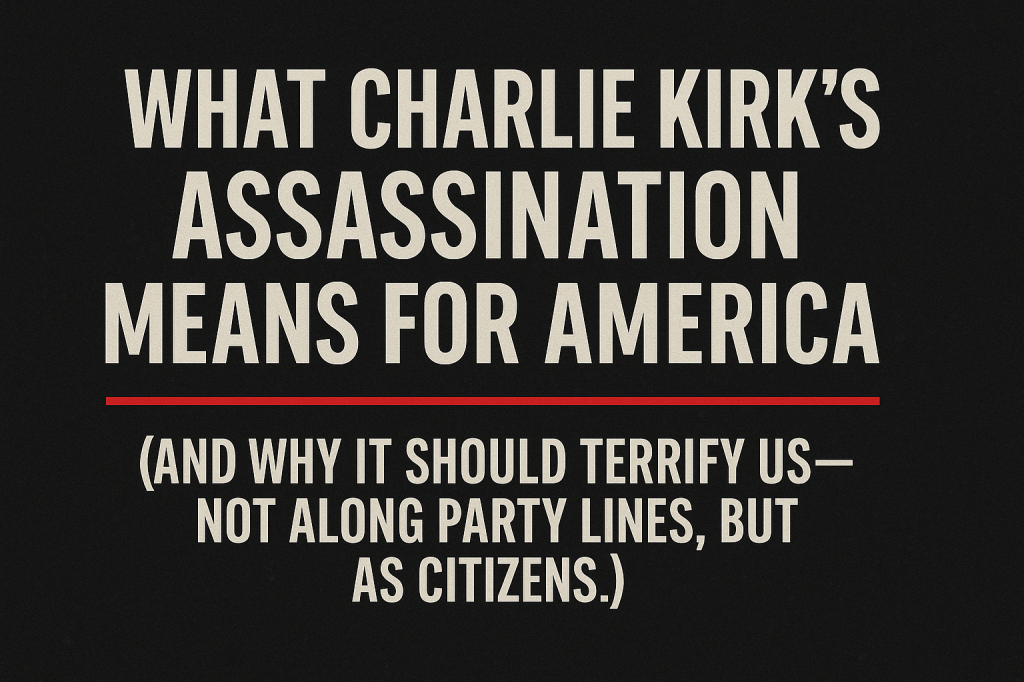
  • What Charlie Kirk’s Assassination Means for America

    What Charlie Kirk’s Assassination Means for America

    (And why it should terrify us—not along party lines, but as citizens.)

    Charlie Kirk, was assassinated today at Utah Valley University. This comes just weeks after a shocking double assassination in Minnesota—two state legislators gunned down in what’s now being investigated as a politically motivated attack. You’d be forgiven for losing track. That’s how fast the temperature is rising.

    Before anything else, I want to express my deepest condolences to Charlie Kirk’s family, friends, and supporters. No matter where you stand politically, no one deserves this. And no country should normalize it.

    But what this isn’t—what this cannot ever be—is just another political tragedy we scroll past. This is unfiltered desperation and failure seeping into our public life.

    We’ve had assassination attempts before—on Trump, on members of Congress—but killing a political influencer in broad daylight on a campus? That’s crossing yet another line.

    We need to stop pretending that violence is a random accident or “outlier.” Hatred isn’t burbling under the surface—it’s flooding the streets. Killings like this don’t just raise eyebrows; they expose how far tribalism has eroded civility.

    Meanwhile, the very infrastructure meant to prevent this—our domestic terror intelligence—is being dismantled. The FBI has slashed staffing in its Domestic Terrorism Operations Section and shuttered its tracking database on hate crimes and school shootings. Prevention is now reactive.

    You feel the threat more clearly each day. You wonder: if someone like Charlie Kirk can be killed in public view, are you next? Are we?

    This wouldn’t be happening if people believed the system still worked. But they don’t. Polls show falling trust in elections, in the press, even in whether your vote matters. Add in constant messaging from the top that institutions are rigged—or worse, that they’re enemies.

    When people believe their voice can’t be heard they begin to feel violence is the message.

    I’ve seen people openly whisper and tweet about civil war. That used to sound unhinged. Now it sounds like something that could happen. And that’s the most dangerous whisper echoing across this country.

    So Where Do We Go from Here?

    If you want to say this is just “rhetoric,” know this: it is already worse than rhetoric. It’s violence.

    If you want to say the FBI or justice system can handle this alone, know this: they’re being de-funded and starved of resources.

    If you want to say elections still matter, ask yourself: what message are you sending when you don’t defend them?

    We need to demand more than prayers. We have to demand two simple things:

    1. Rebuild counterterrorism infrastructure. Money. Personnel. Tools. No more willful ignorance. Don’t allow this to be the beginning of events that give a certain someone the excuse he’s seeking to declare martial law.

    2. Restore faith in institutions. Hold elected officials accountable for their rhetoric. Defend objective fact. Support independent media.

    Because right now, we’re living in what feels like a slow-motion breakdown—not of ideas, but of the very architecture that held democracy together. And when that collapses, violence becomes communication.

    So, yeah: Civil war talk? It’s not crazy anymore. It’s proof that our political ecosystem is cracked open.

    And if that isn’t a moment when decent people across all divides come together—voting, organizing, standing in unified outrage—then what exactly were we saving democracy for?

  • Gen X: We Were Supposed to Be Too Sharp for This Sh*t

    Gen X: We Were Supposed to Be Too Sharp for This Sh*t

    There’s a very specific kind of shame in watching a country fall apart and realizing your generation was supposed to stop it.

    We were the skeptical kids. The “don’t fall for it” crowd. We grew up with irony, sarcasm, and a healthy distrust of institutions. We made fun of cults. We rolled our eyes at televangelists. We knew better.

    At least, we thought we did.

    We were the last analog generation—and the first digital one. We knew how to rewind a cassette and reboot a modem. We brought the internet into being, and with it, the promise of better information, smarter systems, and a more connected world.

    We gave the world Google, Amazon, YouTube.

    We gave it Nirvana, Nine Inch Nails, the Wu-Tang Clan.

    We built the platforms. Designed the interfaces.

    We were supposed to be the bridge between what was and what could be.

    But now?

    We’re watching the whole thing buckle—and pretending we’re just observers.

    We post memes about how great it was to grow up drinking from hoses, while an entire generation can’t afford rent, let alone a mortgage.

    We forward videos about “the good old days” while Gen Z drowns in debt, climate fear, and medical bills for anxiety disorders they inherited from watching us lose the plot.

    And who’s in charge now?

    Trump. Again.

    President 2.0.

    This time with fewer guardrails, more power, and even less shame.

    And standing right behind him, RFK Jr.—now Secretary of Health—gutting the CDC, firing career scientists, and rebuilding America’s public health policy around gut feelings and internet comment sections.

    We used to point at the USSR and say, “Those poor people don’t get real news—just government propaganda.”

    Now we’ve got half the country cheering for our own state-run media, rage-bait headlines, and “alternative facts,” while willingly ignoring everything they know is true.

    We’re not living in 1984. We’re living in something dumber.

    A self-inflicted propaganda state where people know it’s bullshit—and eat it up anyway.

    And Gen X?

    We were supposed to be immune to this.

    Too jaded. Too sharp. Too allergic to fascism.

    We were supposed to be the firewall.

    But we ghosted.

    No Gen X president because the boomers.

    No major Gen X political movement.

    No defining generational stand.

    We just kept scrolling.

    Kept reposting.

    Kept telling ourselves we were “above it.”

    But the truth is—we’re blowing it.

    We were there when the rot was setting in.

    And we didn’t stop it.

    We let the dumbest grifter of our lifetime sell America a cheap hat and a fake war on reality.

    We watched as housing became a luxury, healthcare became a subscription plan, and truth became a punchline.

    We let RFK Jr. cosplay as a truth-teller while he dismantled actual science.

    And now, with AI about to automate our jobs, scrape our souls, and deepfake us into oblivion, we’re busy sharing memes about the 80s while billionaires plug themselves into immortality servers.

    We were supposed to be the generation that didn’t fall for bs.

    Instead, we’re managing the collapse like theme park actors refusing to break character while the rollercoaster catches fire.

    And yeah, I’m a bit crispy about all of this.

    Not just at Trump. Not just at RFK Jr.

    But at us.

    We were supposed to be too sharp for this sh*t.

    We were supposed to know better.

    We were supposed to do better.

    And if we don’t wake up—right now—history won’t even remember our failure.

    It’ll be too busy documenting the fallout.

    So come on Gen X. It’s time!

  • When to Walk Away: A Business Lesson from the Trading Terminal

    When to Walk Away: A Business Lesson from the Trading Terminal

    There’s a moment in business—just like in trading—when your thinking brain quietly exits the building. It doesn’t slam the door or send a calendar invite. It just disappears. And suddenly your emotional brain lights a cigarette, rolls up its sleeves, and says, “Relax—I’ve got this.”

    Spoiler: it does not have this.

    This week, that moment cost me $895 in trading—one bad trade across multiple accounts for a total of an $11,635 loss. But this isn’t about trading. It’s about the universal impulse to stay in the deal too long.

    Read the full post on my Substack here.

  • My Struggle with Stupid People

    My Struggle with Stupid People

    Let’s get something straight right off the bat—I’m not talking about people with below-average IQs. Intelligence isn’t the issue here. Some of the smartest people I’ve met couldn’t change a tire or balance a checkbook to save their lives, and some of the most practical, insightful people I know wouldn’t do well on an IQ test.

    And I don’t hold myself up as some kind of genius. Believe me, I’ve made my share—and probably some of your share—of dumb decisions. Decisions that would make the Three Stooges look like Nobel Prize winners. But here’s the thing: I am not stupid.

    Because stupid isn’t about IQ—it’s about refusing to think critically.

    So, let’s run a quick litmus test for critical thinking:

    When was the last time you heard a better argument than the one you had and thought, ‘Damn… I might be wrong’? If you can’t think of a single time, that’s a red flag.

    Do you ever get new information and just… ignore it? If your instinct is to double down instead of reconsider, congratulations—you’re human. But critical thinkers push past that reflex.

    Here’s where I struggle: I have to work hard to feel empathy for people who have all the information they need to make good voting decisions but still choose to vote against their own interests.

    It’s one thing to be misled. It’s another to be willfully ignorant. And when people keep making choices that actively harm themselves—and the rest of us—it’s hard not to be frustrated.

    The truth is, democracy depends on people actually thinking. And if we can’t do that, we’re in real trouble.

  • Regrets! Regrets! Regrets! And The Eternal Blooper Reel in My Head

    Regrets! Regrets! Regrets! And The Eternal Blooper Reel in My Head

    I’ve got a blooper reel running in my head. No, it’s not the kind of reel you’d expect after a day of business or trading mishaps. This isn’t about missed opportunities or the times I could’ve done better in my career. This is the real blooper reel. The one that plays on a loop whenever I let my guard down.

    It’s the awkward social moments, the times I misread the room, and the moments when I know—deep down—I’ve let people down. It’s about failing to live up to my own standards. Every time I should have been more presentmore compassionate, or just plain more human… I’m there in my head, replaying it all.

    What’s strange is that it’s always running. Every conversation, every social interaction, every moment where I didn’t say the right thing or dropped the ball—it loops in my mind, over and over. And I’m not sure how to turn it off. Not because I haven’t tried, but because it’s like the movie I didn’t ask to be the star of. It just keeps going.

    I’m not diagnosed with OCD (though, who knows, maybe that’s in the cards for later). I’ve got ADHD—which is probably part of the reason why I sometimes struggle to focus on what’s in front of me rather than the endless mental reruns. But ADHD doesn’t explain the constant mental commentary. That’s all me, every day, reliving these moments in vivid, technicolor detail like I’m trapped in an infinite loop of social faux pas.

    Maybe the “blooper reel” is universal—we just don’t admit it out loud. But I can’t help but feel like I’m watching a never-ending series of mistakes, and the worst part is, I imagine everyone who has been on the receiving end missteps is constantly watching too. So the shame and embarrassment are always turned up to 11.

    I don’t want this to sound like some “woe is me” post. The reality is, I’m working through this. I’m figuring out how to let go of the things that don’t serve me and focus on what’s ahead. But it’s hard. It’s exhausting. And for someone who’s spent years building businesses, trading gold, and dealing with the stresses of life, it’s a whole new level of self-inflicted pressure.

    I know I’m not the only one dealing with this. There are so many of us out there—fighting to silence the self-doubt, the moments we didn’t do or say enough. The truth is, it’s a battle. And some days, I’m winning. Other days? I’m stuck rewinding the same mistakes, trying to “fix” things that are long past fixing.

    But here’s the thing: I’m learning to embrace the fact that perfection doesn’t exist. That reel may never stop playing, but maybe I don’t have to listen to it on repeat. I’m still human, and I’ll still make mistakes, but I’m trying to make peace with the fact that I don’t need to be perfect.

    So if you’re out there feeling like I am—stuck in your own head, running your personal blooper reel—just know you’re not alone. We’re all trying to find a way to live with the past, move forward, and make the future just a little less complicated.