Tag: Politics

  • Let’s Talk About Men In Women’s Bathrooms and Sports. I Know You Want To.

    Let’s Talk About Men In Women’s Bathrooms and Sports. I Know You Want To.

    Because apparently this is a keystone issue. One that decides a lot of things. The hill civilization must die on.

    Here’s the part that keeps getting skipped.

    Democrats didn’t vote for predators.

    They voted against performative, federal, gotcha legislation that doesn’t actually stop predators.

    Why?

    Because assault was already illegal.

    Harassment was already illegal.

    Voyeurism was already illegal.

    Bathrooms were not a legal loophole waiting to be discovered. No one’s going to tell the judge, “Well your honor, actually, I just identified my way in there so, we’re good, right?”

    What those bills were designed to do wasn’t protect women—it was to force Democrats into voting for something they already agree with in principle, but in a way that breaks existing law, invites constitutional challenges, and creates enforcement nightmares.

    Same deal with trans women in sports.

    The Democratic position—whether people like it or not—was:

    This is complicated, rare, and already governed at the local and league level.

    You don’t fix edge cases with sweeping federal bans written for cable news chyrons.

    In other words: don’t legislate by panic meme.

    Now contrast that with the other side.

    One party says:

    “We’re not playing culture-war whack-a-mole at the federal level.”

    The other says:

    “This is an emergency,” while:

    • demanding mass deportations and ICE raids,

    • cheering criminal investigations of political enemies,

    • attacking judges and prosecutors,

    • threatening neighbors and allies abroad,

    • allowing in-your-face corruption everyday,

    • and still, somehow, circling the wagons around Epstein. I mean, it’s still entertaining to see the right wing podcasters blow their stacks as they realize that President QAnon himself is likely implicated.

    And yet that party gets framed as the “lesser of two evils.”

    So here’s the actual choice, stripped of the fear soundtrack:

    Would you rather have a party that refuses to pass bad laws just to score points?

    Or one that feeds you a steady drip of bathroom panic while normalizing corruption, abuse of power, and the quiet protection of people who absolutely should have been held accountable?

    You don’t have to dismiss anyone’s fear to see what’s happening.

    You just have to ask why that fear is being endlessly rehearsed—and what it’s training you not to notice.

  • I’ve been told I can’t be taken seriously until I acknowledge that the left has been hijacked by radicals. So, here goes…”

    I’ve been told I can’t be taken seriously until I acknowledge that the left has been hijacked by radicals. So, here goes…”

    Alright. Let’s check the evidence. When people say “the radical left took over,” they usually mean the progressive wing — AOC-types, big ideas, big rhetoric.

    So let’s look at outcomes.

    They wanted Medicare for All, court packing, a wealth tax, abolition of private insurance, Green New Deal–scale change, national rent control.

    They got:

    a bipartisan infrastructure bill negotiated down to the bone,

    modest climate policy routed through markets,

    limited drug price negotiation,

    and student loan relief partly undone by the courts.

    That’s it.

    No Medicare for All.

    No court packing.

    No wealth tax.

    In fact, the people most furious during the Biden years weren’t Republicans — they were progressives, loudly complaining they were being ignored.

    That’s usually your first clue the party hasn’t been hijacked.

    So why am I told I “can’t be taken seriously” unless I accept this story anyway?

    Because right-wing media has repeated it for so long it’s hardened into a premise, not an argument. The left is radical. Everyone knows this. Move on.

    Once that happens, policy stops mattering.

    Now try the same test on the right.

    What the far right wanted was power: loyalty tests, punishment for dissent, criminal investigations of enemies, mass deportations, aggressive ICE raids, law enforcement as a weapon.

    And they’re getting it.

    ICE raids aren’t rhetoric anymore.

    Mass deportation isn’t a chant — it’s an operational goal.

    Institutions are pressured. Independence is treated as defiance.

    Foreign adventurism is back on the menu — enthusiastically.

    That’s the difference.

    One side has a loud flank that tweets and fumes when it’s ignored.

    The other has a loud flank that’s setting norms and bending institutions.

    One side asks for sweeping change and gets incremental policy.

    The other asks for norm-breaking and gets… norm-breaking.

    A loud fringe is annoying.

    A governing fringe is dangerous.

    Calling these two things the same is ridiculous.

    If you can’t tell the difference between activists being ignored and institutions being bent, you’re not being fair-minded.

    You’re just refusing to look.

    And pretending not to see it is its own kind of extremism.

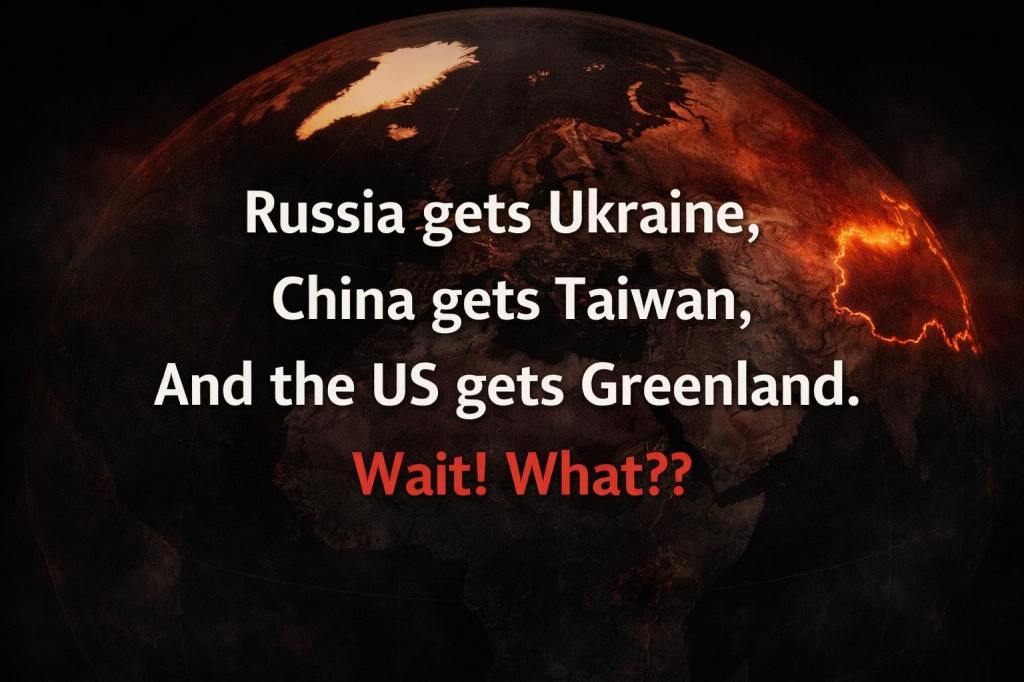
  • Russia gets Ukraine, China gets Taiwan, And the US gets Greenland…. Wait! What?

    Russia gets Ukraine, China gets Taiwan, And the US gets Greenland…. Wait! What?

    For about 80 years, the United States pulled off something historically insane.

    We’re under 5% of the world’s population, yet after WWII we helped design—and then manage—a global system that made us wealthy, secure, and absurdly influential. Not because we were saints. Because we were smart.

    We didn’t run the world like a cartoon villain twirling a mustache.

    We ran it like a country that finally learned the lesson every previous empire missed:

    Fear works fast.

    Consent works longer.

    So instead of ruling by intimidation, we built a system other countries could live with—even benefit from.

    Alliances instead of vassals.

    Rules instead of permanent brinkmanship.

    Open sea lanes so global trade didn’t require every cargo ship to bring its own navy.

    A dollar-centered financial system that quietly turned the U.S. into the tollbooth for global growth.

    Were we perfect? Obviously not. Vietnam. Iraq. CIA adventures best left out of the brochure.

    “We’re here to help” has preceded some deeply unhelpful moments.

    But the model worked because power was paired with legitimacy. Countries didn’t just tolerate American leadership—they chose it. That’s why the unipolar moment didn’t immediately collapse. The world didn’t instinctively band together to knock us down the way it usually does with dominant powers.

    That wasn’t accidental. The arrangements we built were often win-win. Other countries gained security, access, and stability, while we gained influence, markets, and leverage. Everyone could live with the math.

    Then Trump arrived and declared America had been run by idiots.

    He rejects win-win deals on principle. If someone else benefits, he assumes we’re being cheated. That’s why he keeps insisting the U.S. has been “ripped off” by everyone—from allies to trading partners—and why his solution is always the same: make sure someone else loses harder than we do.

    His complaint wasn’t that the U.S. enforced the rules.

    America always enforced the rules.

    His problem was how.

    Where previous presidents used enforcement backed by legitimacy, Trump decided legitimacy was overrated. Too slow. Too many meetings. Too many adults in the room.

    Why persuade when you can threaten?

    So the tone shifted.

    Tariffs as punishment.

    Cooperation replaced with compliance.

    Diplomacy reduced to: Do what we want or your exports get 25% more expensive in the US market.

    That’s a shakedown.

    And shakedowns have a cost.

    Countries governed by fear don’t align—they hedge. They rewrite trade relationships. They diversify supply chains. They quietly build exits.

    They start asking a very dangerous question:

    What if America is the risk now?

    That’s how trust turns into contingency planning.

    At the same time, we’re being sold a shiny new global vision:

    A world carved into spheres.

    Russia handles “its” region.

    China handles “its” region.

    America pulls back to its own region, throws its weight around selectively, and keeps everyone nervous with tariffs.

    Congratulations. We’ve rebooted the 1914 server that brought us WWI.

    A tripolar world isn’t stable. It’s anxious. Transactional. Every country doing math it never wanted to do:

    Who protects me now?

    Who do I appease?

    Who do I pay off?

    What happens when the big guys disagree and I’m standing in the middle?

    That’s a tinderbox.

    So who in their right mind would trade global dominance for this?

    At first glance, it looks like incompetence.

    But there’s another explanation that fits the facts much better.

    If your goal is preserving American power, this strategy is insane.

    If your goal is personal enrichment, it makes perfect sense.

    A stable, rules-based world limits leverage.

    A fearful, fragmented world is ripe for shakedowns.

    A presidency spent at Trump-branded properties, charging governments and lobbyists for access.

    Foreign policy that mysteriously flatters regimes doing business with the Trump orbit.

    A son-in-law leaving government service and immediately receiving $2 billion from a Saudi sovereign wealth fund—over his own advisers’ objections.

    Policy “evolutions,” tariff exemptions, and sudden reversals that just happen to benefit friends and punish critics.

    No conspiracy theory required.

    It’s public. Documented. Often defended as normal.

    But taken together, the pattern is hard to miss.

    Trump isn’t dismantling the postwar order because he misunderstands it.

    He’s dismantling it because it doesn’t serve him.

    We didn’t build the American-led world out of charity.

    We built it because it made us rich, safe, and powerful beyond historical precedent.

    Tearing it down for personal gain isn’t populism.

    It’s looting Uncle Sam.

  • People sometimes ask if my politics are “far left.”

    People sometimes ask if my politics are “far left.”

    People sometimes ask if my politics are “far left.”

    They’re not.

    I’m center-left by any serious U.S. standard. Boring. Functional. Regulated-capitalism-with-guardrails center-left.

    I believe markets are useful but not moral.

    Capitalism works best when it’s regulated.

    Voting should be easy.

    The law should apply to everyone.

    Healthcare and education should be accessible.

    Public education should be well funded and not ideologically captured.

    Peaceful protest should be protected—even when it’s uncomfortable or disruptive.

    Religion should be protected—but not imposed.

    Pluralism is a strength, not a threat.

    That used to be called mainstream.

    I didn’t move left.

    I stayed put.

    If this now sounds radical, it’s not because these ideas changed.

    It’s because we quietly stopped agreeing on what democracy requires.

    In 1995, this would’ve made me a normal Democrat—or a very reasonable Republican.

    In 2026, it apparently makes me dangerous.

    What changed is the scenery.

    At some point, the party that wrapped itself in the American flag started flirting with foreign strongmen, talking about “illiberal democracy,” and—small detail—waving the Union Jack at rallies while lecturing everyone else about patriotism.

    That’s new.

    So when people call views like mine “radical,” I can’t help but wonder:

    When did believing in elections, rule of law, and regulated capitalism become the extreme position?

    If this is “far left,” the news isn’t where I stand.

    It’s how far the map has shifted.

    That’s where I stand.

  • How The US Stayed On Top for Decades

    How The US Stayed On Top for Decades

    For most of modern history, great powers didn’t have allies — they had enemies in waiting. When a country gets strong enough, everyone else starts planning for the day it turns on them.

    The United States was the exception.

    Not because we were perfect.

    Because we understood something basic: power works better when it looks like leadership instead of entitlement.

    I’ve been traveling internationally for about forty years. Here’s something that would shock most Americans who haven’t left the country in a while:

    Much of the world has moved on.

    Cities are cleaner. Infrastructure is newer. Trains run on time. Healthcare is simpler. Daily life, in many places, is smoother, safer, and more modern than what we tolerate at home.

    In some corners of the U.S., we look like the developing country now.

    You don’t see that if you never leave.

    And here’s why that matters.

    For decades, other countries put up with our messiness because we were predictable, fair enough, and broadly aligned with a rules-based system that benefited everyone.

    That’s changing.

    We walk away from international institutions like they’re optional.

    We talk openly about “running” other countries and taking their resources.

    We stop using the language of partnership and start using the language of ownership.

    That doesn’t project strength.

    It projects risk.

    And our allies are reacting exactly the way history says they should.

    Europe is building trade and security plans that don’t depend on Washington.

    Canada is quietly reassessing whether the relationship is still special.

    Mexico is hedging — paying protection money while preparing backup options.

    These aren’t acts of rebellion.

    They’re acts of self-preservation.

    Once a superpower starts saying, “Power entitles,” every smaller country asks the same question:

    Entitles you to what? And am I next?

    That’s how leadership collapses without a single shot fired.

    That’s how “America First” becomes “America Alone.”

    History is full of strong nations that ruled by fear.

    It’s also full of strong nations that woke up one day surrounded by better, calmer, more functional alternatives.

    America avoided that fate for a long time — not because we were saints, but because we understood that trust compounds.

    We’re burning that capital fast.

    And once the world learns it doesn’t need you, it doesn’t come back just because you feel tough.

    That’s the path we’re on.

    And it ends badly — not for them.

    For us.

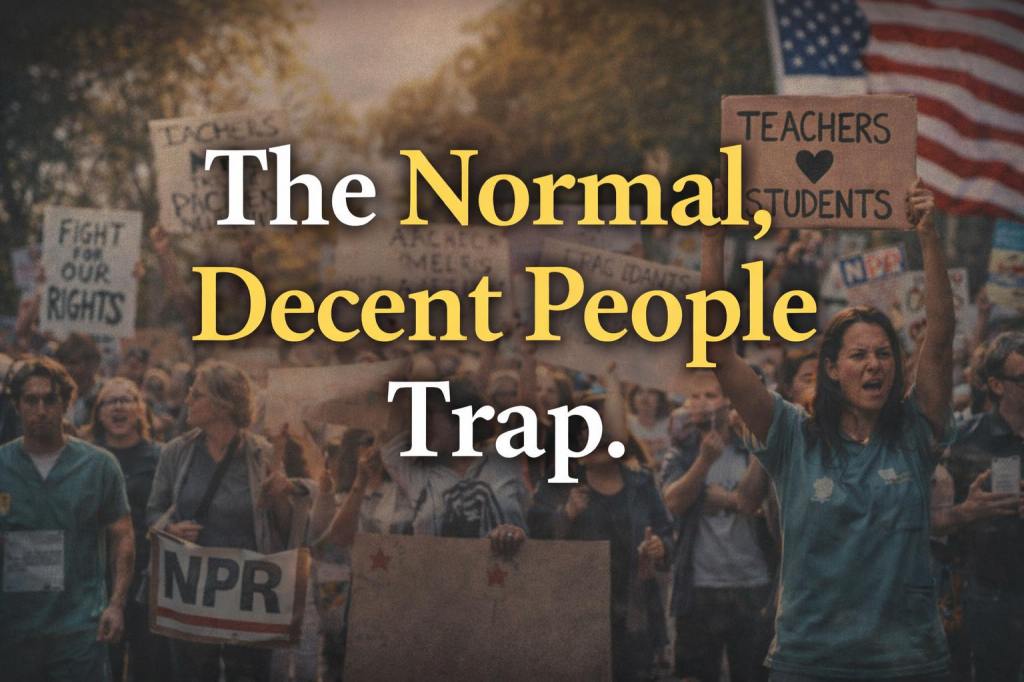
  • The Normal, Decent People, Trap

    The Normal, Decent People, Trap

    Whenever they say “the far left,” replace it with “normal, decent people.” Then read it again.

    Donald Trump:

    “The radical left is destroying our country.”

    → “Normal, decent people are destroying our country.”

    Mike Johnson:

    “We are under siege by the radical left’s agenda.”

    → “We are under siege by normal, decent people’s agenda.”

    J.D. Vance:

    “We must defeat the leftist mob.”

    → “We must defeat normal, decent people.”

    Read those slowly.

    When everyone who believes elections should count, laws should apply, and presidents shouldn’t attempt coups becomes “the far left,” that label stops describing ideology.

    It starts describing anyone who won’t clap.

    This is not a culture war anymore.

    It’s a movement that lost the middle and decided to rename it.

    And that’s the tell.

    When everyone else is normal, decent people what does that make them?

  • That Was An Impressive Military Operation

    That Was An Impressive Military Operation

    Let’s admit something up front. There’s a visceral thrill when the U.S. military pulls off something genuinely hard. Precision. Surprise. Professionals being professional. The capture of Nicolás Maduro had serious action-movie competence. You can respect the execution without apology.

    I do. I’m human.

    I also tend to like things Russia hates. Same with China. Just the kinda guy I am, I guess. And they hate this. Which brings us to the cognative dissonance many of us feel but don’t know quite how to articulate.

    Because impressive isn’t the same thing as smart.

    And capability isn’t the same thing as judgment.

    Trump, naturally, was thrilled. Not just about the operation — about the idea of it. Talk drifted quickly from “mission accomplished” to “maybe we’ll just run Venezuela for a while.” Oil. Management. Fixing things. As if this were a distressed private equity deal and not a sovereign nation.

    Think about that for one second.

    This is the same guy who couldn’t run a casino, struggles to run the country he’s president of, and still hasn’t delivered on the things he actually campaigned on. Grocery prices? Healthcare? But sure — let’s add a collapsed petro-state to the to-do list. What’s one more tab left open?

    And let’s not pretend the timing is random. This is also a spectacular way to change the subject from the Epstein files. Trump himself once warned that desperate presidents start foreign conflicts to distract from bad news. He was right then. He just didn’t realize he was writing his own future Yelp review.

    Yes, Maduro was indicted years ago on drug charges. That part’s real. But when Trump starts openly talking about oil, the “this is about drugs” explanation starts to feel like set dressing. If this were really about narcotics, the press rollout would look very different.

    Here’s a quick thought experiment.

    If a foreign power snatched Trump out of the White House tomorrow and announced they’d “run the country for a bit,” would J.D. Vance nod gravely and say, “Well, fair is fair”? Of course not. He’d be on TV before the rotors stopped spinning, explaining why this was the end of civilization.

    Which brings us to the part that actually matters.

    This sets a precedent.

    Not a legal one. A behavioral one.

    And yes, people will notice. Especially Ukraine. When the most powerful country on Earth demonstrates that regime change is acceptable if you feel justified enough, you don’t get to act surprised when others adopt the same logic.

    So yes — the raid was slick. I won’t deny it. Who doesn’t enjoy watching the good guys win?

    The only problem is the quiet question underneath it all:

    Are we still sure we’re the good guys?

    Because adrenaline isn’t morality. Skill isn’t legitimacy. And flexing power without consistency isn’t leadership.

    It’s just bad precedent.

  • Why Is Christianity Declining In America

    Why Is Christianity Declining In America

    I’ve been thinking a lot lately about what’s killing Christianity in America. I don’t think it’s the drag brunches or TikTok witches or the “liberal media.” I kinda think it’s the Christians.

    Let me explain.

    For centuries, Christianity grew because of what people saw in those who followed Him. They saw kindness. Integrity. Sacrifice. They saw someone who fed the hungry, healed the sick, sat with the outcasts, and asked His followers to do the same. They saw people living in ways that made others say, “I don’t know what that is, but I want it.”

    That’s how faith spreads. Not by force. Not by law. By witness.

    But something’s shifted.

    More and more Americans—especially young ones—aren’t just walking away from church. They’re running. And not because they’re lazy or sinful or corrupted by culture. They’re walking away because the loudest voices in American Christianity no longer sound anything like Christ.

    They hear cruelty. Smugness. Power grabs. Tax cuts for billionaires. Votes against feeding the poor and healing the sick. They hear talk of guns, walls, surveillance, punishment. They hear fear dressed up as faith.

    And then they look around at the people in their lives—their friends, coworkers, neighbors. The ones who don’t believe. The ones who left church years ago. The ones who don’t talk about Jesus but somehow act more like Him than the ones who won’t shut up about Him.

    And it gets awkward.

    When your billboard says “love your neighbor” but your actions scream “just not that one,” people notice. When the folks claiming moral high ground are publicly more obsessed with bathrooms than hungry kids, it starts to feel like a parody of itself.

    The problem isn’t that Christianity has failed. The problem is that too many self-professed Christians have become terrible advertisements for it.

    And if you’re reading this and feeling defensive, maybe pause and ask yourself why. Are you following Him—or just following people who say they are?

    Because at some point, if the church has become the leading supplier of hypocrisy in your town, you don’t get to blame the devil for the empty pews.

  • Why It’s So Hard To Change Someone’s Mind

    Why It’s So Hard To Change Someone’s Mind

    I used to believe facts were currency.

    If I put enough solid data on the table, I assumed the other person would eventually look at the pile, nod, and cash out their wrong opinion.

    This belief lasted longer than it should have. About as long as I believed eating cereal for dinner was a phase, not a lifestyle choice I would later defend vigorously.

    Here’s the uncomfortable reality:

    Facts don’t compete with other facts.

    They compete with identity.

    Most arguments fail not because the evidence is weak, but because the argument is aimed at the wrong target. We assume people are trying to be correct. Usually, they’re just trying to belong.

    Beliefs aren’t opinions.

    They’re uniforms.

    When you challenge someone’s belief, you’re not disputing a fact. You’re challenging their tribe, their past decisions, and the role they’ve been playing for years.

    That’s not a debate.

    That’s a threat assessment.

    This is why evidence loses to belonging.

    Once something becomes tribal, truth becomes secondary. Agreeing with the “wrong” fact isn’t growth — it’s defection. And people don’t defect casually, especially not in public, and especially not online.

    At that point, the argument is no longer about truth.

    It’s a loyalty test.

    This also explains why correcting people rarely works.

    Correction doesn’t feel helpful. It feels like exposure. The brain doesn’t hear new information — it hears you’re in danger. Curiosity shuts down. Defenses go up.

    The cleaner the correction, the harder people cling to the position. From the outside, this looks like stupidity. It usually isn’t.

    It’s self-preservation.

    Changing your mind is expensive.

    It costs pride.

    It costs status.

    Sometimes it costs relationships.

    Admitting you were wrong doesn’t update a belief. It rewrites a story. It forces you to revisit things you said, shared, defended — and sit with the possibility that you were wrong.

    Most people would rather be wrong than embarrassed.

    So bad arguments survive. Not because they’re persuasive, but because they’re safe. They keep you in good standing. They let you avoid that quiet, unwelcome realization — usually late at night — that you might have been played.

    I’m not exempt. I’ve held losing positions far longer than I should have because exiting felt like admitting defeat. Doubling down feels like strength, even when it’s just damage with confidence.

    Facts still matter.

    Just not on the timeline we want, and not in environments where being wrong carries a social cost. Facts work when accepting them costs less than ignoring them.

    Most public arguments fail for a simple reason.

    They think they’re debating information.

    They’re negotiating identity.

    And until we’re honest about that, we’ll keep wondering why the facts were solid…

    and the argument went nowhere.

  • Why a Photo from 2004 Looks Like It Was Taken Last Tuesday

    Why a Photo from 2004 Looks Like It Was Taken Last Tuesday

    You can look at a photo from the 50s, 60s, 70s, or 80s and instantly know the decade.

    Not the year.
    The decade.

    It’s in the lapels. The hair volume. The posture. Even the font on a street sign in the background feels time-stamped. Blur the faces and you’d still know where you were in the timeline.

    Now try that with a photo from 2003. Or 2012. Or last Tuesday.

    Remove the cell phone model from the frame and you’re guessing. A photo from 2004 could be from 2024. Step back far enough and the last twenty-five years collapse into a single, flat visual moment, like a hotel hallway designed to offend no one and be remembered by no one.

    Yes, digital photos don’t yellow. Everything looks permanently “now.”
    But the stagnation isn’t technological. It’s cultural.

    The monoculture is dead.

    For most of the 20th century, there was a current. You either swam with it or against it, but everyone was responding to the same force. In the 70s, you wore the polyester or you rejected it. Even rebellion was legible—because you knew exactly what it was rebelling against.

    Now? Every style that has ever existed is available simultaneously, usually for about fifteen dollars and free shipping. Nothing ever leaves. Nothing has to mean anything. We aren’t inventing new aesthetics—we’re just curating better playlists of the past.

    There is one exception, of course.

    Historians won’t struggle to date photos of people in MAGA hats and merch. Those will be instantly identifiable as 2015–2025—preserved in high resolution, forensically searchable, and destined to cause a very specific kind of generational embarrassment.

    Our cities followed suit. Neutral palettes. Exposed brick. The same sans-serif fonts everywhere. Drop a café from Brooklyn into Berlin or Barcelona and no one would blink. We built a global architecture of anywhere—comfortable, inoffensive, and, like Taylor Swift, impossible to date.

    So if fashion, architecture, and culture no longer mark time, what does?

    Politics.

    It’s the last remaining monoculture—the one thing we all still see, whether we want to or not. When culture fragments into a thousand niches, collective attention has to go somewhere. It went to the fight.

    The past had eras defined by how we looked.

    We have a long, endless present defined by what we scream at each other.

    And if future historians want to date our photos, they won’t look at the hemline or the haircut.

    They’ll look at the panic in our eyes.