Tag: Politics

  • I Tried to Stay Quiet. But Apparently We’re Doing Tanks Now.

    I Tried to Stay Quiet. But Apparently We’re Doing Tanks Now.

    (originally posted on my Facebook page)

    I’ve been taking a break from posting on here. You’re welcome.

    It’s been nice, honestly. Less doomscrolling, fewer arguments with people I went to high school with, and a brief, beautiful window where I could pretend that maybe things were just… normal. But then I saw the day getting closer: Trump is throwing himself a military parade down Pennsylvania Avenue this weekend.

    Yes. Tanks. Planes. Flags. The whole third-world-dictator aesthetic. And I figured, alright—time to crawl out of the bunker and say a thing.

    The excuse is that it’s the Army’s 250th birthday, which is technically true. But it also happens to be Trump’s 79th birthday. So… yeah. It’s less “honoring the troops” and more “celebrating Dear Leader with flyovers and a cake shaped like Trump Tower.”

    But hey, if you’ve ever looked at D.C. and thought, “What this place really needs is a little more North Korea,” your moment has arrived.

    And just to make the timing extra bleak, this is happening one week after Trump sent the National Guard into Los Angeles—over the objections of California’s governor. First time that’s happened in sixty years. Back then, it was LBJ sending troops to protect civil rights marchers. This time, it’s Trump sending troops to protect… his reputation. From protesters.

    You know, real freedom-loving stuff.

    And the executive order he used to do it? Doesn’t even name LA. Doesn’t have to. It’s written vaguely enough to let him send troops anywhere that doesn’t clap on the one and three.

    So no, this isn’t just about Los Angeles. This is a test balloon. See how far he can go, how many people shrug, and how many cameras he can get pointed at himself while the Constitution quietly wheezes in the background.

    And I know how this sounds. I really do. If you had told me ten years ago I’d be writing about a U.S. president using the military to intimidate his own population, I’d have assumed I’d finally lost the plot and was living in an asylum somewhere yelling at soup cans. But here we are.

    ICE is already ramping up raids. The deportation push is real. The mass roundups? They’re not a scare tactic. They’re part of the plan. Trump’s asking for $185 billion for immigration enforcement—which is more than the UK and France spend on their entire militaries. That’s not border security. That’s infrastructure for authoritarianism.

    Stephen Miller—who still looks like he was carved out of cold deli meat—is already talking about deporting 3,000 people a day.

    The thing that makes this moment so dangerous is how normal it all feels now. A few years ago, something like this would’ve sparked national outrage. Now it’s just another Tuesday. Another broken norm. Another test to see what we’ll tolerate. And spoiler: it’s a lot.

    Democrats are out here debating whether it’s too “alarmist” to use the word fascism, while Republicans are busy making sure they’re not the next ones to get publicly humiliated by Trump’s Truth Social posts. At this point, he could replace the Lincoln Memorial with a sculpture of his meme coin and they’d all show up to applaud.

    Anyway. I didn’t want to break my non-posting streak for this. I was trying to keep the blood pressure in a manageable range and pretend the world was just weird, not dark. But the tanks are coming. The flags are flying. The script is writing itself. And if we’re not careful, we’ll look up four days from now and realize we just watched the next chapter of American decline roll down the street while we argued about gas prices.

    Happy almost-birthday, Mr. President. Hope your little party goes great. I’ll be over here, quietly panic-Googling “how to spot the early signs of soft authoritarianism” like a normal person.

  • Defending Democracy: Our Moment to Act

    Defending Democracy: Our Moment to Act

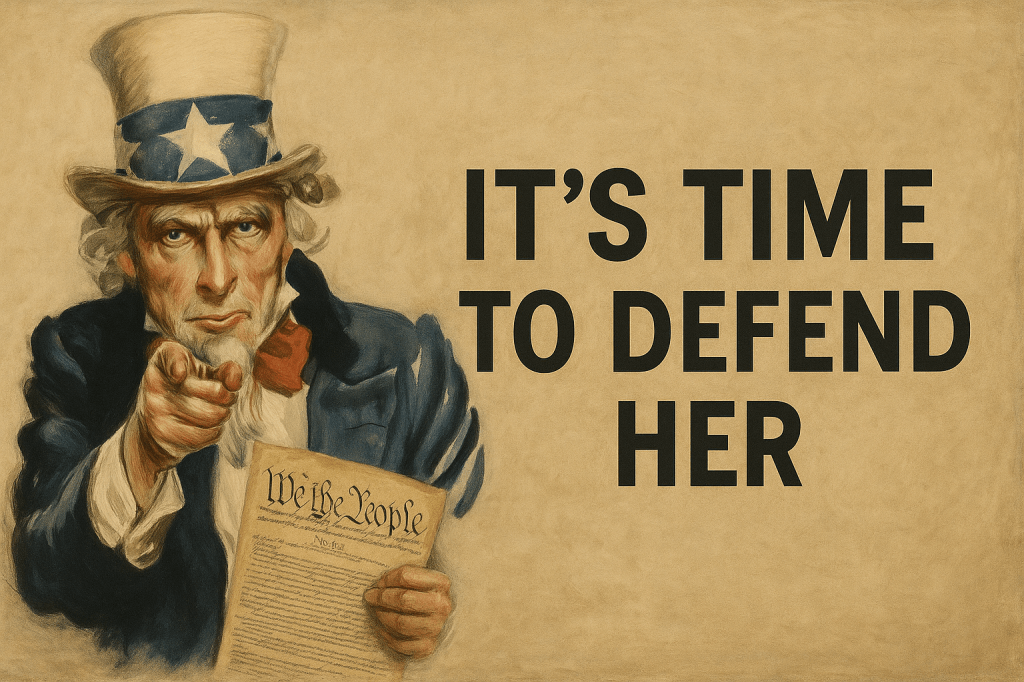
    It’s easy to feel overwhelmed in the face of what is nothing less than a coup against the Constitution—but we must not falter. Every generation faces a defining moment, a call to defend the great American experiment. We don’t get to choose when, but we do choose how we rise. Now is our time.

    These are dark days. Neighbors, friends, and loved ones have been swept up in a movement that thrives on resentment, division, and cruelty. We see bigotry not just tolerated but celebrated. This has always been part of America’s struggle, but we once shamed it into the shadows and called upon the better angels of our nature. Now, with permission from Trump and his politics of grievance, it flies proudly in the open. The Republican Party has been hijacked—not by conservatives of principle, but by those who seek to dismantle democracy itself. Their goal is clear: autocratic breakthrough. The moment they overcome our democratic guardrails, the point of no return will be crossed.

    We are witnessing firsthand just how important it was to vote. This crisis exists because not enough of us turned out. Not enough of us took this threat seriously. We allowed it to be sane-washed—a tactic where extremism is repackaged as reasonable, where authoritarianism is softened with careful language, making it easier for people to dismiss the danger. They even twist logic to justify abhorrent behavior. But the consequences of that mistake are now undeniable.

    Our job is simple: we cannot let this continue. We must stand firm, push back, and force hatred back into the margins of history where it belongs.

    But resistance alone is not enough. We must engage. It starts with showing up—joining protests in person and online, flooding Congress with calls and emails, demanding that they rein in this administration. Call: (202) 224-3121 and follow the instructions. We must be prepared to stand up for what’s right and, crucially, to welcome traditional Republicans into our fold as we unite for the common cause of saving our Constitution.

    America has never fully lived up to its ideals, but we have always moved forward. A more perfect union is built not by ignoring our failures, but by striving to correct them. Progress has never been easy, but history proves it is always possible.

    This fight will not be won overnight, but it will be won. If we stand together, if we refuse to yield to despair, if we meet this moment with courage and conviction—we will prevail.

  • How the Wealthy Control Assets and Impact the Economy

    How the Wealthy Control Assets and Impact the Economy

    When the wealthy have money, they don’t just let it sit in a bank account collecting dust. They use it to buy real assets—houses, office buildings, stocks, businesses, art, yachts, and even sports teams. The more they buy, the more the prices of those assets rise, making it harder for middle and working-class people to afford them. Instead of owning, more and more people end up renting these things back from the wealthy, which just makes the rich even richer.

    This is how wealth keeps getting concentrated at the top and the way trickle-down economics failed us. The U.S. and much of the Western world haven’t seen this level of wealth inequality since the 1920s. Back then, the wealth gap was a major factor that led to the Great Depression. We’re seeing the same trend today, and if we don’t do something about it, most Americans will experience lower living standards in the future. That’s why so many younger people have lost faith in the American Dream—they just don’t see a realistic path to financial security, homeownership, or upward mobility.

    The only reasonable way to fix this is by taxing the wealthy and using that money to invest in our country’s future. We need better public education, greater access to healthcare, and major investments in infrastructure. These things would directly improve people’s lives and address the growing frustration of those who feel left behind by globalization and the extreme concentration of wealth. Right now, the top 1% controls about 31% of the total wealth in the U.S., while the bottom 50% has just 2.6%. That’s not a functioning economy—it’s a system rigged to benefit the few at the expense of the many.

    Trump’s budget proposal does absolutely nothing to address these problems. Instead, it doubles down on the same failed trickle-down policies we’ve seen before: cutting spending on social programs, borrowing even more money to run up the national debt, and handing out massive tax breaks to the ultra-rich and corporations. Nothing in this plan lowers the cost of housing. Nothing makes groceries more affordable. Nothing helps raise wages or improve the standard of living for working Americans.

    If we keep going down this road, we’re only going to see more of the same—an economy where the wealthy hoard more and more, while everyone else struggles to get by. It doesn’t have to be this way. We can choose policies that actually invest in people and create opportunities for everyone, not just the privileged few. The question is whether we have the political will to do it.

  • Hey MAGA: Let’s talk about Hamas and Israel—and then about what’s happening right here in the U.S.

    Hey MAGA: Let’s talk about Hamas and Israel—and then about what’s happening right here in the U.S.

    In Hamas-run schools, kids are taught to hate Jews from the time they can walk. It’s not subtle. It’s in the textbooks, in the songs they sing, in the lessons drilled into them every single day. It’s the foundation of their education. And that has always been a roadblock to peace.

    During negotiations, Israel has repeatedly asked Hamas for a simple first step: stop teaching children to hate Jews. Just stop making it part of the curriculum. Hamas never agreed. Because when you spend decades shaping entire generations to believe the other side is their mortal enemy, peace isn’t really on the table.

    Now, let’s talk about America.

    I’ve noticed a disturbing parallel. Increasingly, the right sees the left not as the other half of a shared country—not as people they argue with but ultimately respect—but as the enemy within. Not political opponents, but traitors. And sure, people can go back and point fingers about who started it—just like they do in the Middle East—but at some point, we have to decide to break the cycle.

    I’ve seen people on the left contribute to this toxic divide too. But the glee, the joy that comes from “owning the libs”? That’s overwhelmingly pushed from the right. And it comes straight from the top.

    Just the other day, Trump sent out an email hawking t-shirts with insults about the left, saying something along the lines of:

    “Imagine how fun it will be to walk down the street in this shirt while loony liberals give you nasty looks.”

    This isn’t leadership. This is a guy whose entire strategy is division. He does it during national disasters—hurricanes, wildfires, plane crashes. He does it every single day.

    We have to come together. We have to start somewhere. And I believe a lot of people on the right are waking up. They didn’t vote for a dictator. They didn’t vote to align America with Russia and North Korea. They didn’t vote to throw democracy out the window.

    But that’s exactly where this road leads.

    It’s time to decide: Do we keep playing into the divide? Or do we step back and ask what kind of future we actually want?

  • To MAGA: Was Voting For Trump the Lesser of Two Evils? Let’s apply some critical thinking together and find out.

    To MAGA: Was Voting For Trump the Lesser of Two Evils? Let’s apply some critical thinking together and find out.

    I keep hearing from some MAGA friends that they’d consider voting for a Democrat if they’d just run a “halfway decent candidate.” That they don’t love Trump, but he’s still the lesser of two evils.

    Let’s take a step back. The lesser evil? Trump?!

    We’re not talking about a normal politician here. We’re talking about someone who:

    • Fired 17 independent inspectors general in his first week back, gutting the people responsible for keeping government corruption in check.

    • Gutted the federal workforce by imposing a hiring freeze and replacing career officials with political loyalists, dismantling expertise across agencies.

    • Abandoning Europe to Russia, signaling that NATO allies should fend for themselves, emboldening Putin’s expansionist ambitions.

    • Allowed China to strengthen its dominance in the Pacific while stripping U.S. influence abroad.

    • Tried to freeze $3 trillion in federal funding, threatening the economy until a judge had to step in and stop him.

    This is not the lesser evil. This is reckless, vindictive, and dangerous.

    The Socialism Scare Tactic

    One of the most common defenses I hear for Trump is that Democrats—Biden, Harris, all of them—are taking America toward socialism or communism. But let’s be real: we already have elements of socialism in our country, and they aren’t the problem.

    • Social Security, created under FDR and strengthened by Republican presidents, is one of the most popular programs in U.S. history.

    • Medicare, signed into law under Democratic leadership but expanded under Republican administrations, ensures seniors don’t go bankrupt from healthcare costs.

    • The G.I. Bill, passed under a Democratic president but championed by conservative lawmakers, helped millions of veterans buy homes and get an education.

    • Interstate highways, police departments, fire departments, public schools—all forms of government-funded programs that people rely on daily, and no one is calling them communism.

    In reality, the U.S. has always been a mixed economy—capitalist at its core, but with government programs that provide a safety net where the free market fails. That’s not socialism; that’s smart policy.

    And if the fear is that Biden or Harris are secretly planning to turn the U.S. into Venezuela, let’s look at actual policies:

    • The stock market rose under Biden. That doesn’t happen in socialist economies.

    • Corporate profits grew under Biden. That doesn’t happen in socialist economies.

    • The private sector added millions of jobs under Biden. Again, not socialism.

    If we’re being honest, the real economic disaster right now isn’t creeping socialism—it’s Trump’s reckless spending, debt ballooning policies, and economic chaos.

    Would Kamala Harris Really Have Been Worse?

    Let’s assume, for a moment, that you don’t like Harris. Maybe you think she’s ineffective, uninspiring, or not the right choice for president. Fine. But would she have been worse than Trump?

    Would she have:

    • Put American democracy in jeopardy?

    • Tried to block government funding to score political points?

    • Torn down U.S. alliances while cozying up to authoritarian regimes?

    • Handed over federal agencies to unqualified cronies?

    No, she wouldn’t have. We may not agree on policies, but we can agree that basic government functioning shouldn’t be at risk every day.

    This Is Bigger Than Policy Disagreements

    This isn’t about loving the Democratic Party. It’s not about being thrilled with Joe Biden or Kamala Harris. This is about the fact that our country is being deliberately weakened—economically, diplomatically, and institutionally—by someone who is putting his own interests above everything else.

    And the worst part? He’s not even hiding it.

    So when I hear people say they’d consider voting for a Democrat but just can’t stomach it, I have to ask—how bad does it have to get? How much more damage do we have to see before we stop pretending that Trump is just another politician?

    This isn’t about left vs. right anymore. It’s about whether or not we still have a functioning democracy when all of this is over.

  • How To Know If You Are (Or Anyone Is) An Intellectually Honest Person

    How To Know If You Are (Or Anyone Is) An Intellectually Honest Person

    I’ve always believed that, regardless of our differences, most people value truth. Yet, it’s disheartening to see individuals in my social media circles persistently sharing misinformation, even after being corrected. This behavior challenges the notion of intellectual honesty.​

    I’m not talking about differing opinions based on the same facts. I’m talking about those “alternative facts” that misshape our opinions.

    The Media Landscape and Misinformation

    It’s perplexing that while many distrust mainstream media, they place unwavering trust in right-leaning outlets that have been caught spreading falsehoods.​

    · Fox News settled a $787.5 million lawsuit after admitting to knowingly disseminating false election claims.​

    ·Tucker Carlson even after leaving Fox, continues to push narratives that he knows are misleading or completely false—whether it’s the Jan. 6 insurrection, Putin’s intentions, or manufactured culture war nonsense.

    · Some right-wing influencers turned out to have been literally on the payroll of Russian propaganda operations, pushing Kremlin narratives under the guise of “alternative media.”

    While MSM isn’t without fault, they typically issue corrections and uphold accountability. Conversely, certain right-leaning outlets have faced legal repercussions for deliberate misinformation.​

    Concerning Settlements and Their Implications

    Recent developments have added to the confusion. For instance, Meta agreed to pay $25 million to settle a lawsuit filed by President Trump after the company suspended his accounts post-January 6. Similarly, ABC News settled a defamation lawsuit by agreeing to contribute $15 million to Trump’s presidential library. ​

    These settlements, driven by fears of backlash or potential violence from certain groups, inadvertently suggest equivalence between MSM and outlets known for misinformation. This false equivalence fuels narratives like “they’re all the same,” undermining genuine journalistic efforts.​

    The Chilling Effect of Threats and Intimidation

    Alarmingly, some Republican members of Congress have expressed fears for their physical safety, influencing their political stances. Representative Eric Swalwell highlighted that threats to them and their families deter GOP officials from criticizing the president. Such intimidation tactics are reminiscent of strategies used by autocrats to consolidate power, stifling dissent and eroding democratic principles.​

    Reflecting on Intellectual Honesty

    A few years ago, if asked how many times a news source could mislead before losing credibility, many would likely say, “Not many.” Yet, today, some continue to trust sources with documented histories of deception.

    So, I pose these questions:

    Are you an intellectually honest person?

    Do you genuinely care about the truth?

    Or do you only seek information that confirms your existing beliefs, which you must allow, may be shaped by misinformation if you consume conservative media these days.

    It is unfortunate, because honest conservative voices are needed and I find them at The Bulwark, The Warning by Steve Schmidt, David Frum, and Rick Wilson at The Lincoln Project. If you’re looking for an honest conservative perspective on the Ukraine War I suggest Ryan McBeth or Professor Darin Gerdes. They can all be found on YouTube.

    If you correct yourself and allow your opinions to be changed upon realizing you’re wrong, that’s commendable. But if you persist in spreading falsehoods after being presented with facts, the issue may not be misinformation—it might be you.

    In these challenging times, upholding truth and intellectual honesty is more crucial than ever. Let’s strive to be better, for the sake of our discourse and our democracy.

  • Why MAGA Doesn’t Resemble Yesteryear’s GOP

    Why MAGA Doesn’t Resemble Yesteryear’s GOP

    The Republican Party of 20 years ago? Pro-democracy, pro-international alliances, and definitely NOT an outlier among Western conservatives. Fast forward to today, and the MAGA movement is rewriting the script—big time.

    1️⃣ A New Tribe: MAGA Republicans aren’t just breaking with the left—they’re breaking with the entire Western conservative tradition. Their mindset aligns closer to Russia’s Putin and Turkey’s Erdoğan than to Britain’s Tories or Germany’s CDU.

    2️⃣ Goodbye Global Cooperation: The old GOP was about strong alliances (think Bush and Blair “shoulder to shoulder”). MAGA? Not so much. From pulling military support from allies to shrugging at international norms, Trump’s America plays by different rules.

    3️⃣ Autocracy Over Democracy? The Republican Party once championed democracy. Now, MAGA’s values—authoritarian tendencies, distrust of institutions, and nationalism—are pulling them into a different ideological orbit.

    4️⃣ Economics as a Weapon: Trade wars, economic self-harm, and an “America First” approach that even conservative economists are scratching their heads over—this isn’t Reaganomics.

    5️⃣ Shock & Awe Politics: Trump, JD Vance, and their crew operate on a different frequency. What seems disastrous or erratic to traditional Western leaders is just another Tuesday in MAGA-world.

    Bottom line? MAGA isn’t just a more extreme version of the old GOP—it’s something entirely different. If Western democracies don’t recognize this shift, they’ll keep getting blindsided.

    Inspired by: Financial Times article by John Burn-Murdoch

  • When We Accidentally Decided That Authoritarianism Is Okay

    When We Accidentally Decided That Authoritarianism Is Okay

    As a Gen X American, I grew up believing that authoritarian regimes—communism, dictatorships—were the enemies of everything we stood for. The Soviet Union, East Germany, Cuba—those were the cautionary tales. We learned that democracy meant something special: a government of the people, by the people, for the people. That was America’s promise, our core value.

    But today, it feels like that lesson has been forgotten by a worrying number of Americans. Some have become convinced that Democrats have gone so far off track that the only solution is to embrace a different flavor of authoritarianism—a right-wing strongman who promises to restore order by force rather than consensus.

    How did we get here?

    I think it all traces back to when our news media stopped being accountable to truth. The pivotal moment came in 1987, when the FCC abolished the Fairness Doctrine, a rule that required broadcasters to present controversial issues of public importance in an honest, balanced way. Suddenly, news outlets could openly pick sides, prioritize profits, and turn journalism into entertainment or partisan propaganda.

    Fast forward a few decades, and we have a polarized America, divided not by reality but by the media each side consumes. Many of us no longer agree on basic facts. Once truth is lost, authoritarianism starts looking tempting—especially if it promises to silence the “other side.”

    But history has warned us again and again that authoritarianism never ends well. Not in East Germany. Not in Cuba. Not in the Soviet Union. And certainly not here.

    We need to wake up and remember what we once knew instinctively: democracy isn’t perfect, but it’s infinitely better than the alternative. We have to reclaim the idea that government of the people, by the people, and for the people is still worth fighting for—even if we have to fight for it within our own borders.

  • What is the FIRST thing you notice about someone?

    What is the FIRST thing you notice about someone?

    Science tells us the very first thing we instinctively notice about someone isn’t their height, weight, hairstyle, or even that questionable fashion choice from the ‘90s—it’s whether they’re male or female. And when there’s ambiguity, our brains can glitch a bit, making us do a subconscious double-take. It’s not prejudice; it’s just human wiring.

    Now, stick with me here. Just like you, I’m still a bit salty about Pluto losing its planet status. Science updates can mess with our heads, especially when they change how we see the world—or ourselves. But here’s the deal: science has revealed that gender isn’t a simple either/or thing. I know, right? 🤯

    Think about it—within the category of men you know, some might be macho football fanatics, and some might prefer writing software or novels. Women range from the ultra-feminine to those who could probably beat me at arm-wrestling (honestly, not that high of a bar). Gender traits vary, and now science shows us that variation doesn’t neatly stop at the borders we’ve always assumed.

    I understand the discomfort around this—change can feel unsettling. But refusing to acknowledge this complexity is a bit like stubbornly insisting a tomato is a vegetable. Comforting? Maybe. Accurate? Not quite.

    And speaking of accuracy, did you know there’s an entire range of naturally occurring biological variations in gender anatomy? Some individuals are born intersex, with genuinely ambiguous physical characteristics due to various combinations of chromosomes, hormones, and anatomy. Science recognizes these realities, and we’ve largely learned not to ridicule people for traits they can’t control—like height, skin color, or sexual orientation. It’s time we grew up and added gender identity to that list of basic human respect.

    Which brings me to sports – the big controversy of the political moment. A common objection I hear is, “But what about sports fairness?” Look, fairness matters. No one wants LeBron James competing in women’s gymnastics—although I’d honestly pay good money to see him try (and I tried for at least 15 minutes to get AI to generate an image of that for us to enjoy but apparetly it goes against something called “Standards & Practices” but I think ChatGPT’s creators have lost their sense of humor). But seriously, we already categorize athletes based on criteria like weight, age, and skill. Adding hormone levels or other scientifically sound criteria to ensure fair competition isn’t some radical move. The Olympics do it. Professional sports do it. It’s simply adjusting categories to reflect reality, something sports have always done.

    The goal isn’t to erase fairness; it’s to embrace reality with compassion, reason, and a bit of humor. So yeah, Pluto might not be a planet anymore, and gender might not be strictly binary, but we’re still orbiting in the same solar system. Let’s keep adapting, laughing a bit, and relying on science to guide us forward.

  • Why Changing Someone’s Mind About Trump Is So Hard

    Why Changing Someone’s Mind About Trump Is So Hard

    Ever try to change someone’s mind about Trump? Not easy, is it? Feels impossible sometimes. But here’s the thing—it’s not just Trump supporters who struggle with this. We all do.

    Changing your mind isn’t just about facts. If it were, most Trump supporters would have abandoned him the moment he promised to wipe out the national debt and then added trillions to it. Or when he swore Mexico would pay for the wall, and taxpayers ended up footing the bill. Or when he said only the “best people” would work for him, and half of them ended up indicted, testifying against him, or both.

    But facts aren’t enough, because changing your mind isn’t just an intellectual process—it’s an emotional one. And the bigger the belief, the harder it is to let go.

    Now, imagine that belief isn’t just about a policy or a politician, but about who you are as a person.

    That’s what Trump sold. Not just an agenda, but an identity. He told people they weren’t just supporting a candidate—they were saving America. They weren’t just voters, they were patriots, warriors, the last line of defense against corruption and socialism and the deep state.

    And when you believe that deeply, admitting you were wrong isn’t just humbling—it’s devastating. Because if Trump was a fraud, if he was conning them the whole time, what does that say about them?

    That’s why no matter how many times he lies, fails, or even turns on his own people, they hold on. Because letting go feels like losing the fight of their lives.

    But here’s the thing—changing your mind isn’t losing. It’s growth. It doesn’t mean you were stupid. It means you trusted someone who turned out to be unworthy of it. And we’ve all done that.

    At some point, the evidence against Trump will be too overwhelming to ignore. And when that moment comes, I hope people remember that seeing the truth doesn’t make you weak—it makes you free.