Spain isn’t just “doing okay” while the rest of Europe nurses a hangover — it’s Europe’s outlier in a good way. Since early 2024, Spain has been growing at roughly three percent a year while the eurozone plods along near one. Credit markets noticed: S&P bumped the sovereign in mid-September, and within days Moody’s and Fitch followed suit. When all three ratings agencies are suddenly in a good mood about you, it’s usually because the story is real, not vibes.
The growth mix isn’t mysterious:
People: Spain opened the door while others slammed it. Net immigration has averaged around six hundred thousand a year since 2022, mostly working-age and heavily Latin American — which makes integration faster (language, culture, networks). That’s not a talking point; that’s the math. It’s also a big reason employment has hit records and consumer demand is sturdy.
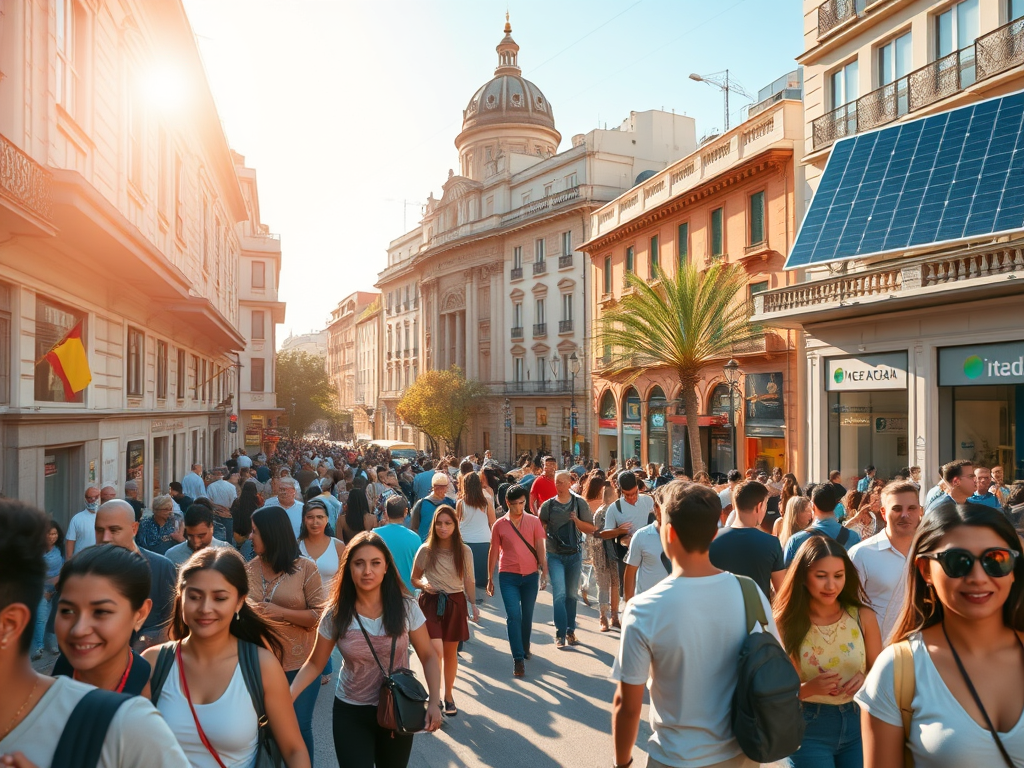
Power: Cheap, abundant renewables have turned Spain from a sunny tourist postcard into an energy-cost arbitrage play for industry and data-heavy services. In 2024, renewables supplied a record ~56% of electricity, and year-to-date 2025 has pushed higher. That lowers input costs and draws capital. (The grid, yes, needs beefing up after the April outage — and investments are now flowing.)
Policy follow-through: NGEU funds have been deployed into real stuff (infrastructure, modernization), and earlier labor reforms tightened up job stability. Brussels’ baseline: Spain can still clock around 2.6% growth in 2025 — in Europe, that’s sprinting.
Now for the adult supervision: per-capita gains lag headline GDP, productivity is still yawning, and unemployment — although falling to around 10% — remains among the eurozone’s highest. The fix isn’t a new slogan; it’s a pipeline: streamline rules, crowd in long-term risk capital, and upskill into higher-value services (IT, finance, engineering). That’s where you turn an immigration-led demand pop into durable per-capita prosperity.
How Madrid plays its power in Europe
Spain’s “soft power” used to be sunshine and tapas. Today it’s growth, grid, and people — a combination that gives Madrid surprising clout in EU tables where sluggish peers need a positive outlier. The message Spain quietly sends in Brussels: we can cut emissions, grow faster than you, and do it without slamming the door on newcomers. That lets Spain lean into:
Energy bargaining: With wind/solar scaling and interconnectors improving, Spain can punch above its weight in talks about EU power markets, grids, and decarbonization timelines. The subtext is “we’ve shown this can work — now fund the pipes.”
Fiscal credibility: Upgrades from S&P/Moody’s/Fitch improve borrowing optics just as Europe re-tightens fiscal rules. That buys room to keep investing while others cut.
Migration realism: While some capitals grandstand at the border, Spain’s labor-market-first posture is adding capacity exactly where Europe is short. That makes Madrid the practical voice when migration inevitably returns to the EU agenda.
What could blow this up? Politics and housing. Sánchez governs with dental floss; big reforms are a knife fight. And if rents keep outrunning wages and public services stay tight, tolerance for high inflows could fray — fast. The economic story is strong; the social license needs maintenance.
The scoreboard (for the macro geeks)
2025 growth: Bank of Spain and the European Commission are in the ~2.6% camp; the government’s latest revision is a hair higher after a better-than-expected Q2. Either way, Spain is still outrunning the bloc.
Labor: Unemployment near 10.3%, lowest since 2008 but still elevated versus EU peers. Youth unemployment remains sticky.
Energy: 56% renewables in 2024, roughly ~59% so far in 2025 — with grid investment pledged after the spring blackout.
Catalonia: where things actually stand
Madrid bet on de-escalation and legal normalization. The Amnesty Law for the 2017 independence cases passed and, crucially, Spain’s Constitutional Court upheld it on June 26, 2025. Application is case-by-case: many have already benefited, while high-profile figures like Puigdemont are still working through the process. Politics, not prisons, now dominates.
On public sentiment, support for independence has eased off its highs, bobbing around ~38–40% in 2025 surveys, with the Socialists (PSC) leading regionally and pro-independence parties recalibrating. Translation: the temperature is lower, the question isn’t “UDI tomorrow” but “what’s the next workable status that keeps growth and dignity intact?”
Bottom line: Spain’s edge right now is a rare mix — demographic momentum, green electrons, and steady EU cash channeled into the real economy. If the ruling class can keep the coalition intact, scale skills faster than rents, and turn grid upgrades into a 2030 powerhouse, Spain’s “quiet flex” becomes structural. If not, it risks being remembered as a great run of form that never quite converted to per-capita lift. I’m betting the former — but only if they keep treating immigration as an asset and productivity as the main event.
Let’s talk about how weak-minded you have to be to fall for Tulsi Gabbard’s latest stunt—a breathless declaration that the entire Russia investigation was a “hoax,” complete with a memo she declassified like it’s the Rosetta Stone of victimhood.
Except it’s not. It’s theater.
And for anyone paying attention over the last eight years, it’s also nonsense.
Let’s do what Tulsi and her followers refuse to do: look at the actual facts.
The Mueller Report—the result of a two-year investigation led by a lifelong Republican, by the way—found that:
Russia interfered “in sweeping and systematic fashion” in the 2016 election.
The Russian government’s goal was to help Trump and hurt Clinton.
The Trump campaign welcomed the interference and, in multiple cases, had contact with Russian operatives.
Paul Manafort, Trump’s campaign chairman, handed over internal polling data to Konstantin Kilimnik, a man the FBI identified as having ties to Russian intelligence.
Trump himself tried to obstruct the investigation on multiple occasions—ten, to be exact. Mueller didn’t charge him only because a sitting president couldn’t be indicted under DOJ guidelines.
Then came the Senate Intelligence Committee report—and let’s be clear here: this wasn’t the Democrats’ spin.
It was a bipartisan investigation led by Republican Senator Richard Burr. It ran for over three years, produced more than 1,000 pages of findings, and concluded—unanimously—that Russia did, in fact, interfere in the 2016 election and that Trump associates posed counterintelligence threats.
You don’t have to love Hillary Clinton. You don’t have to love the FBI. But you do have to completely ignore all evidence—and I mean every shred of documented reality—to believe Tulsi Gabbard’s narrative.
She’s not uncovering some hidden truth. She’s throwing a smoke bomb into the room so no one notices the fire.
It’s no coincidence this memo dropped just as Trump faces backlash for allegedly burying the Epstein files. When in doubt, blame Obama. Distract. Project. Repeat.
Tulsi isn’t exposing a crime. She’s providing cover for one.
So if you find yourself nodding along with this latest fever dream, maybe ask yourself: how many lies have you been fed—and how many more are you willing to swallow just to keep your illusions intact?
Because this isn’t about justice. It’s about erasure. It’s about rewriting history to protect a man who’s never faced accountability in his life.
And Tulsi Gabbard is just the latest volunteer in the cleanup crew.
America’s superpower status didn’t happen by accident. For decades, we’ve stood on two mighty pillars: unparalleled military strength and a vast network of global trade. Our Navy doesn’t just float around looking intimidating; it actively safeguards international trade routes, ensuring that goods flow smoothly for us and our allies. This protection isn’t just about economics; it’s about influence. From Hollywood movies to fast-food chains, our cultural footprint is everywhere, shaping tastes and ideas worldwide.
But power isn’t just about flexing muscles; it’s also about building relationships. Through diplomacy, aid, and cultural exchanges, we’ve cultivated goodwill that benefits us on the global stage. Countries have trusted us, aligning their security and economic strategies with ours.
Enter Trump. In just a few months back in office, he’s managed to shake this trust to its core. Our closest allies are now rethinking their ties with us:
• Canada: They’re reconsidering their purchase of 88 F-35 fighter jets from Lockheed Martin, exploring alternatives like the Swedish Saab Gripen, partly due to the unpredictable nature of U.S. policies under Trump.
• European Union: The EU has launched the “Readiness 2030” strategy to reduce dependency on U.S. defense systems, emphasizing the purchase of European-made military equipment. This move aims to bolster European defense autonomy in response to shifting U.S. foreign policies.
• Intelligence Sharing: The suspension of U.S. intelligence-sharing with Ukraine has alarmed European allies, prompting them to reconsider their reliance on U.S. military support and explore independent defense strategies.
Now, some might say, “Well, isn’t it good that Europe is stepping up?” And yes—in theory, more self-reliant allies are a good thing. But not when they start buying their defense equipment from someone else.
We want them buying from us—because it keeps our defense sector strong, our tech cutting edge, and our alliances tight. When they buy elsewhere, they start building loyalties elsewhere. That means fewer shared systems, less interoperability, and more opportunities for geopolitical rivals to wedge their way in.
Losing our dominant position comes with a price tag that most people don’t see. If the world stops trusting the U.S., they stop trusting the dollar—and that’s where it gets real. De-dollarization means the U.S. loses its incredible financial leverage. It means more inflation at home, higher interest rates, weaker buying power, and less influence abroad. The dollar isn’t just currency; it’s part of what makes us the center of the global economy.
When America falls from that perch, it won’t just be about bruised egos—it’ll be about a seismic shift in the global order. Less stability, more regional conflict, more power in the hands of authoritarian regimes that don’t give a damn about democracy or human rights.
Building trust and dominance takes decades; destroying it can happen in weeks. Trump’s actions are pushing our allies to question their alignment with us, potentially weakening the very foundations of our global standing.
If we want to keep America #1, we need to remember that leadership isn’t just about power—it’s about partnership. Undermining our alliances doesn’t make us stronger; it paves the way for others to take our place.
It’s easy and lazy to simply return from a trip to North Korea and relate the surreal reality. I’d love to (and will) recount experiences and conversations I had and I’ll do my best to make it an entertaining and informative read. But if you know anything about North Korea you already know the anecdotes about the isolationism, the lack of knowledge of the outside, the orchestrated, contrived, and sometimes staged tours given to foreigners who are adventurous enough to get approved for visas and travel to the hermit kingdom.
North Korea fascinates me. It’s potentially a nuclear-armed nation with a temperamental, thin-skinned regime that has a hair-trigger and a complicated relationship with reality.
But after consuming all the documentaries, Vice episodes (including those featuring Dennis Rodman), and reading the accounts of recent visitors, I hungered to get past the staring-and-scoffing stage. I aspired to more. I wanted to understand the root causes of the madness. Having moved to Spain just 10 years beyond that country’s emergence from a right-wing dictatorship, I know there are layers of complexity to any country’s politics, economics, culture, and relationships with the outside. I know that if we can’t comprehend how North Korea views itself and how it understands the world we can’t begin to predict its behavior or even engage it constructively.
So before I delve into my own experiences and observations in upcoming posts, I want to set the stage in this post with what brought North Korea to its current situation. I’ll keep it light and short.
Beginning in 1910, all of Korea was occupied by the Japanese and the Japanese were brutal occupiers. Many Koreans fled to Manchuria to escape the brutality including a particular family by the name of Kim. After Japan lost World War II, the Soviet Union and the western allies (led by the US) split Korea across the middle and forced Japan out. Although the United Nations had a plan to unify the country and hold elections, before they could do so the Soviet Union recognized the northern half as a sovereign country and installed the son of the Kim family – who subscribed to communist ideals and had proven to be an effective leader – as the vetted ruler.
Kim Il Sung (surnames come first in Korean) quickly organized his military and set his sights on reunifying all of Korea under his new government. With the help of Soviet and Chinese espionage services, Kim Il Sung reached the erroneous conclusion that the United States would not intervene if the North invaded the South. And so the Korean war began in June of 1950 with Kim Il Sung launching an invasion.
Pyongyang, North Korea after allied bombing during Korean War
At first it looked good for Kim Il Sung but after nearly accomplishing his goal of conquering the entire peninsula, the United Nations interceded and the United Stated provided almost 90% of the 341,000 troops that drove Kim’s forces back deep into the North, almost back to China. Between 1950 and 1952, the US dropped more conventional ordinance and napalm on North Korea than they dropped throughout all of the Pacific campaign of World War II. In fact, not a single building of any significance was left standing in North Korea. You can imagine the public sentiment toward the US that provoked in the North.
In order to help Kim Il Sung prevent a complete loss, China stepped in with large numbers of troops and the Soviet Union began providing technical and strategic assistance. They pushed the United Nations-backed allies back toward the original lines where things stagnated resulting in a tactical stalemate.
That Chinese-and-Soviet-assisted comeback essentially restored the line between the North and South at the 38th parallel (where it had been prior to the North’s invasion) and caused the US to propose a cease-fire, which was signed in July of 1953. The cease-fire remains in place today but technically the war has not ended. The US today maintains roughly 28,500 soldiers, sailors, airmen, and Marines in South Korea to counter-balance the North.
Immediately, Kim Il Sung led a massive rebuilding campaign in the North and began establishing one of the most successful-ever cults of personality. He began calling himself the “Great Leader” and had statues and monuments built in his honor. He established a centrally organized economy with state-owned industry and collective farms in the traditional Marxist fashion.
One of the most important tenants of his power involved contriving the narrative that he actually won the war. The narrative points to the fact that the South had provoked skirmishes along the border and the persistence of rumors that it was actually the South that was about to invade the North and try to unify all of Korea under the South’s rule. Thus, according to this narrative, the North’s invasion was actually provoked and was a defensive measure. Holding the line at the 38th parallel, creating a stalemate, forcing heavy losses among the Americans, and forcing the US to request the armistice agreement counted as a victory for Kim Il Sung.
Kim Il Sung created one of the most successful cults-of-personality in human history
That was his story and he stuck to it. It’s the narrative that is taught as gospel in the North, officially known as the Democratic People’s Republic of Korea (DPRK). To North Koreans, the United States is the unprovoked country that ruthlessly bombed them into the Stone Age. To strengthen his grip on power, Kim Il Sung claimed that the US deliberately spread diseases among the North Korean population. Though both Moscow and Beijing later determined these claims to be false, they helped spread the rumors for many years to come.
Rebuilding was a herculean task and Kim Il Sung drove the country forward by imbuing a staunch culture of self reliance. This idea of the masses being the masters of their destiny, counting only on their own resources, became known as “Juche” (pronounced joot-chay).
By the early 1990’s North Korea was mostly isolated from the rest of the world except occasional contact and trade with Russia, China, Cuba, and Vietnam. The country had over-spent on arms and its agriculture sector was unable to produce enough food to feed the population. The state-run media continued to contribute to the cult-of-personality Kim Il Sung had built. In 1994, Kim Il Sung died of a sudden heart attack and his son, Kim Jong Il assumed power.
Kim Jong Il inherited his father’s cult of personality when he succeeded him in 1994
Kim Jong Il mostly continued the policies of his father and inherited the cult of personality. Both he and his father are essentially deified in public education and many North Koreans believed that Kim Jong Il had magical powers to control the weather based upon his mood. Due to the collapse of the communist block in the rest of the world, North Korea lost its trading partners and became even more isolated. Floods, droughts, and famine in the 90’s worsened its conditions and up to 3.5 million people are believed to have died of starvation. Foreign aid sent by many countries, including the US, is believed to have fallen into the hands of the ruling class and was undistributed to the masses.
Kim Jong Il’s government was reputed to be the most repressive in the world, at one time having over 200,000 political prisoners, held mostly in harsh labor and mining camps where life expectancy was often measured in months. Under Kim Jong Il there was no freedom of the press, religion, or equal education.
There are over 500 statues of his father, Kim Il Sung in North Korea. Some are as large as the Statue of Liberty. Statues of Kim Jong Il, who died in 2011 have now been erected as well. When Kim Jong Il died, his 27 year old (aprox) son, Kim Jong Un assumed power and remains the country’s leader today.
Kim Jong Un, the grandson of Kim Il Sung & son of Kim Jong Il is the current leader of North Korea (officially, Democratic People’s Republic of Korea)
Meanwhile, in the South, a right wing government took hold and although it too went through rough times, over the decades the country has found prosperity – first through a burgeoning textile industry and later through heavy industry and technology. South Korea is a democratic nation today with worldwide-known brands such as Daewoo, Hyundai, and Samsung and has even spawned an international pop star (Psy – Gangnam Style).
North Korea on the other hand, remains firmly intent on the idea of reunification. In fact, a frequent slogan officially posted across the country decries “Single Minded Unity”. Yet the likelihood of any kind of reunification remains remote at best. Despite that, everyone I asked stated firmly that reunification would indeed occur and that in fact it was near. Everyone asserted this would occur peacefully and only required the US to withdraw its troops from the South in order to give the North the opportunity to “convince” the South of the reasonableness of their reunification position.
Single-Minded Unity: A frequently seen image in DPRK denoting “Korea Is One”
The North maintains the 4th largest standing army in the world and its population largely foregoes luxuries like hot water in homes so that the state can develop nuclear weapons, maintain a large military complex and continue to foment the cult of personality of its leaders.
Occasionally, North Korea threatens the west (and the US in particular) with nuclear strikes and it continues to develop and test long-range missiles and nuclear warheads. In decades past, it is believed the North sent occasional specialized paramilitary teams onto Japan’s mainland to kidnap doctors and other professionals and hold them in North Korea to practice their trades and teach at the universities. In Japan, these people simply disappeared and were never heard from again. Only occasionally were there intelligence leaks indicating they were alive and well living inside the DPRK.
It is also believed that North Korea is the largest producer of falsified US currency, a leading exporter of methamphetamine, and secretly tries to export its nuclear knowledge to generate much-needed cash.
Since the beginning of the rule of the young Kim Jong Un the country has opened a bit more. Travel restrictions to the country have eased though foreign visitors are not free to roam the country and must be accompanied by guides / minders. Economic investment from China has increased. Despite that, several Americans who were traveling there have been detained and two remain in custody today, the latest was detained while I was in the country and I’ll recount that anecdote in a future post.
That essentially brings us to the present time and provides the backdrop for my trip to the DPRK.




 Mike McCready


